Is Heat Pump Cheaper Than Gas? A Comprehensive Cost Comparison
Analyze whether a heat pump is cheaper than gas for home heating, including upfront costs, operating expenses, incentives, climate effects, and long-term savings.


According to Heatpump Smart, a heat pump can offer lower operating costs than gas in many regions, especially where electricity is competitively priced and the grid is decarbonizing. However, upfront installation costs and local energy prices strongly influence total cost of ownership. This quick answer highlights that long-term savings depend on climate, efficiency, incentives, and energy price trends.
Is heat pump cheaper than gas? A practical question
Is heat pump cheaper than gas? The short answer is nuanced. In many regions,Heatpump Smart analysis shows that heat pumps deliver lower operating costs over the lifetime of the system, particularly when electricity prices are stable and the grid has a lower carbon intensity. But the initial installation cost for an air-source or geothermal heat pump is typically higher than a conventional gas boiler or furnace. The ultimate value hinges on the balance of upfront investment, available incentives, ongoing electricity and gas prices, and how well the system matches your home’s load profile. This section sets the stage for a structured cost comparison that homeowners, builders, and property managers can use to plan a decision with confidence.
Key cost drivers: upfront vs operating costs
The core of the question is not simply “which is cheaper” but “which costs less over time.” Upfront costs for heat pumps include equipment, installation, refrigeration lines, and sometimes electrical upgrades. Gas boilers or furnaces usually have lower initial price, but their ongoing fuel costs depend on local gas prices, consumption, and efficiency. A thorough comparison weighs the system’s COP (coefficient of performance) for heat pumps against the annual fuel consumption and efficiency rating of gas boilers. In practice, Heatpump Smart recommends a cost-of-ownership approach: model expected annual energy use, multiply by projected energy prices for electricity and gas, and apply any rebates or tax credits. This method yields a more actionable long-term forecast than a sticker price alone.
Running costs: electricity prices, COP, and climate effects
Running costs are driven by electricity prices and the heat pump’s efficiency. A heat pump’s COP indicates how many units of heat you get per unit of electricity; higher COPs mean lower operating costs. Electricity price volatility and grid decarbonization affect the comparison over time. Gas prices fluctuate with market conditions and supply chains. In moderate climates, heat pumps can outperform gas on operating costs even if electricity costs are somewhat higher, because the system often provides cooling in summer at minimal incremental cost. Conversely, in regions with very cheap gas and high, unstable electricity prices, gas may have the edge in certain seasons. Heatpump Smart notes that the best answer is climate-adjusted: colder climates favor heat pumps with supplemental heating, while milder climates may tilt toward gas in terms of simple running cost.
Upfront costs and payback period (conceptual framework)
Upfront costs for heat pumps reflect equipment costs, installation complexity, and potential electrical upgrades. Gas boilers usually come with simpler installation and lower initial price. The payback period depends on how long you stay in the home, the differential in energy prices, and whether incentives reduce the effective upfront cost. A reliable estimate requires a customized energy model for your home, taking into account insulation, ductwork, heat loss, and thermal comfort expectations. Heatpump Smart emphasizes that while upfront investment is higher, the long-term operational savings can offset this gap, particularly where incentives are strong and energy prices trend unfavorably for fossil fuels.
Incentives, rebates, and policy context
Government and utility incentives can substantially shorten the payback period for heat pumps. Rebates, tax credits, and low-interest financing reduce the effective upfront cost and improve the overall value proposition. It’s essential to verify program eligibility, maximum rebate amounts, and whether incentives stack with other discounts. Heatpump Smart highlights that incentives vary by location and product type (air-source vs. geothermal). Always compare after-incentive costs to ensure you’re evaluating the true economics of each option.
Climate, building envelope, and load matching
A comprehensive cost assessment must consider building envelope quality, insulation, window performance, and thermostat controls. A well-insulated home reduces heat demand, making heat pumps more cost-effective. Poor envelope conditions can erode potential savings, especially in very cold climates where auxiliary heat is used. Heatpump Smart recommends a whole-home approach: seal air leaks, improve insulation, and install a well-designed control strategy before finalizing a heat pump buy decision. Matching the system to the load profile yields the most reliable long-term savings.
Perimeter case study: a practical look at two homes
To illustrate, imagine two homes with similar size and occupancy but different electricity and gas price environments. Home A sits in a region with stable electricity prices and moderate gas costs; Home B experiences rising electricity prices and volatile gas markets. In Home A, a heat pump might approach parity with gas over a 10–15 year horizon if incentives reduce upfront costs. In Home B, the same heat pump could offer meaningful savings sooner, particularly if the electrical grid decarbonizes and incentives apply. These scenarios underscore that “cheaper” is not universal but highly dependent on local economics and incentives, reinforcing Heatpump Smart’s emphasis on region-specific analysis.
Authoritative sources and evidence you can consult
For readers who want to dig deeper, consult official sources and energy research portals:
- https://www.energy.gov/energysaver/heat-pumps
- https://www.energy.gov/eere/buildings/heat-pumps
- https://www.nrel.gov/heat-pumps.html
References and planning checklist
Before you commit, create a simple checklist:
- Get at least three quotes comparing heat-pump installation with gas boiler replacement.
- Confirm available rebates and verify eligibility.
- Run a tailored energy model that includes load shape, insulation, and thermostat strategy.
- Consider both a short-term impact (first year) and long-term ownership costs.
- Verify service availability and maintenance costs for the heat pump model you’re considering.
Comparison
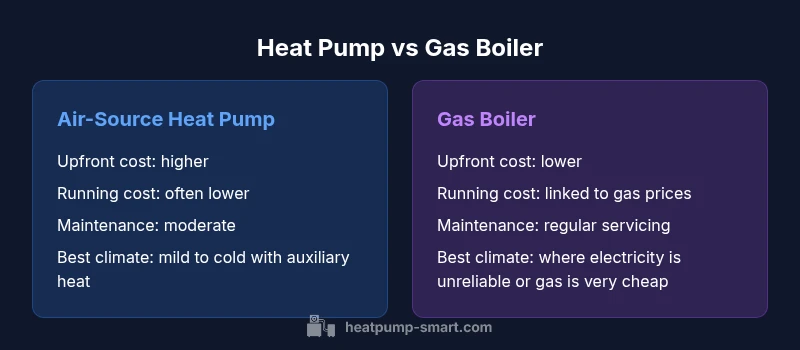
| Feature | Air-source heat pump | Gas boiler |
|---|---|---|
| Upfront cost | higher upfront cost | lower upfront cost |
| Running costs (annualized) | potentially lower with favorable electricity pricing and high COP | often higher if gas prices are low or electricity is expensive |
| Maintenance | generally lower maintenance over time | regular annual servicing required |
| Emissions | lower emissions when the electricity grid is clean | depends on gas usage and boiler efficiency |
| Climate performance | strong in moderate to cold climates with backup heat | best for climates where gas is widely available and grid electricity is costly |
| Best for | homes seeking long-term energy savings and cooling capability | homes prioritizing upfront affordability and simple retrofit |
Advantages
- Potentially lower operating costs over time in many regions
- Provides built-in cooling in summer without a separate system
- Can qualify for rebates and tax credits to reduce upfront cost
- Quieter operation and fewer emissions when powered by clean grids
- Improves home comfort with precise temperature control
Disadvantages
- Higher upfront installation cost and complexity
- Performance drops in extreme cold without auxiliary heat
- Requires access to electricity and reliable grid power
- Ductwork and space for outdoor unit can be a constraint
- In some markets, payback depends heavily on incentives and electricity prices
Heat pumps often win on lifetime costs in many climates, but gas can compete in some regions.
If your electricity price is reasonable and you can access substantial incentives, Heat Pump is typically the better long-term value. In regions with cheap gas or unstable electricity, a gas option may be more affordable upfront, but consider long-term energy trends and grid decarbonization.
Your Questions Answered
Is a heat pump cheaper than gas overall in most homes?
In many cases, yes, particularly where electricity prices are reasonable and incentives exist. The long-term operating costs are often lower than gas, but the upfront installation price and local energy economics matter. Use a total-cost-of-ownership approach to be sure.
In many homes, heat pumps win on long-term costs, but you’ll want a tailored estimate based on your energy prices and incentives.
Do heat pumps work well in cold climates?
Heat pumps can perform well in cold climates, especially newer models with improved cold-weather efficiency and auxiliary heat. In very harsh winters, some supplemental heating may be used, which can affect running costs.
They work well in many cold areas with the right model and controls; sometimes auxiliary heat is needed in extreme cold.
How do incentives affect the economics?
Rebates and tax credits reduce upfront costs, improving the payback period. Check local programs and eligibility, and model costs with and without incentives to see the net impact.
Incentives can make heat pumps much more affordable upfront, shortening the time to break-even.
What maintenance costs should I expect?
Heat pumps generally require routine maintenance similar to other central systems, with some annual checks. Gas boilers require combustion-related maintenance. Overall, maintenance costs for heat pumps tend to be lower and less frequent.
Maintenance is usually straightforward and often less costly than gas boilers over time.
Does the type of heat pump matter (air-source vs geothermal)?
Geothermal systems typically have higher upfront costs but can offer lower operating costs due to high efficiency. Air-source heat pumps are cheaper to install and suitable for many climates, though efficiency varies with outdoor temperatures.
Geothermal is often more efficient but pricier; air-source is usually cheaper to install and versatile.
How should I compare quotes from installers?
Ask for a total cost of ownership, including equipment, install, insulation work, ductwork, and ongoing energy costs. Ensure the quotes assume similar performance targets and maintenance needs for an apples-to-apples comparison.
Get quotes that cover all costs and show long-term energy use so you can compare fairly.
Top Takeaways
- Assess local energy prices and incentives before deciding
- Heat pumps usually offer lower lifetime costs with favorable electricity prices
- Cold climates may require auxiliary heat; ensure proper sizing and insulation
- Incentives can dramatically shorten payback periods
- Choose quotes that include total cost of ownership, not just sticker price