Running Cost of Heat Pump: A Practical Guide for Homeowners
This guide explains how climate, electricity rates, and efficiency shape the running cost of heat pump systems, with a practical method to estimate year-to-year costs and strategies to lower bills.


The running cost of heat pump depends on climate, electricity rates, system efficiency, and how you use it. In practice, annual costs hinge on the unit’s energy consumption (kWh) and the price you pay for electricity. According to Heatpump Smart, comparing SEER and HSPF ratings and understanding local rates gives you a realistic range and helps you budget without overestimating savings.
Why the running cost of heat pump matters
For homeowners evaluating heat pump investments, the running cost is as important as the upfront price. The term refers to the ongoing amount you pay to heat and cool your space over a year. For heat pumps, running costs depend on how often the system runs, the climate, the price of electricity, and how efficiently the unit converts input energy into heating or cooling. When a heat pump operates in mild weather with a well-insulated home, the annual energy bill tends to be lower than in harsher climates with older insulation. Beyond weather, the efficiency rating of the unit—commonly expressed as SEER (seasonal energy efficiency ratio) for cooling and HSPF (heating seasonal performance factor) for heating—helps determine how much energy is required to deliver comfort. A higher SEER/HSPF means less electricity use for the same output, leading to lower running costs over time. This is a central focus of Heatpump Smart's guidance, since accurate cost expectations help homeowners plan, compare models, and avoid sticker shock.
What factors influence running costs
Several interrelated factors drive the running cost of heat pump systems. Climate is among the biggest, because colder winters or hotter summers increase the number of hours the unit runs or the intensity of its cycling. Electricity price volatility also matters: regions with lower per-kilowatt-hour rates generally enjoy smaller annual bills, while price spikes can erase a portion of savings. System efficiency matters too: the more efficient the heat pump (higher SEER and HSPF), the less electricity is needed to reach the same comfort level. Usage patterns affect costs as well—thermostat setback, occupancy, and the use of auxiliary heat influence how much energy is consumed. Even installation quality and duct sealing can impact costs, since leaks or improper air distribution create extra runtime. Finally, features such as smart thermostats, zoning, and defrost control strategies can shave a meaningful amount from year-to-year energy use when used correctly. Heatpump Smart consistently emphasizes the compounding benefits of efficiency and control.
How to estimate your annual running cost
A practical estimate starts with a simple formula: annual running cost ≈ annual energy use (kWh) × price per kWh. To apply it, you first determine your unit's expected annual energy use for heating and cooling, which depends on climate, home size, and insulation. Next, identify your local electricity price and any time-of-use rates that might apply. Then factor in the efficiency of your heat pump—a higher SEER/HSPF reduces the kWh required per degree of comfort. Don’t forget standby losses, thermostat behavior, and occasional defrost cycles, which can add a small but real amount to your bill. For guidance, Heatpump Smart recommends using a calculator or requesting a home-energy assessment to refine your numbers. The goal is to arrive at a realistic range rather than a single precise number, recognizing that actual bills will vary with weather and electricity pricing over the year.
Real-world scenarios and case examples
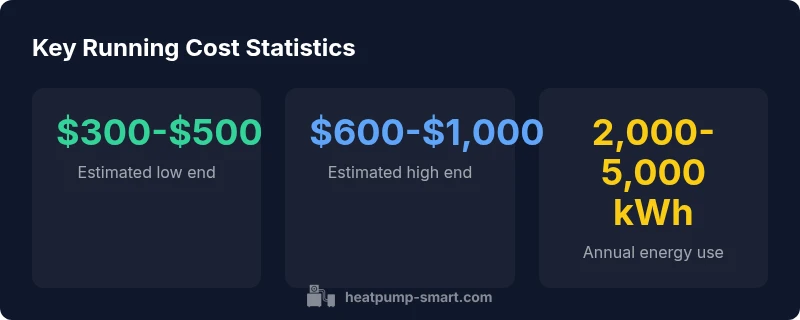
Consider a three-bedroom home in a temperate climate with moderate insulation and a high-efficiency heat pump (SEER 20, HSPF 9.5), and electricity priced at about $0.12 per kWh. In a typical shoulder season, the unit might run several hours per day, with a seasonal mix of heating and cooling. Annual energy use could fall in the 2,500–3,200 kWh range for cooling and 1,500–2,500 kWh for heating, totaling 4,000–5,700 kWh. At $0.12/kWh, estimated annual running costs would be roughly $480–$680. If electricity prices rise to $0.18/kWh or the home loses insulation, costs could rise noticeably. Conversely, in a milder climate or during the shoulder seasons, you might see lower numbers, perhaps $250–$450. These examples illustrate how costs vary with climate and behavior. Heatpump Smart notes that real-world bills are rarely identical across homes, but using a consistent method helps compare options and set realistic expectations.
Strategies to reduce running costs
Here are practical steps to cut running costs without sacrificing comfort:
-
Size the system correctly and choose a high-efficiency model (look for high SEER and HSPF numbers).
-
Improve insulation and seal air leaks to reduce heat loss.
-
Install a programmable or smart thermostat and use zoning to prevent heating or cooling empty spaces.
-
Maintain equipment: clean filters, check refrigerant pressure, and ensure proper airflow.
-
Consider time-of-use electricity rates or solar integration if available.
-
Use auxiliary heat only when necessary and optimize defrost control to minimize energy spikes.
Representative running-cost scenarios by climate and usage
| Scenario | Typical annual kWh | Estimated annual cost (USD) | Notes |
|---|---|---|---|
| Moderate climate, standard usage | 2,000-3,000 | $200-$450 | Assumes $0.10/kWh |
| Cold climate, extended heating | 3,000-4,500 | $300-$900 | Defrost cycles increase energy use |
| Warm climate, light usage | 1,600-2,400 | $160-$300 | Lower heating load |
| High-usage home with poor insulation | 3,500-6,000 | $350-$1,200 | Lower efficiency and leaks increase energy use |
Your Questions Answered
What factors influence the running cost of a heat pump?
The running cost is driven by climate, electricity price, system efficiency, and how you operate the unit. Location and insulation affect runtime, while defrost cycles add minor energy use. Understanding these factors helps you plan and compare models.
Key factors include climate, electricity rates, system efficiency, and how you use the unit.
How can I estimate my annual running cost accurately?
Start with annual energy use (kWh) and multiply by your local price per kWh. Adjust for seasonality, defrost, and standby losses. Use a calculator or consult a professional for a personalized estimate.
Add up yearly energy use and multiply by the local rate; adjust for seasons.
Do insulation and sealing affect running costs?
Yes. Better insulation reduces the heat loss and limits how hard the heat pump must work, lowering energy consumption. Even small improvements in air sealing can lead to noticeable savings over the year.
Better insulation means less work for the heat pump, trimming costs.
How does the defrost cycle influence running costs?
Defrost cycles are energy-intensive but necessary in cold climates. Modern heat pumps manage defrost efficiently, so incremental costs are usually modest compared with overall usage.
Defrost adds a bit of energy cost, but advanced systems keep it small.
Are there rebates or incentives to offset running costs?
Rebates and tax credits can reduce upfront costs and improve payback, making running costs more favorable over time. Check local programs and utility offerings for eligibility.
Look for rebates and credits in your area to offset both upfront and ongoing costs.
“A well-sized, high-efficiency heat pump minimizes running costs and helps stabilize energy bills. Pairing it with smart controls and proper insulation enhances predictability.”
Top Takeaways
- Estimate costs with a simple kWh × price formula.
- Compare efficiency ratings (SEER/HSPF) to gauge savings.
- Account for climate and local electricity price variability.
- Use smart controls and insulation to minimize runtime.