Heat Pump vs Central Air: An In-Depth Comparison
Learn what is a heat pump vs central air and how the choice affects efficiency, climate performance, installation, and long-term costs. An analytical comparison for homeowners.


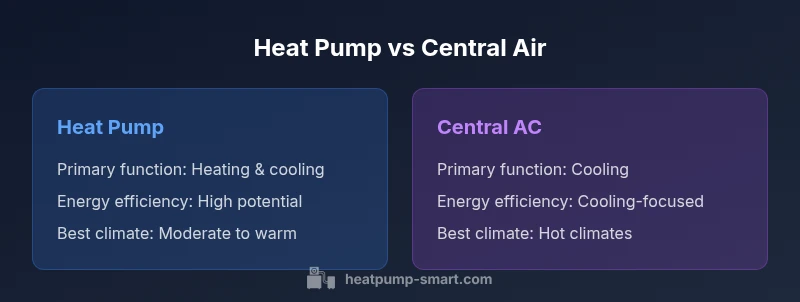
What is a heat pump vs central air? In short, a heat pump provides both heating and cooling by moving heat between indoors and outdoors, while central air cools only. Heat pumps can be highly efficient in moderate climates and may be eligible for rebates, but performance declines in very cold weather unless auxiliary heat is used. If you already have a furnace, central air is often cheaper upfront.
What is a heat pump vs central air: core concepts
What is a heat pump vs central air? At a high level, a heat pump is a versatile HVAC system that moves heat from outside to inside to heat your home in winter and reverses in summer to cool. Central air, by contrast, cools spaces through a dedicated cooling loop and is typically paired with a separate heating system such as a furnace. According to Heatpump Smart, heat pumps operate on refrigerant cycles that transfer heat rather than generate it, which is a key driver of efficiency. Heatpump Smart analysis also notes that real-world performance depends on climate, duct design, insulation, and thermostat control. For homeowners weighing options, the question often comes down to year-round comfort, climate tolerance, and existing equipment. A heat pump can be a single, energy-efficient solution for both heating and cooling, while central air is a streamlined cooling system that relies on another heat source for winter.
How heating and cooling actually work
In a heat pump, refrigerant absorbs heat from outdoors during the heating cycle and releases it indoors via the indoor air handler. In cooling mode, the cycle reverses to draw indoor heat outside. A central air system typically uses a furnace or air handler to heat (via combustion or electric resistance) and a separate air conditioner to cool. The heating performance of a central air setup depends on the HVAC furnace efficiency, while a heat pump provides both modes in a single package. This fundamental difference affects not just comfort, but also control strategy, zoning, and maintenance planning. Heatpump Smart notes that proper duct design and refrigerant integrity are critical to achieving promised performance for either system.
Efficiency and performance in different climates
Efficiency for heat pumps is often discussed in terms of seasonality and climate. In moderate winters, a heat pump can deliver high COP and strong energy savings because moving heat costs less energy than producing it. In very cold climates, performance can decline unless a supplementary heat source is available. Central air’s cooling efficiency is generally strong and predictable, but its heating efficiency is tied to the furnace and its SEER/Ax ratings. Heatpump Smart emphasizes that insulation, air sealing, and thermostat strategy can dramatically affect real-world results for both systems. The right choice depends on the balance of winter heating needs, summer cooling demand, and local electricity versus fuel costs.
Climate considerations: where each shines
For homes in temperate or mixed climates, a heat pump often delivers the broadest value by providing both heating and cooling with a single energy model. In regions with harsh winters, you may rely on a supplemental heat source; some homeowners install a dual-fuel arrangement to optimize costs. Central air can excel in warm or hot climates where cooling dominates and a reliable furnace handles winter heating. If you prioritize peak comfort with a simplified system, a heat pump combined with efficient insulation can outperform a standalone central AC in many scenarios. Heatpump Smart reinforces that climate suitability is a major determinant of total cost and satisfaction.
Installation and upfront costs: planning and incentives
Upfront costs for heat pump installations can be higher when ductwork or outdoor equipment needs upgrading, while central air may be cheaper if you already have a furnace and ducts. The installation complexity depends on existing infrastructure, refrigerant line work, and electrical capacity. Incentives and rebates for heat pumps have become more common in many regions, which can narrow the gap versus central air. Heatpump Smart’s guidance suggests performing a full load calculation and a duct leakage test before committing to any change, to ensure the system you choose meets your home’s size, insulation, and occupancy patterns.
Maintenance, reliability, and lifespan
Both heat pumps and central air demand regular maintenance to preserve efficiency and reliability. Heat pumps require periodic checks of refrigerant levels, outdoor unit cleanliness, and indoor coil maintenance. Central air systems need furnace servicing (if paired with central heating) and annual A/C inspection. The complexity of a heat pump means a single service window can address both heating and cooling components, while central air may involve separate service cycles for the furnace and AC. In general, well-designed systems with proper airflow and clean coils deliver the longest service life. Heatpump Smart highlights that ongoing maintenance is a better predictor of longevity than initial purchase price alone.
Practical decision guide: which is best for you
To decide, start with climate first: do you live in a region with mild winters or severe cold? If you frequently experience both heating and cooling needs and can access incentives, a heat pump is often a strong long-term choice. If heating is reliably provided by an efficient furnace, and upfront cost or simplicity matters, central air can be the more straightforward option. Consider your current ductwork, insulation, and home size. A detailed comparison, including a professional load estimate, is essential. Heatpump Smart suggests listing priorities (cost, climate resilience, control options) and testing a few configurations to gauge comfort and cost-per-year.
Real-world scenarios and myths
Myth: Heat pumps only work in warm climates. Reality: Modern heat pumps work across many climates, with supplemental heat options for cold snaps. Myth: Central air is always cheaper to install. Reality: If ductwork and an existing furnace are involved, the difference may be smaller, and incentives can tip the balance toward heat pumps. Real-world cases show homeowners benefiting from a hybrid approach, especially when balancing long-term energy costs and system reliability. Heatpump Smart data indicates that the best solution is highly site-specific and depends on local electricity prices, insulation, and thermal envelope quality.
Comparison
| Feature | Heat pump (air-source) | Central air conditioner (furnace-backed) |
|---|---|---|
| Primary function | Heating & cooling (with electric backup) | Cooling only; heating via separate furnace |
| Heating performance in cold weather | Maintains warmth with auxiliary heat; efficiency reduces at very low outdoor temps | Relies on furnace; heating depends on furnace efficiency |
| Energy efficiency (seasonal) | High potential efficiency in moderate climates; operates on moving heat | Efficient for cooling; heating depends on furnace and ductwork |
| Installation considerations | Requires outdoor unit, refrigerant lines, and possibly new ductwork | Often cheaper if existing furnace and ductwork are in place |
| Upgrade path and incentives | Strong incentives in many regions; upgrading for efficiency is common | Incentives exist but vary; often tied to heating system changes |
| Ongoing maintenance | Outdoor unit service, refrigerant checks, filter changes | Furnace and AC components require regular servicing |
| Best climate fit | Moderate and warm climates; excellent year-round performance | Warm climates with reliable cooling; less suited for very cold winters |
| Noise and space | Outdoor unit noise; spacing required for outdoor equipment | Indoor air handler and outdoor unit require space and ductwork |
| Cost considerations | Higher upfront cost; potential long-term savings with efficiency | Lower upfront cost; simpler if heating is already installed |
Advantages
- One system for heating and cooling simplifies maintenance
- Potentially lower operating costs in moderate climates
- Can qualify for energy-efficiency incentives
- Better zoning options with heat pumps
Disadvantages
- Performance can drop in extreme cold without supplemental heat
- Higher upfront installation costs in some setups
- Requires appropriate ductwork or outdoor unit placement
Heat pump generally offers better year-round efficiency and climate flexibility, especially in temperate regions; central air remains a solid choice when heating is already supplied by a furnace and upfront costs matter.
If you live in a region with mild winters and energy incentives, heat pumps are usually the smarter long-term choice. If your existing heating is reliable and you want lower upfront costs, central air backed by a furnace may be preferable.
Your Questions Answered
What is the main difference between a heat pump and central air?
A heat pump provides both heating and cooling by moving heat, while central air cools and relies on a separate heating source. The choice affects efficiency, climate suitability, and overall system design.
Heat pumps heat and cool in one unit; central air cools, using a separate heater for warmth.
Can a heat pump replace a furnace or boiler?
In many homes a heat pump can replace a dedicated furnace or boiler, especially with a backup heat source for very cold days. Location, climate, and existing ductwork influence feasibility.
Yes, heat pumps can replace traditional heaters in many homes, depending on climate and setup.
Is a heat pump more expensive to install than central air?
Installation costs depend on ductwork, outdoor unit needs, and the existing heating system. Heat pumps can be more expensive upfront, but incentives may reduce the gap.
Upfront costs vary; heat pumps may be higher initially, with potential rebates.
How does climate affect heat pump performance in winter?
Very cold temperatures can reduce heat pump efficiency unless auxiliary heat is available. In extremely cold climates, a hybrid approach with a furnace may be optimal.
Colder winters may require backup heat with a heat pump.
Do heat pumps require refrigerant top-ups?
Modern heat pumps are designed to operate without frequent refrigerant top-ups. Leaks or improper installation can cause issues and require service.
Refrigerant leaks are a sign of trouble; regular service helps.
Are there rebates or tax credits for heat pump installations?
Many regions offer rebates or tax credits for energy-efficient heat pumps. Availability varies by location and program rules; check local incentives.
Look for local incentives; programs differ by area.
Top Takeaways
- Assess climate and heating needs before deciding
- Heat pumps offer year-round comfort and potential energy savings
- Central air can be cheaper upfront when heating is already installed
- Check local incentives and rebates before committing
- Ensure proper installation and ductwork for optimal performance