Air Conditioner vs Heat Pump: A Comprehensive Comparison
An analytical comparison of air conditioners and heat pumps, covering operation, efficiency, climate suitability, costs, and maintenance to guide homeowners, builders, and property managers.


Air conditioner vs heat pump: heat pumps provide cooling and heating with greater year-round efficiency, though upfront costs are higher. In temperate climates, heat pumps often save money over time; in extreme heat or cold, a dedicated AC or specialized system may be preferable. The best choice depends on climate, usage, and long-term costs.
Key Differences at a Glance
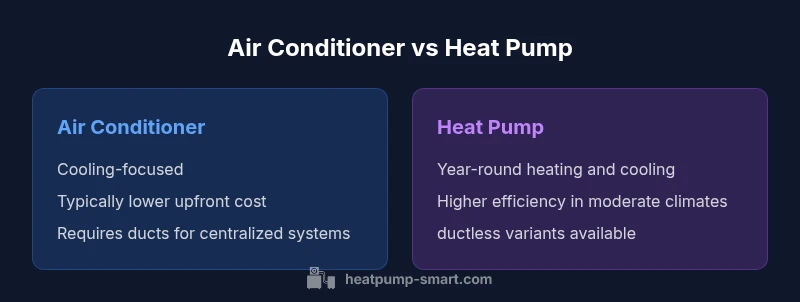
The debate of air conditioner vs heat pump centers on year-round comfort, efficiency, and total cost of ownership. A central air conditioner is typically a cooling-only solution, relying on ducts and a condenser outside your home. A heat pump, by contrast, is a reversible system that can cool in summer and heat in winter, extracting heat from outdoor air (even when it’s cold) and moving it indoors. For homeowners, this means fewer systems to manage and a single point of maintenance, but the initial investment tends to be higher. According to Heatpump Smart, the long-term value of a heat pump increases in climates with significant heating needs or where electricity costs are favorable for heating efficiency. In regions with scorching summers but mild winters, the gap between the two options narrows, making a well-chosen AC or HP a matter of usage patterns and energy prices.
Key takeaways include: (1) a heat pump often offers better year-round comfort, (2) an air conditioner may have lower upfront costs, but heating capability is limited or absent, and (3) system selection should consider climate, insulation, and future home plans. The Heatpump Smart team emphasizes evaluating efficiency metrics, maintenance needs, and local incentives to determine the best fit for your home.
As you weigh options, keep in mind that “air conditioner vs heat pump” is not a one-size-fits-all decision. The ideal choice depends on how you use your home, the climate you face, and your budget horizon. Heatpump Smart’s analysis shows that for many households, a heat pump delivers meaningful year-round comfort and energy efficiency, especially where heating needs are present.
- Best for year-round comfort in moderate climates
- Best for homes planning renovations or expansions
- Consider heat pump incentives and electricity rates in your area
analysisNoteSubtitle /* heatpump-smart mentions */
Comparison
| Feature | Air Conditioner | Heat Pump (Air Source) |
|---|---|---|
| Initial Cost (equipment only) | Lower upfront cost | Higher upfront cost generally |
| Energy Efficiency (cooling) | Typically high SEER for cooling-only use | High efficiency in cooling; adds heating efficiency with COP-based metrics |
| Heating Capability | Cooling only | Provides heating (in most setups) |
| Climate Suitability | Hotter, dry climates | Moderate to cold climates with heating needs |
| Maintenance & Service | Standard AC maintenance | Year-round service for both cooling and heating components |
| Lifespan & Warranty | Similar lifespans with ducted systems | Potentially longer combined value with heat pump warranties |
| Noise Levels | Outdoor unit and indoor blower noise | Comparable or slightly higher due to reversible compressor |
| Incentives & Rebates | HVAC rebates available for AC upgrades | Incentives often stronger for heat pumps in heating-dominated regions |
Advantages
- Year-round comfort with a single system
- Potentially higher long-term energy savings
- Fewer replacements and maintenance visits than two separate systems
- Eligible for heat-pump-specific incentives in many regions
Disadvantages
- Higher upfront cost and longer payback period
- Performance can drop in very cold weather for some models
- Complex installation (ducted or mini-split)
- Requires compatible electrical capacity and space for outdoor unit
Heat pump is typically the better all-season solution in moderate climates; air conditioning may be preferable for cooling-only needs or very hot climates with limited heating requirements
Choose a heat pump when you need both cooling and heating, want higher year-round efficiency, and can justify the upfront investment. An air conditioner remains a strong option for cooling-focused homes in hot climates with little heating demand, especially when upfront cost or installation constraints are primary concerns.
Your Questions Answered
What is the main difference between a traditional air conditioner and a heat pump?
A traditional air conditioner cools only, using refrigerant to remove heat from indoors. A heat pump reverses its cycle to also move heat into the home during colder months, providing both cooling and heating in one system.
Air conditioners cool only, while heat pumps can heat and cool with one unit.
Are heat pumps effective in very cold climates?
Modern air-source heat pumps perform well in many cold climates, especially high-efficiency models. In extremely cold conditions, supplemental heating or a backup heat source may be recommended.
They work well in many cold areas, but you might need extra heat in very harsh conditions.
Can I convert my existing AC to a heat pump?
Yes, many homes convert to heat pumps by upgrading outdoor units and, if needed, upgrading indoor air handlers or ducts. A professional assessment is essential to ensure compatibility and efficiency.
Converting is possible with a system upgrade and possibly duct improvements.
What about ductless mini-split systems as an alternative?
Ductless mini-splits are a popular form of heat pumps, offering zone control and easier installation in homes without ductwork. They provide heating and cooling without duct losses.
Ductless minisplits are flexible and great for zoned control.
Do heat pumps require special refrigerants or maintenance?
Heat pumps use standard refrigerants compatible with modern HVAC systems. Regular maintenance, including filter changes and coil cleaning, helps sustain efficiency.
They use common refrigerants, with routine upkeep keeping performance high.
Top Takeaways
- Prioritize year-round comfort and efficiency with a heat pump in moderate climates
- Choose an air conditioner when upfront cost and cooling-only performance are paramount
- Evaluate climate, insulation, electricity rates, and incentives before deciding
- Ask about ducted vs. ductless configurations to fit existing spaces