AC vs Heat Pump: Practical Comparison for Homeowners
An objective comparison of air conditioning and heat pump systems, exploring efficiency, climate suitability, costs, maintenance, and best-use scenarios for homeowners.


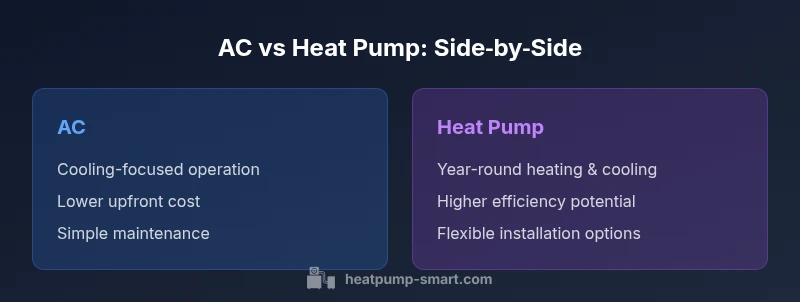
AC vs Heat Pump: For most homes, a heat pump provides year‑round comfort by cooling in summer and heating in winter, often with higher efficiency than a conventional AC. In milder climates it’s a straightforward upgrade, while in very cold regions performance and cost tradeoffs matter. According to Heatpump Smart, climate and usage patterns drive the best choice.
Defining the landscape: AC vs Heat Pump for home comfort
When homeowners compare ac vs heat pump, the primary question is whether you want a cooling-focused system or a versatile year‑round climate control solution. An air conditioner alone cools spaces in hot months, while a heat pump can cool in summer and heat in winter using the same refrigerant cycle. The Heatpump Smart team emphasizes that the decision should hinge on climate, home insulation, and daily usage patterns. In mild climates, a heat pump often provides superior efficiency and comfort, while in regions with extreme cold, adding supplemental heating might be necessary. The practical choice is seldom determined by label alone; it depends on how you live in your home, the existing ductwork, and your willingness to invest upfront for long-term savings. Below we unpack the core differences, common myths, and real-world scenarios to help homeowners navigate the ac vs heat pump decision with confidence. This analysis weighs practical usage, energy performance, and lifestyle considerations, not marketing claims. Heatpump Smart Analysis, 2026, informs common decision patterns and effective installation strategies.
How a traditional air conditioner works vs a heat pump
A traditional air conditioner removes heat from indoor spaces using an outdoor condenser and an indoor evaporator coil connected by refrigerant lines. A heat pump performs the same cooling cycle but includes a reversing valve that switches operation to heating in cold months, pulling warmth from outside air and delivering it inside. This fundamental difference means a heat pump can eliminate the need for a separate furnace in many homes, provided there is adequate insulation and ductwork. Both systems rely on electricity to power the compressor, fan motors, and controls, so the environmental impact and running costs hinge on the electricity source and efficiency of the equipment. Modern heat pumps also offer advanced features like smart thermostats, zoning, and compatibility with solar or other renewables, expanding the opportunities for home energy management. The decision to choose AC vs heat pump should consider not just the cooling needs, but how heating will be handled across the year.
Climate and efficiency considerations across regions
Efficiency for cooling is influenced by the SEER rating on the unit and the airflow design of the home. For heating, heat pumps excel in moderate climates where outdoor temperatures do not frequently fall below freezing, enabling efficient heat transfer with electricity. In very cold climates, heat pumps may rely on auxiliary heat sources, reducing overall efficiency gains. The advantages of a heat pump grow as the electrical grid becomes cleaner and outdoor temperatures are less extreme, aligning with energy‑saving goals and decarbonization efforts. Heat pumps also offer consistent indoor temperatures and faster cooling or heating responses, improving comfort. Homeowners should assess seasonal patterns, insulation quality, and window performance to determine how significant the efficiency delta will be between an AC and a heat pump in their climate. Heatpump Smart’s analysis highlights that climate compatibility and usage patterns are the strongest predictors of long‑term savings.
Cost structure: upfront costs, operating costs, and incentives
Upfront costs for a traditional AC setup are typically lower than for a heat pump system, especially if the home already has ductwork and a furnace. A heat pump can offer greater long‑term savings through higher efficiency and reduced energy use for heating, but the initial investment may be higher due to equipment and potential duct changes. Operating costs depend on electricity prices, climate, and how often the system runs for heating versus cooling. In regions with strong incentives, rebates, and tax credits, the economic gap between AC and heat pump can narrow substantially. It’s important to include maintenance costs over the life of the system and to consider potential replacements of components such as compressors or reversing valves when evaluating total cost of ownership. Heatpump Smart’s guidance emphasizes calculating total cost of ownership rather than focusing solely on upfront price.
Installation, ductwork, and space requirements
An air conditioner setup often integrates with existing ductwork and a central furnace, but that depends on the home’s design. Heat pumps can be installed as ducted systems or as ductless mini‑splits, which offer flexibility for homes without full ductwork. Ducted heat pumps can reuse some existing infrastructure, but may require modifications to airflow and zones. Outdoor and indoor unit placement affects noise, aesthetics, and performance; local climate also influences outdoor unit sizing and drainage considerations. Retrofitting for a heat pump may involve upgrading electrical service, recalibrating thermostats, and ensuring proper refrigerant line insulation. In contrast, a traditional AC install is typically simpler if a furnace is already present. Consider space for outdoor units, indoor air handler locations, and the potential need for upgrades to electrical panels or wiring.
Maintenance, reliability, and service expectations
Regular maintenance for both AC and heat pump systems includes filter changes, coil cleaning, and annual inspections of refrigerant lines, electrical connections, and thermostat controls. Heat pumps have moving parts in both heating and cooling modes, which can lead to broader maintenance considerations, particularly for older equipment. The reliability of either system hinges on the quality of installation, ductwork integrity, and the chosen brand’s warranty. Regular maintenance can prevent common issues such as refrigerant leaks, compressor failures, and thermostat miscommunications. Planning for preventive service and readily available parts can reduce the risk of unexpected breakdowns and extend system life. Heatpump Smart emphasizes proactive maintenance schedules as part of responsible ownership, especially in regions with fluctuating temperatures and evolving energy codes.
Real-world scenarios: homes, buildings, and budgets
For single‑family homes in temperate zones, a heat pump often delivers best all‑around performance, combining cooling and heating in a single package. In homes with energy‑efficient envelopes and good insulation, heat pumps can substantially reduce operating costs over time. Apartments or retrofits with limited ductwork may benefit from ductless heat pumps, avoiding invasive renovations. For commercial or multi‑unit buildings, zoning, control systems, and scalable solutions play a bigger role in choosing between a conventional AC system and a heat pump network. Budget planning should include not only the equipment cost but also installation complexity, potential ductwork changes, and the value of incentives. Overall, the ac vs heat pump decision should reflect how a home is used, how it’s insulated, and what kind of climate the occupants experience year round. Heatpump Smart’s guidance helps homeowners prioritize real‑world usage over marketing claims.
Decision framework: a practical 6-step checklist
- Define heating and cooling needs across seasons. 2) Assess existing ductwork and space for outdoor and indoor units. 3) Compare upfront costs against long‑term energy savings. 4) Review local incentives and utility programs. 5) Check climate considerations for cold or hot extremes. 6) Plan for maintenance and service access and choose a reputable installer. This structured approach helps prevent common pitfalls and ensures you select the system that best fits your home and budget.
Future-proofing and technology trends
Advances in heat pump technology continue to improve cold‑climate performance, speed of heating, and responsiveness. Smart controls, zoning capabilities, and integration with solar or other renewables enhance flexibility and efficiency. As electrical grids decarbonize, heat pumps can offer additional environmental benefits. For homeowners, staying informed about refrigerant types, warranty terms, and service availability can impact long‑term satisfaction and cost. The shift toward energy‑efficient, climate‑adaptive systems means that the ac vs heat pump decision increasingly centers on real-world needs, lifestyle, and commitment to upgrading insulation and control systems.
Comparison
| Feature | AC | Heat Pump |
|---|---|---|
| Typical use case | Cooling-focused cooling system | Cooling and heating in one package |
| Energy efficiency (contextual) | Model-dependent; often high for cooling | Often higher overall efficiency when heating is used regularly |
| Upfront cost | Lower upfront cost with existing ductwork | Higher upfront cost for equipment and installation |
| Cold-weather performance | Reliable in warm and mild climates | Can require supplemental heat in very cold conditions |
| Maintenance needs | Simple annual service | Requires year-round maintenance for heating and cooling |
| Noise considerations | Outdoor unit noise depends on distance | Outdoor unit heating cycles can increase noise at times |
| Environmental impact | Depends on electricity source and efficiency | Lower emissions potential with clean grids and efficient units |
| Best for | Homes with strong cooling needs and good ducts | Homes seeking year‑round comfort and efficiency |
Advantages
- Year-round climate control from a single system
- Potential for higher long-term energy savings
- Improved comfort with precise zoning and controls
- Fewer separate appliances to manage
Disadvantages
- Higher upfront cost and possible installation complexity
- Performance in extreme cold may require supplemental heat
- Maintenance considerations for dual heating/cooling components
Heat pumps generally offer superior year‑round performance and potential long‑term savings for most homes, especially in moderate climates.
If your climate is temperate and you value year‑round comfort with energy efficiency, a heat pump is usually the better choice. In very cold regions, an AC with a separate heating option may be more straightforward, though newer cold‑climate heat pumps mitigate many of these concerns. The best outcome comes from a professional assessment that accounts for insulation, ductwork, and local incentives.
Your Questions Answered
Is a heat pump suitable for very cold climates?
In very cold climates, standard air-source heat pumps may require supplemental heating. Look for models rated for low outdoor temperatures and consider insulation upgrades and a backup heat source for the coldest days.
Cold climates may need backup heat. Check low-temperature ratings and insulation.
Can a traditional AC be converted to a heat pump?
Converting an existing AC setup to a heat pump typically involves upgrading components like the outdoor unit and reversing valve, and often requires electrical and ductwork adjustments. A professional assessment is essential.
Conversion can be complex; you’ll likely need a new unit and potentially new wiring and ducts.
What are the maintenance differences between AC and heat pump systems?
Both require regular filter changes and inspections. Heat pumps introduce heating components that require attention year‑round, including refrigerant integrity and coil cleanliness in both modes.
Regular maintenance matters for both; heat pumps may need extra checks for heating parts.
Which is better for homes without ductwork?
Ductless heat pumps are a strong option for homes without ductwork, providing targeted cooling and heating without extensive renovations. Traditional AC may be less feasible without adding ducts or a heat source.
Ductless heat pumps work well where there’s no existing duct system.
How do energy costs compare between AC and heat pump?
Operating costs depend on usage patterns and electricity prices. Heat pumps often save on heating due to higher efficiency, especially when paired with an efficient grid or renewable energy; cooling costs depend on unit efficiency.
Heat pumps can save energy overall, but it depends on climate and electricity costs.
Are there incentives for installing heat pumps?
Many regions offer rebates, tax credits, or utility incentives for heat pumps, particularly when paired with energy‑efficiency upgrades. Check local programs and eligibility requirements.
Look for local rebates and credits for heat pumps to offset upfront costs.
Top Takeaways
- Assess climate and heating needs before deciding
- Calculate total cost of ownership including incentives
- Check existing ductwork and space for equipment
- Leverage smart controls and zoning for efficiency
- Plan for routine maintenance and service access