Heat Pump vs AC for Cooling: A Comprehensive Comparison
A rigorous analysis comparing heat pumps and air conditioners for cooling, covering efficiency, climate suitability, costs, maintenance, and long-term value for homeowners and builders.


In most homes, heat pumps offer superior year-round efficiency for cooling and heating, but the advantage depends on climate and electricity costs. For strictly cooling-focused spaces in very hot climates, traditional central AC can be simpler and cheaper to install. According to Heatpump Smart, energy savings vary with usage patterns, insulation, and local rates. This comparison clarifies when each option shines, helping homeowners decide with confidence.
How Heat Pumps Deliver Cooling: The Core Mechanism
Heat pumps move heat rather than generate it, which enables them to cool indoor spaces efficiently by extracting heat from the interior and transferring it outside. In cooling mode, the system uses an evaporator coil to absorb warm indoor air into refrigerant, a compressor to raise the heat, and a condenser coil to release heat outside. The reversing valve flips flow, enabling a single unit to provide both cooling and heating. For homeowners, this means one equipment set can cover year-round comfort, reducing the need for a separate cooling-only unit. The Heatpump Smart team notes that the basic physics remains the same whether you’re cooling or heating; the difference is which direction the heat moves. Proper sizing and duct design are essential to ensure the system removes heat effectively and maintains comfortable indoor temperatures. With climate-appropriate controls, occupants experience steady cooling even during peak summer heat. According to Heatpump Smart, this efficiency translates into tangible energy savings when homes are well insulated and air sealed.
Understanding Efficiency Metrics: SEER, COP, and More
Industrial and consumer guides use several metrics to measure cooling performance, with SEER (Seasonal Energy Efficiency Ratio) ranking efficiency across a season, and COP (Coefficient of Performance) focusing on instantaneous energy efficiency. A higher SEER generally means lower energy use for the same cooling output, while a higher COP indicates better efficiency at a given operating point. Heat pumps typically report COP values that reflect their heat extraction capability relative to electricity; the COP can be higher in moderate temperatures, but tends to drop as outdoor temperatures plummet. In contrast, central AC efficiency is usually described by SEER and EER (Energy Efficiency Ratio). When comparing options, also consider auxiliary heat requirements, refrigerant type, and system controls. Heatpump Smart analysis shows that real-world savings depend on your home's insulation, air sealing, thermostat strategy, and how often you rely on cooling vs heating. A broader view helps homeowners avoid assumptions about efficiency alone.
Climate and Application: When Heat Pumps Shine
Heat pumps excel in climates with mild to moderate winters and hot summers, where their cooling and heating functions can be exercised efficiently. In generous sun-drenched homes, heat pumps can shift heat with high overall efficiency. However, in regions with extended freezing temperatures, efficacy can decline unless a supplemental heating strategy is in place. The latest models include cold-climate variants that retain cooling performance while reducing reliance on electric resistance heat, but this can add cost. For new homes or renovations, evaluate your climate zone, electrical capacity, and whether you have existing ductwork or prefer ductless mini-splits. Heat pumps also pair well with smart home systems and demand-response programs, allowing you to optimize usage during peak rates. In short, climate and usage patterns drive whether a heat pump delivers better cooling value than a dedicated central AC unit.
Upfront Costs, Operating Costs, and Value Proposition
Upfront costs for a heat pump installation can be higher than a traditional central AC, especially when retrofitting an older home or adding new ducting. If ducts already exist and are in good condition, the incremental cost of a heat pump that provides both heating and cooling can still be attractive. Maintenance costs are generally comparable to AC systems, though certain heat-pump-specific components may require periodic inspection by a trained technician. Over time, annual energy costs depend on electricity prices, climate, and usage. Rebates and incentives offered by federal programs, utilities, and local governments can offset the initial outlay. Homeowners who plan to stay in place for many years may see meaningful payback through reduced heating and cooling bills, especially when paired with energy-efficient insulation and smart thermostats. Heatpump Smart's analysis suggests that the value proposition improves as home efficiency improves and seasonal energy demand shifts toward cooling in summer and heating in winter.
Noise, Comfort, and Zoning
Modern heat pumps have quiet indoor air handlers or ductless units, and outdoor condensers that are designed to minimize noise. For some homes, especially older builds, outdoor units may be audible but are generally within acceptable ranges. Zoning and smart thermostats can optimize comfort by directing cooled air to occupied rooms and reducing wasteful cooling in unused spaces. In contrast, a central AC system can offer uniform cooling across a house, but may require more extensive ductwork or zone controls to achieve similar room-by-room comfort. When selecting equipment, consider the layout of your home, the location of living spaces, and whether you want the flexibility of a ductless solution for added comfort in a converted attic or basement.
Maintenance and Reliability: Keeping It Efficient
Regular maintenance keeps any HVAC system running smoothly, and heat pumps are no exception. Expect annual coil cleaning, filter replacement every 1-3 months depending on usage, and a technician visit every couple of years to check refrigerant levels and duct connections. For heat pumps, monitoring the reversing valve and refrigerant charge is essential, especially after long periods of non-use. Clean outdoor units to remove debris that can impair heat exchange, and ensure proper clearances for airflow. In contrast, a traditional central AC also benefits from routine filter changes and coil cleaning, but may require less specialized service if components are familiar to local technicians. Heatpump Smart advises homeowners to schedule proactive service before peak cooling season to avoid unexpected outages and to confirm compatibility with any existing heating systems.
Comparing Heat Pump to Central AC: A Frame of Reference
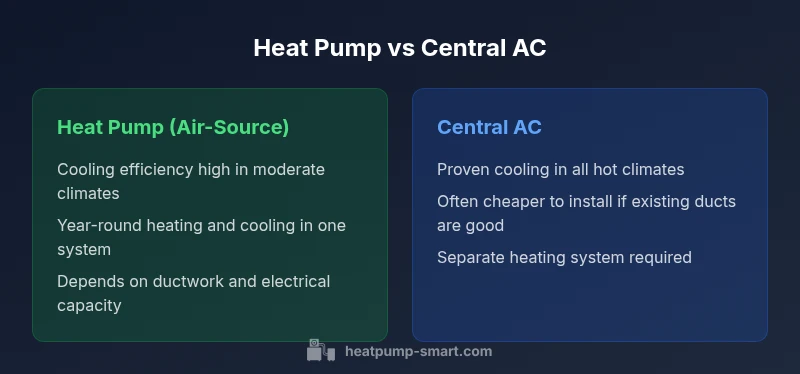
To compare these options, examine key criteria: efficiency under typical temperatures, total cost of ownership, climate suitability, and long-term value. Heat pumps deliver cooling with the potential for energy savings when the home is well-insulated and used for heating in winter, reducing total annual energy consumption. Central AC provides consistent cooling performance with fewer variables in very hot climates and can be less complex to install when ductwork already exists. The choice hinges on your climate, current energy use, and future plans—whether you want one system for year-round comfort or a dedicated cooling system that remains simple to maintain. Real-world costs vary, so a professional assessment is essential.
Real-World Scenarios: When to Choose Heat Pump vs AC
Scenario A: A newly built home in a temperate climate with good insulation and an existing heater. A heat pump is likely to offer both cooling and heating benefits and may justify a single-system approach. Scenario B: A hot climate with limited heating needs and extensive ductwork. A central AC might be simpler and cheaper to install, with robust cooling performance. Scenario C: An older home in a cold climate undergoing renovation. A heat pump could be paired with supplemental heating, but duct upgrades or a hybrid system could be a better fit. These scenarios illustrate that there is no one-size-fits-all answer; choose based on climate, usage patterns, and energy costs.
Economic Considerations: Rebates, Tax Credits, and Payback
Many jurisdictions offer rebates or tax incentives for heat-pump installations, particularly when paired with energy efficiency improvements. Incentives can help offset the higher upfront costs and shorten the payback period. Evaluate both utility-run and government programs, and check whether your installation qualifies for demand-response or utility-based time-of-use programs. When calculating payback, include anticipated energy savings from both heating and cooling, potential maintenance costs, and any required upgrades to electrical service. Heatpump Smart analysis indicates that the overall financial picture improves as home insulation, air sealing, and thermostat optimization improve energy performance.
How to Inspect a System Before Buying
Before committing to a heat-pump or central AC purchase, perform a practical audit of your home’s energy profile. Check insulation levels, air leakage, and ceiling heights; assess whether your ducts are well-sealed and appropriately sized. For heating loads, verify that your current furnace or heat source is compatible with a heat pump and what modifications, if any, would be needed. Request a detailed load calculation from the installer and ensure the proposal includes a refrigerant charge, ductwork assessment, and equipment warranty. Ask about maintenance requirements, expected noise levels, and the expected performance during peak season. A thorough technician assessment reduces the risk of oversizing or undersizing and helps you select the most cost-effective option.
The Final Decision: Summary Guidance for Different Homes
Homeowners should weigh climate, existing heating systems, and long-term energy goals when choosing between heat pumps and central AC. For temperate climates with year-round heating and cooling needs, a heat pump can offer substantial efficiency benefits and simplified maintenance. For extremely hot climates where warm-season cooling is the primary need and existing ductwork is ready, a traditional central AC may deliver consistent performance with potentially lower upfront costs. In all cases, perform a professional load calculation, consider potential rebates, and align your choice with long-term comfort and energy-savings objectives. Heatpump Smart suggests framing your decision around payback period, overall energy mix, and reliability.
What to Ask Your Installer
To ensure a solid decision, prepare a checklist of questions for your installer:
- What size system do you recommend based on a professional load calculation?
- How would a heat pump perform in summer vs winter in my climate?
- Do I need ductwork updates or zoning controls?
- What are the expected energy costs and maintenance requirements?
- Which refrigerant is used and what are the availability and cost implications?
- What warranties and service plans are included?
- Are there rebates or incentives I qualify for, and how do I apply?
- How long will installation take, and what disruptions should I expect? Use the answers to compare proposals side-by-side and make a choice that fits your home and budget.
Authority Sources
This article references leading sources on heat pumps and cooling efficiency to help homeowners verify claims and explore options. See official guidelines and research from recognized authorities for deeper reading.
Authority Sources (Continued)
- https://www.energy.gov/energysaver/heat-pumps
- https://www.nrel.gov/
- https://ashrae.org/
Comparison
| Feature | Heat Pump (Air-Source) | Central AC |
|---|---|---|
| Cooling Efficiency (relative performance) | High efficiency in moderate climates; may rely on auxiliary heat in cold spells | Consistent cooling performance in hot climates; independent of heating load |
| Upfront Installation Cost | Moderate to high; ductwork condition influences costs | Typically lower upfront if ducts are in good shape; varies by home |
| Operating Cost (seasonal efficiency) | Potentially lower overall costs when heating and cooling are combined | Predictable cooling costs; heating is not a factor |
| Climate Suitability | Excellent for year-round use in temperate zones | Best for cooling in hot climates; heating is separate concern |
| Maintenance Needs | Comparable to AC; occasional specialist service for reversing valve/refrigerant | Standard AC maintenance; may require ductwork checks |
| Noise & Space | Indoor units can be compact; outdoor unit noise varies by model | Outdoor unit can be larger; location affects perceived noise |
| Incentives & Rebates | Often eligible for energy-efficiency programs and rebates | Strong incentives in many regions, depending on efficiency |
Advantages
- Year-round climate control with a single system
- Potentially higher overall efficiency in temperate climates
- Eligibility for rebates and incentives
- Flexible installation options (ducted or ductless)
Disadvantages
- Higher upfront cost in some cases
- Performance can drop in extreme cold without auxiliary heat
- Requires careful sizing and professional setup
Heat pumps generally offer better overall efficiency and year-round comfort in temperate climates; central AC may be simpler and cheaper for cooling-only needs in very hot climates.
Choose heat pumps for homes needing both heating and cooling and where energy savings matter most. Opt for central AC if the primary goal is straightforward cooling with lower initial cost and existing ductwork.
Your Questions Answered
Is a heat pump better for cooling overall?
Heat pumps can be more energy-efficient for cooling, especially in temperate climates, but your climate and heating needs influence the overall value. In very hot climates, a dedicated central AC might offer simpler, lower-cost cooling. Always run a cost-benefit analysis.
Heat pumps can be more energy-efficient for cooling in moderate climates, but in extreme heat, a dedicated central AC may be simpler and cheaper. A professional load assessment helps decide.
Will a heat pump work in cold climates?
Yes, many heat pumps operate effectively in cold weather, but performance can decline without supplemental heat. Cold-climate variants exist, yet installation costs may rise. Consider potential backup heating options when sizing.
Heat pumps work in cold weather with some caveats; look for models designed for cold climates and plan for supplemental heat if needed.
Do I need ductwork replacement to switch to a heat pump?
Ductwork compatibility matters. If existing ducts are leaky or poorly sized, you may need upgrades or a hybrid/ductless option to maximize performance. A professional assessment will confirm requirements.
Ductwork matters either way. A pro can tell you if you need upgrades or if ductless options fit your home.
Are rebates available for heat pumps?
Many regions offer incentives for heat-pump installations, especially when paired with home energy upgrades. Check federal, state, and utility programs to understand eligibility and application steps.
Yes, there are often rebates. Check federal and local programs to see what's available for your installation.
What maintenance does a heat pump require?
Regular maintenance includes coil cleaning, filter changes, and periodic system checks. Monitor the reversing valve and refrigerant levels with annual professional service to maintain efficiency.
Keep filters clean, schedule annual checks, and ensure coils and the outdoor unit are clear of debris.
How do I decide between heat pump and AC?
Base the decision on climate, annual energy use, heating needs, existing ductwork, and total cost of ownership. A professional load calculation helps quantify payback and comfort outcomes.
Compare climate, heating needs, and total costs. A load calc from a pro helps decide.
Top Takeaways
- Evaluate climate and heating needs before choosing
- Consider total cost of ownership, not just upfront price
- Check for rebates and incentives in your area
- Plan for appropriate ductwork or zoning adjustments
- Consult an HVAC professional for a tailored load calculation