Heat Pump vs AC: A Thorough Homeowner Guide
Compare heat pumps and central air to understand efficiency, heating capability, and long-term costs. This Heatpump Smart guide helps homeowners, builders, and property managers decide the best fit for climate, insulation, and energy goals.


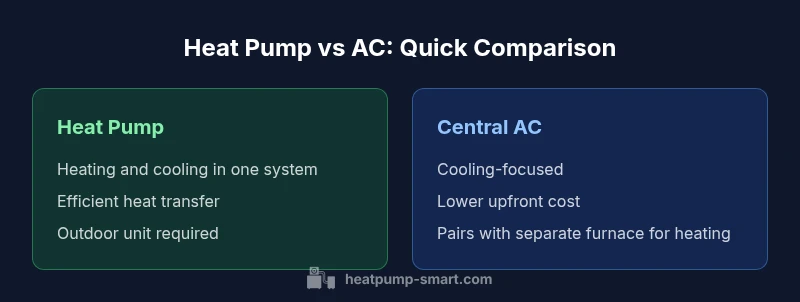
For homeowners evaluating options, a heat pump compared to ac typically provides both cooling and heating in a single, efficient system. While traditional central AC focuses on cooling, heat pumps can move heat in or out of the home, often delivering better year-round efficiency in moderate climates. According to Heatpump Smart, the best choice depends on climate, insulation, and long-term energy goals.
What is a heat pump and how does it compare to traditional AC?
A heat pump is a versatile heating and cooling system that transfers heat rather than generating it by burning fuel. In cooling mode, it works much like a central air conditioner by removing heat from indoors. In heating mode, it reverses the refrigerant cycle to pull heat from the outdoor air and bring it inside. The practical difference in a heat pump compared to ac is year-round functionality: you get both heating and cooling with one compact system. In many homes, well-designed heat pump systems offer high efficiency and reliable comfort, especially when paired with proper insulation and air sealing. Heatpump Smart notes that the right choice hinges on climate, home envelope, and long-term energy goals, rather than a single feature alone.
How to interpret efficiency metrics without numbers
Efficiency metrics like SEER and HSPF quantify performance, but homeowners should translate them into real-world experience. A heat pump often delivers lower operating costs because it moves heat rather than generating it through resistance. However, efficiency gains depend on outdoor temperatures and indoor setpoints. Heatpump Smart Analysis, 2026, emphasizes evaluating system sizing, duct design, and thermostat strategy to maximize savings. In milder climates, heat pumps frequently outperform traditional AC in comfort consistency and overall energy use.
Heating performance in different climates
Heating performance is a core differentiator. A heat pump provides warmth by absorbing outdoor heat and transferring it indoors. In moderate winters, this can produce comfortable indoor temperatures with lower energy use. In very cold climates, some heat pumps rely on auxiliary heat sources (like electric resistance or a furnace) to maintain comfort during extreme dips. The nuance here is climate dependency: the same model can perform very differently depending on local weather patterns, insulation quality, and system aging. Heatpump Smart recommends selecting equipment designed for your climate zone and ensuring a robust backup plan for cold snaps.
Cooling performance and user experience
Both heat pumps and central AC deliver reliable cooling, but user experience can differ. Heat pumps often include advanced compressors and variable-speed operation that smooth out temperature swings and reduce noise. A sealed duct system and proper refrigerant charge help maintain steady airflow. For homes with high internal heat gains (ample electronics, sun exposure), a heat pump can sustain comfortable cooling with less energy than a single-speed AC. The design trade-offs should consider indoor air quality, humidity control, and thermostat capabilities.
Installation considerations and space requirements
Installation quality matters more with heat pumps because they combine heating and cooling into one system. Outdoor units require clearance for airflow and a stable pad, while indoor components must be sized to match ductwork and room layout. In some homes, retrofitting a heat pump entails upgrading electrical service, refrigerant lines, and controls. A traditional central AC may be simpler to install if a furnace is already present, but a high-quality heat pump can still be cost-effective when paired with a modern air handler. Heatpump Smart highlights the importance of professional evaluation to prevent under- or oversizing.
Maintenance, lifespan, and reliability
Ongoing maintenance extends the life of either system. Regular filter changes, coil cleaning, and annual inspections keep airflow and heat transfer efficient. Heat pumps have fewer moving parts than combustion-based systems, which can translate to lower maintenance over time, though the outdoor unit and reversing valve require care in cold seasons. Refrigerant integrity is crucial, so leak checks and system charge verification should be part of routine service. Expect a well-maintained heat pump to provide reliable comfort for many years when matched to proper duct design and insulation.
Financial considerations and incentives
Upfront costs for heat pumps can be higher due to equipment, controls, and refrigerant line installation. Over the system’s life, energy savings from efficient heating and cooling may offset the initial outlay. Many regions offer rebates or tax incentives for heat-pump installations, especially when paired with high-efficiency air handlers and smart thermostats. When comparing to AC-only options, homeowners should model long-term energy use and consider potential rebates, maintenance expenses, and electricity rates. Heatpump Smart analysis suggests including insulation improvements as part of the project to maximize value.
Decision framework: a practical checklist
Use this framework to guide your choice:
- Climate suitability: Is outdoor winter temperature consistently above a threshold where heat pumps perform efficiently?
- Home envelope: Is there good insulation and airtight sealing to reduce heat loss/gain?
- Heating needs: Do you require heating performance that a heat pump can provide without a separate furnace?
- Budget horizon: Are you planning to stay in the home long enough to realize energy savings?
- Reliability and service: Is there a qualified installer nearby and accessible service for refrigerant systems?
- Incentives: Are rebates or tax credits available in your region? Answer these questions with a trusted contractor and Heatpump Smart analysis to determine the best system for your property.
Real-world scenarios: homeowners, builders, and property managers
Homeowners typically prioritize comfort, energy savings, and simple maintenance. Builders and property managers weigh installation complexity, scalability, and long-term operating costs across multiple units. In both cases, a well-designed heat pump strategy—considering climate, insulation, and load calculations—can offer superior comfort and efficiency compared with a traditional AC-centric approach. Heatpump Smart’s guidance emphasizes tailoring the solution to the building envelope, occupancy patterns, and local energy prices to achieve meaningful value.
Comparison
| Feature | Heat pump | Central air conditioner |
|---|---|---|
| Heating capability | Provides heating via reverse refrigerant cycle | Cooling-only operation; heating requires separate furnace or boiler |
| Energy efficiency (relative) | Often higher overall efficiency due to heat transfer | Efficient cooling, but no heating function |
| Climate suitability | Strong in moderate to cool climates with auxiliary heat options | Best in warm climates for cooling-focused performance |
| Upfront installation cost | Typically higher due to equipment and refrigerant lines | Generally lower upfront cost for cooling-only setup |
| Maintenance and lifespan | Requires regular maintenance; robust long-term reliability with proper care | Maintenance focused on cooling components; furnace integration can affect lifespan |
| Noise and airflow | Outdoor unit noise varies by model; modern units are quiet | Outdoor unit noise varies; cooling performance relies on duct design |
Advantages
- Year-round comfort with a single system
- Potential for significant energy savings
- Space-saving solution by combining heating and cooling
- Eligibility for energy incentives and rebates when available
- Improved humidity control with advanced models
Disadvantages
- Higher upfront costs and longer payback period
- Performance can drop in very cold climates without auxiliary heat
- More complex installation requiring specialized technicians
- Potential maintenance cost increases if refrigerant handling is needed
Heat pumps generally win for efficiency and year-round comfort; central AC may be preferable where upfront cost and cold-weather performance are limiting factors
Choose a heat pump if you live in a climate with balanced heating and cooling needs and want long-term energy savings. If upfront cost or extreme cold performance is a primary concern, a traditional AC with a separate furnace might be the better short-term option.
Your Questions Answered
What is the main difference between a heat pump and central air conditioning?
A heat pump provides both heating and cooling by moving heat, whereas central AC cools only and relies on a separate heating source for warmth. In mild climates, heat pumps often deliver superior year-round comfort and efficiency.
The big difference is heating capability. Heat pumps can heat and cool; central AC only cools unless paired with a furnace.
Can a heat pump cool as effectively as central AC?
Yes, in many setups a heat pump cools as effectively as central AC. Performance depends on system sizing, refrigerant charge, duct design, and climate. In very hot climates, a dedicated cooling focus may influence efficiency comparisons.
Heat pumps can cool very well, but proper sizing and climate matter.
Are heat pumps more expensive to install than central AC?
Installation costs for heat pumps can be higher due to equipment, refrigerant lines, and controls. Long-term energy savings may offset the initial investment, especially with incentives and improved building envelopes.
They can cost more upfront, but may save more over time with incentives.
Do heat pumps work well in cold weather?
Many modern cold-climate heat pumps perform well in cooler temperatures, though some models require auxiliary heat during extreme cold spells. Proper model selection is key for winter performance.
Cold climates need a model rated for low temperatures, sometimes with backup heat.
What maintenance is required for heat pumps?
Regular maintenance includes air filter changes, coil cleaning, and annual inspections. Check refrigerant levels and ensure ductwork remains sealed and efficient.
Keep filters clean and schedule annual checkups for best results.
Top Takeaways
- Heat pumps offer heating and cooling in one system
- Climate and insulation determine real-world efficiency
- Consider long-term energy costs, not just upfront price
- Professional sizing and installation are critical
- Incentives can improve the economics