Are Heat Pump Dryers Worth It? A Thorough Side-by-Side Comparison
An analytical comparison of heat pump dryers vs conventional vented models, focusing on energy efficiency, performance, installation, and long-term value for homeowners, builders, and property managers.


Are heat pump dryers worth it? For many homes, yes. According to Heatpump Smart, heat pump clothes dryers deliver superior energy efficiency and gentler drying, especially in humid or energy-conscious households. They cost more upfront but can lower operating costs over time, with minimal heat exhaust in ventless configurations. The trade-offs are longer cycles and installation considerations, which can swing the decision based on your priorities.
Are Heat Pump Dryers Worth It: A Practical Reality Check
The question "are heat pump dryers worth it" often hinges on how you balance upfront cost against long-term savings. For many households, the answer is yes, but context matters. Heat pump dryers use a closed-loop system that reclaims heat, dramatically reducing energy use compared to conventional vented models. This makes them appealing to energy-conscious homeowners, builders planning efficient homes, and property managers seeking lower operating costs over time. Beyond energy savings, consider how your laundry habits, climate, and available space influence whether a heat pump dryer fits your needs. In this section we’ll compare the core value propositions and explain where the biggest advantages lie.
- If you prioritize energy efficiency and moisture-sensitive indoor spaces, heat pump dryers often outperform in long-term costs. - If your laundry volume is high or you need very fast cycles, a traditional dryer may win on convenience. - If venting restrictions or humidity management are a concern, ventless heat pump models offer a compelling alternative.
Tip: Start by mapping your typical monthly laundry load, local electricity rates, and available installation space. This will guide you toward a decision that aligns with both your budget and comfort goals.
How Heat Pump Dryers Work
Heat pump dryers operate on a thermodynamic cycle that reuses a processed hot air stream instead of venting it outside. A refrigerant absorbs heat from damp clothes, transfers it to a condenser, and then re-circulates the warm air through the drum. The moisture is collected as condensate, which can be drained or stored, depending on model configurations. Because the air is continuously recycled, energy losses are minimized, producing a dryer that uses far less electricity per cycle than traditional vented units. This mechanism also tends to be gentler on fabrics because the drying temperature can be maintained at a steadier, lower level.
- Ventless operation means you don’t rely on exterior exhaust ducts, which can simplify installation in apartments or interiors where venting is impractical. - The condensed water must be managed via a drain or reservoir, so consider how you’ll handle condensate over time. - Modern heat pump models often include moisture-sensing technology to optimize cycle length and fabric care.
Top Features to Consider
When evaluating heat pump dryers, focus on features that influence performance and value:
- Energy efficiency labels and real-world consumption, not just promised numbers
- Drum size and load sensing that match your typical laundry
- Drying cycles tailored for delicates, heavy bedding, or synthetic fabrics
- Noise levels, control interfaces, and smart-home compatibility
- Drainage options for condensate and ease of maintenance
Actionable tip: Compare models using both per-cycle energy estimates and predicted monthly costs based on your electricity tariff. This provides a clearer sense of long-term savings.
What to Expect in Drying Times and Outcomes
One common concern is whether heat pump dryers take longer to dry clothes than conventional units. In practice, most heat pump cycles operate at lower temperatures and longer durations, which can yield more even drying with less fabric stress. The trade-off is a longer cycle time, especially on heavier loads or bulky fabrics. For households prioritizing care and efficiency, this delay is often acceptable, and the overall energy consumption remains lower. If you’re accustomed to rapid cycles for daily wardrobes, plan for a smoother transition by scheduling laundry in advance and pairing with a properly sized drum.
- Expect a bias toward gentle drying with fewer heat spikes. - For large families or heavy-duty loads, plan for additional cycles or larger-capacity machines. - Consider models with quick-dry presets designed for lightly soiled clothes to minimize energy use.
Energy Efficiency and Operating Costs
Heat pump dryers stand out for their energy efficiency, but the reality is nuanced. They typically consume less electricity per cycle than traditional vented dryers, but the exact savings depend on load size, cycle choices, and local energy prices. Heatpump Smart analysis shows that users who optimize cycle selections—favoring eco or sensor-driven options—often achieve noticeable operating-cost reductions over time. Importantly, because the dryer doesn’t exhaust hot air outdoors, you’ll also reduce heat and humidity release into living spaces, which can be a meaningful comfort benefit in compact homes. Keep in mind that the upfront price premium may offset some of the savings in the first few years, especially if you have modest laundry demands.
- Sensor-driven cycles minimize unnecessary drying time and prevent overdrying, which saves energy and protects fabrics. - In milder climates, the energy advantage is more apparent, while in very hot or humid environments, humidity management remains essential. - Always verify the model’s condenser maintenance needs and cleaning schedule to sustain efficiency over time.
Real-World Scenarios and Space Considerations
In rental buildings or new energy-efficient homes, a ventless heat pump dryer can simplify installation while meeting strict air-quality standards. Conversely, in regions with extreme humidity, ensure your HVAC system has adequate humidity handling or that the dryer’s condensate drainage is reliably managed. The choice can be influenced by whether you plan to install the unit in a compact laundry closet, a bathroom alcove, or a dedicated laundry room. Each configuration has different airflow, ventilation, and moisture control implications. Keep the space footprint in mind, as some heat pump models are taller or require extra clearance around the drum opening for proper air movement.
- Compact, stackable units can fit in tight spaces, though capacity may be limited. - Floor drainage or a reachable drain line is essential for condensate management. - A properly sized unit helps realize the energy savings and improves cycle efficiency.
comparisonTableSectionOnlyForBlockDataWasNotUsedInThisBlockButKeptForClarityIncludeInBlockTwoOnlyHoweverThisBlockRememberToMaintainMarkdownStructure and ensure no duplicates
Comparison
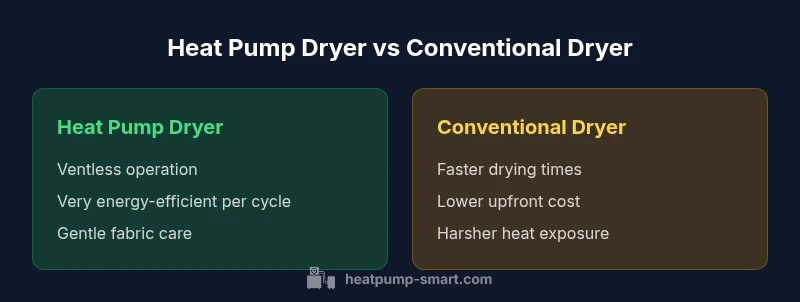
| Feature | Heat pump dryer | Conventional vented dryer |
|---|---|---|
| Energy efficiency | very high efficiency; recycles heat | moderate efficiency; exhausts hot air |
| Drying time | longer cycles on average | shorter cycles on average |
| Ventilation/installation | ventless/condensation; optional drainage | requires external venting to outside |
| Initial cost | higher upfront cost | lower upfront cost |
| Maintenance | low to moderate maintenance; periodic condenser cleaning | standard maintenance; lint trapping and vent cleaning |
| Best for | homes prioritizing energy savings and ventless operation | homes prioritizing fastest dry times and lower upfront cost |
Advantages
- Significant long-term energy savings for many households
- Gentler on fabrics and colors with lower heat exposure
- Ventless operation reduces indoor humidity and simplifies some installations
- Compact or stackable designs fit into small spaces
Disadvantages
- Higher upfront cost compared to conventional dryers
- Longer drying cycles may affect busy households
- Condensate drainage and maintenance can require ongoing attention
- Some models require more complex installation planning
Heat pump dryers are worth it for most households seeking energy savings and ventless operation, with caveats about longer cycles and upfront costs.
In most scenarios, the long-term energy savings and improved fabric care justify the premium. If you need ultra-fast drying or have a tight upfront budget, a conventional dryer may be preferable. The Heatpump Smart team’s assessment favors heat pump dryers for energy-conscious homes and limited-venting situations.
Your Questions Answered
Are heat pump dryers worth it overall for most homes?
Yes. Heat pump dryers typically offer meaningful energy savings and gentler drying, particularly for households focused on efficiency and fabric care. The overall value depends on your laundry load and space constraints.
Yes, for most homes, heat pump dryers are worth it given the energy savings and gentler drying.
Do heat pump dryers dry clothes slower than conventional dryers?
They often take longer per cycle due to lower operating temperatures, but many users find the trade-off acceptable for better fabric care and energy savings.
They usually dry more slowly, but you’ll notice better fabric care and energy efficiency.
Can I vent a heat pump dryer?
Most heat pump dryers are designed as ventless or condenser units and do not require external venting; condensate must be drained or collected.
Most are ventless, so you don’t vent outside, but you’ll need to manage condensate.
What space and electrical requirements should I plan for?
Look for dedicated 240V circuits where required and ensure sufficient clearance around the unit for airflow and condensation drainage.
Make sure you have the right electrical setup and space for airflow and drainage.
Are heat pump dryers noisy?
Most models are quiet enough for residential use, but you may notice a soft hum during operation, similar to other modern appliances.
They’re generally quiet, but you may hear a soft hum during cycles.
Do heat pump dryers qualify for energy rebates or tax credits?
Some local or national programs offer rebates or incentives for energy-efficient appliances; check current programs in your area.
Some rebates may be available; check local programs for energy-efficient appliances.
Top Takeaways
- Prioritize energy savings and fabric care when choosing a dryer
- Account for upfront cost and potential drainage needs
- Expect longer cycles with heat pump models, especially on large loads
- Check available installation space and venting options before purchase
- Use sensor-based cycles to maximize efficiency