Central heat vs heat pump: An in-depth comparison
Analytical comparison of central heat and heat pumps, covering operation, costs, climate suitability, installation, and long-term value for homeowners, builders, and managers.


Central heat vs heat pump is a rigorous comparison of two heating approaches: traditional central heating (boilers/furnaces fueled by gas, oil, or electricity) and heat pumps that move heat using electricity. In most homes with access to clean electricity, heat pumps deliver higher energy efficiency and lower operating costs over the long term, though upfront installation costs and climate considerations can tilt the balance. This quick answer outlines the core differences in operation, costs, climate suitability, and installation realities to help decisions at a glance.
What 'central heat' and 'heat pump' mean in practical terms
When homeowners talk about central heat, they typically refer to a centralized boiler or furnace that heats water or air and distributes it through pipes or ductwork to every room. Central heat can run on natural gas, propane, oil, or electricity, and its performance hinges on the fuel source, boiler/ furnace efficiency, and the integrity of the distribution system. A heat pump, by contrast, uses electrical energy to move existing heat from outside (air, ground, or water) into the home. In heating mode, it behaves like a reversible air conditioner, delivering heat rather than generating it. The central question in 2026 is how much you value energy efficiency, long-term operating costs, installation constraints, and climate suitability. This distinction matters for new builds, major retrofits, and property management portfolios where energy performance determines tenant comfort and operating budgets. According to Heatpump Smart, evaluating grid electricity quality and local fuel costs is essential before choosing between these two paths.
How central heat systems and heat pumps actually work
Central heat systems rely on a primary energy source to generate heat. A gas or oil boiler converts fuel into hot water or steam that travels through radiators or underfloor pipes. Electric boilers operate similarly but use electricity as the energy source, which can be convenient in all-electric homes. Heat pumps extract ambient heat from outside air, the ground, or groundwater and raise it to a usable temperature for heating spaces and water. The efficiency hinges on the coefficient of performance (COP) and the seasonal performance factor (SPF). In winter, heat pumps can reach high COPs when the outdoor temperature remains above the critical threshold, but very cold climates may reduce efficiency and require auxiliary heating. Heatpump Smart notes that system selection should balance climate realities with building envelope quality and occupancy patterns.
Key performance metrics to compare
- COP and SPF for heat pumps indicate how efficiently they convert electricity into usable heat; higher values mean lower operating costs for the same heat output. For central boilers, AFUE (for gas/oil) and efficiency ratings guide fuel-use effectiveness. In real-world terms, a well-insulated home paired with a high-efficiency heat pump typically delivers more consistent comfort at lower energy bills than an older boiler, especially when electricity is relatively low-cost and the grid is decarbonized. Heatpump Smart emphasizes that performance hinges on climate, home airtightness, and thermostat strategy. A tightly sealed building with an appropriately sized heat pump can outperform a traditional boiler in many mid- to high-temperature heating scenarios.
Costs and long-term value: upfront vs operating expenses
Upfront costs for a heat pump installation can be higher than for a traditional boiler due to equipment, refrigerant circuit work, and potential electrical upgrades. Operating costs, however, often favor heat pumps when electricity prices are stable and grid decarbonization progresses. For central heat, fuel costs—gas, oil, or electricity—tend to fluctuate with commodity markets and seasonal demand. In the long term, a high-efficiency boiler with proper maintenance can compete with a mid-range heat pump, especially in regions with high electricity prices or limited space for outdoor equipment. Heatpump Smart advises homeowners to model total cost of ownership over a 10–20 year horizon, including replacement cycles, labor, and potential rebates.
Climate considerations and space requirements
Heat pumps excel in moderate to cold climates where electricity is relatively inexpensive and the building envelope is well insulated. In extremely cold regions, some heat pumps rely on supplemental heat sources, increasing operational complexity and costs. Central boilers, particularly gas or oil, can offer strong performance in cold weather with robust fuel supply, but fuel price volatility can affect annual bills. Space requirements differ: heat pumps need outdoor unit(s) and usually a robust electrical service, while gas/oil boilers require venting and storage space for fuel. For property managers, the decision should factor in occupancy patterns, peak heating demand, and potential demand charges.
Installation realities: retrofit and compatibility
Retrofitting a central boiler to a heat pump often involves reconsidering insulation, radiator sizing, and distribution ductwork. Some homes may already have ductwork that’s compatible with forced-air heat pumps, while others require alternative strategies like radiant floors or hydronic systems. Electrical upgrades may be necessary for heat pumps, including panel capacity and backup heat controls. Central heat can reuse existing radiators and ductwork, but efficiency hinges on boiler condition and system design. Heatpump Smart highlights that a professional assessment is essential to identify bottlenecks, such as inadequate insulation, oversized radiators, or the lack of a suitable outdoor unit location.
Maintenance, reliability, and service life
Boilers and furnaces require annual or biennial servicing to maintain efficiency and safety, with component wear predictable over time. Heat pumps demand regular refrigerant checks, coil cleaning, and compressor health assessments; some units also require outdoor air sensor maintenance. Lifecycle expectations vary by brand, climate, and usage, but most boilers and heat pumps are designed for 15–20 years of service with proper maintenance. Heatpump Smart notes that maintenance plans and service windows are critical to ensuring predictable performance and avoiding costly downtime during peak heating season.
Environmental impact and refrigerants
The environmental profile of central heat depends on fuel type and efficiency. Gas or oil boilers emit CO2 relative to fuel consumption; newer condensing boilers improve efficiency but still rely on fossil fuels unless paired with clean energy sources. Heat pumps reduce direct combustion emissions and can substantially cut overall greenhouse gas emissions when powered by low-carbon electricity. Refrigerants used in heat pumps do introduce environmental considerations, especially if leaks occur; modern refrigerants are chosen for low global warming potential, but ongoing maintenance is essential to minimize risk. Heatpump Smart emphasizes evaluating the full lifecycle impact, including electricity source, refrigerant integrity, and end-of-life recycling.
Decision framework: how to choose for your home or building
Start with a baseline energy model that accounts for insulation, air leakage, windows, and occupancy. If electricity is affordable and decarbonized, a heat pump often leads to lower total energy costs and a smaller carbon footprint. For existing homes with limited electrical capacity, or in extremely cold climates, a high-efficiency boiler with a supplementary heat source may be more practical. Consider rebates, available incentives, and potential system upgrades to support heat pump operation, such as upgrading the electrical panel or adding a heat recovery ventilation system.
Real-world scenarios and practical takeaways
Consider a home with moderate insulation, a well-sealed envelope, and a renewable electricity supply. A heat pump can deliver consistent comfort with lower operating costs and easier zoning. In contrast, an older home with leaky ducts and existing gas lines might benefit from incremental upgrades to a high-efficiency boiler or a hybrid approach that uses heat pumps for primary heating and auxiliary heat sources for peak cold periods. For property managers, the choice can hinge on maintenance capacity, service networks, and resident preferences for heat delivery methods (radiator vs forced-air). Heatpump Smart recommends a phased evaluation: energy audit, equipment matchup, and a pilot installation in a representative zone before full replacement.
Comparison
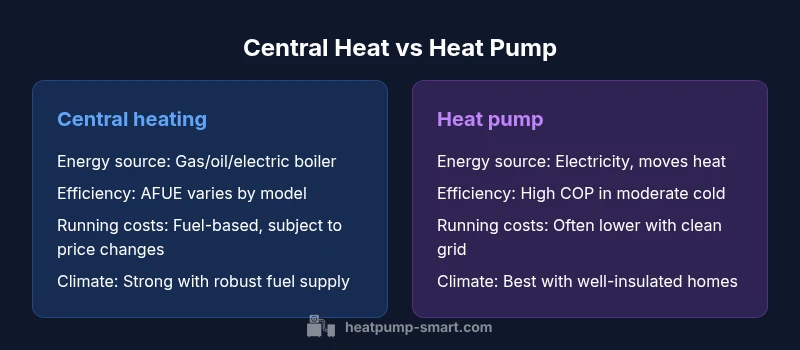
| Feature | Central heating (boiler/furnace) | Heat pump (air-source or ground-source) |
|---|---|---|
| Energy source | Gas/oil/electric boiler | Electricity, moving heat (air/ground source) |
| Efficiency potential | Depends on boiler AFUE; newer models can reach high efficiency | Typically high COP; best in well-insulated homes |
| Running costs | Fuel-based costs with price volatility | Electricity costs with potential long-term savings |
| Climate suitability | Strong in regions with reliable fuel supply | Strong in moderate-to-cold climates with adequate electricity |
| Installation complexity | Venting, fuel supply, and space considerations | Outdoor unit installation plus electrical upgrades |
| Emissions | Fuel combustion emissions; varies by fuel type | Lower direct emissions; depends on electricity mix |
| Maintenance | Annual boiler service; parts wear | |
| Lifespan | 15–25 years typical; major components wear out | 15–20 years typical; compressor and refrigerant service needed |
| Best for | Existing gas/oil infrastructure; retrofit-friendly in some cases | New builds or upgrades with clean electricity; cold climates with backup heat |
Advantages
- Potentially lower operating costs with heat pumps in clean-grid regions
- Reduced direct emissions when powered by low-carbon electricity
- Flexible placement and zoning with heat pump systems
- Ability to leverage rebates and incentives in many jurisdictions
- Continued use of existing radiators/air distribution with compatible designs
Disadvantages
- Higher upfront costs for heat pumps and possible electrical upgrades
- Performance can drop in very cold climates without supplemental heat
- Heat pumps require outdoor units and proper clearances
- Maintenance may be more specialized (refrigerant checks)
Heat pumps are generally the smarter long-term choice in well-insulated homes with clean electricity; central heat remains viable where electrical upgrades are not feasible or where fuel reliability is paramount.
For most modern homes, heat pumps offer greater efficiency and potential savings, especially as grids decarbonize. Central heat may be preferable where upfront costs, infrastructure limits, or extreme winter conditions constrain heat pump performance.
Your Questions Answered
What is central heat in homes today?
Central heat refers to a centralized heating system (boiler or furnace) that distributes heat through ducts or radiators. Fuel options include gas, oil, or electricity. The system’s efficiency depends on the boiler/furnace efficiency and the distribution system design. In modern homes, high-efficiency boilers and properly sealed ductwork improve performance, but fuel costs and emissions remain important considerations.
Central heat is a single, centralized heating system like a boiler or furnace that distributes warmth through ducts or radiators. Its efficiency and emissions depend on the fuel and equipment used.
Are heat pumps cheaper to run than boilers?
In many cases, yes, especially where electricity is affordable and the electricity grid is decarbonizing. Heat pumps deliver heat more efficiently by moving existing heat rather than generating it. However, in extreme cold or in homes with poor insulation, supplemental heating may reduce the savings. Always model annual energy costs with local electricity rates and fuel prices.
Often, heat pumps cost less to run than boilers, but climate and insulation matter.
Can heat pumps operate effectively in very cold climates?
Yes, but performance may drop as outdoor temperatures fall. Many cold-climate heat pumps include backup resistance heat or use a secondary heat source. Proper insulation and a correctly sized unit are essential to maintain comfort without excessive energy use.
They can work in cold climates, but you might need backup heat.
What installation costs should I expect?
Upfront costs for heat pumps can be higher due to equipment, refrigerant work, and electrical upgrades. Central heating may be cheaper to install if you already have the necessary boiler and distribution system. Always obtain multiple quotes and include potential electrical panel upgrades in the estimate.
Expect higher upfront costs for heat pumps due to equipment and wiring needs.
Do I need a backup heat source with a heat pump?
In very cold climates, many setups use a backup heat source to maintain comfort during extreme cold. Some heat pumps operate efficiently with supplemental heat, while others can rely on an integrated system to balance performance and cost.
A backup heat source is common in very cold areas.
How long do central heat and heat pumps last?
Both systems typically offer 15–20 years of service with proper maintenance. Boilers may require more frequent component replacements over time, while heat pumps rely on compressor and refrigerant service. Your local climate, usage patterns, and maintenance schedule strongly influence longevity.
Most systems last 15–20 years with good maintenance.
Top Takeaways
- Assess building envelope before choosing a system
- Model total cost of ownership over 10–20 years
- Consider climate, electricity price, and grid decarbonization
- Plan for potential electrical upgrades if selecting a heat pump
- Evaluate available rebates and incentives early