CMP Heat Pump Rate: Compare Air-Source vs Geothermal Options
Compare CMP heat pump rate for air-source vs geothermal options, focusing on COP, seasonal performance, and long-term energy savings to choose the best system for your climate today.


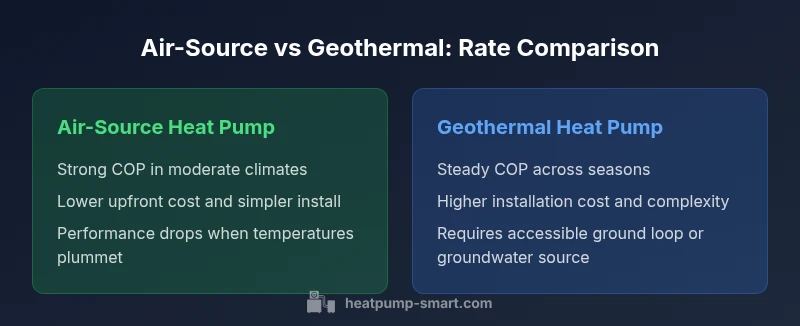
Among CMP heat pump rate choices, air-source models often show higher nominal performance in moderate weather, whereas geothermal systems tend to hold a steadier COP across seasons. To pick the best option, compare COP across your climate, estimate seasonal energy use, and weigh installation costs and efficiency gains over the system life.
What CMP Heat Pump Rate Really Means
The CMP heat pump rate refers to how efficiently a heat pump converts electrical energy into usable heat across the seasons. The core metrics used in reviews and comparisons are COP (Coefficient of Performance) and HSPF (Heating Seasonal Performance Factor). A higher COP or HSPF indicates more heat per unit of electricity, which translates to lower operating costs over time. In practice, the rate is influenced by outdoor temperature, indoor setpoints, system load, and how well the home is sealed and insulated. The Heatpump Smart team notes that a fair CMP heat pump rate assessment must examine performance across the weather range you actually experience, not just the rated peak. In other words, a system with an outstanding label might underperform in your climate if not sized and installed correctly.
Key Factors That Influence Heat Pump Rate in Practice
Performance is shaped by climate, home envelope, and equipment choices. The outdoor temperature profile defines how hard the compressor works and how often the defrost cycle runs in winter. A well-insulated home with sealed ducts reduces the load, letting the heat pump achieve its rated COP more consistently. Sizing is critical: an oversized unit cycles on and off, wasting energy, while an undersized unit struggles to meet loads on peak days. Thermostat strategy, fan speed control, and proper refrigerant charge also influence rate stability. The Heatpump Smart team emphasizes that envelope improvements—and proper commissioning—often yield more meaningful gains than chasing a marginal COP increase on a single unit.
Air-Source vs Geothermal: How Their Rates Compare
Air-source heat pumps pull heat from outdoor air and rely on an efficient compressor and refrigerant cycle to deliver heat indoors. Their rate tends to be strong in moderate climates but can degrade as outdoor temperatures drop, unless paired with auxiliary heat or a very well sized system. Geothermal heat pumps draw heat from the ground or a groundwater source, where the temperature remains relatively stable year-round. This makes their rate (COP) more consistent across seasons, though the upfront cost and installation footprint are typically higher. The Heatpump Smart analysis shows that climate, soil or water conditions, and system design drive the practical performance more than the label alone.
How to Read COP, HSPF, and Other Rate Metrics
COP measures instantaneous efficiency, usually defined at a reference outdoor temperature. HSPF captures heating performance across the heating season. Both values improve with better insulation, efficient duct design, and proper system sizing. When evaluating CMP heat pump rate, compare COP at temperatures representative of your worst winter day, not just the mid-season rating. Also consider electricity price projections, system maintenance plans, and how auxiliary heat interacts with your annual energy use. Heatpump Smart recommends tracking monthly energy usage in the first heating season to validate the rated performance.
Practical Scenarios: When to Choose Which System
Scenario 1: Moderate climate, single-family home, and a tight budget. An air-source heat pump often delivers excellent rate improvements with lower upfront costs, especially if the home envelope is already efficient. Scenario 2: Cold climate with high heating demand. Geothermal tends to maintain higher rate stability across temperature swings, offering long-term energy savings despite higher install costs. Scenario 3: Small home in a warm climate with occasional cold snaps. A high-efficiency air-source model can provide robust year-round performance at a lower total cost of ownership. The best approach is to model annual energy use and consider local climate data when CMP heat pump rate is the primary decision driver.
Installation and System Design Considerations
Rate stability hinges on proper installation. Duct sealing and insulation set the baseline load, while correct refrigerant charge ensures peak efficiency. For geothermal loops, site suitability and access to drilling equipment determine feasibility and cost. Noise management, outdoor unit placement, and vibration isolation influence user satisfaction and maintenance needs. Heatpump Smart highlights that a thoughtful design phase—covering load calculation, envelope improvements, and future expansion plans—yields the most reliable CMP heat pump rate.
Real-World Numbers: What Homeowners See in Bills
Homeowners frequently notice energy bills reflect the sum of climate demands, occupancy patterns, and how well a system is matched to the house. Reviews show that when CMP heat pump rate is optimized through better insulation, duct sealing, and correct sizing, operating costs can be significantly lower than baseline electric heating. The variation across homes is substantial: climate zones, building age, and thermostat habits all influence the realized COP and HSPF. Heatpump Smart analysis indicates that, on average, the most meaningful gains come from envelope improvements coupled with a properly sized system, not from a single feature.
Maintenance and Rate Stability
Regular maintenance—refrigerant checks, coil cleaning, drain pan inspection, and thermostat calibration—helps maintain peak COP and reduces rate volatility. Dirty coils or low refrigerant reduce efficiency and raise energy consumption. For many homeowners, a proactive maintenance schedule pays for itself via steadier performance and lower emergency heat usage. Heatpump Smart emphasizes scheduling annual service as a cornerstone of preserving CMP heat pump rate.
How to Use the Comparison Table for Your Decision
This article frames how to evaluate rate differences between system types. Use the table as a baseline: consider COP in your climate, installation complexity, and ongoing costs. The most reliable decisions arise from combining the table with a home energy audit, local climate data, and a real-world pilot period after installation. Tailor the outcome to your home’s envelope, hot water load, and comfort preferences.
Comparison
| Feature | Air-Source Heat Pump | Geothermal Heat Pump |
|---|---|---|
| COP at moderate outdoor temps | High efficiency in mild weather | Moderate-to-High, steady across seasons |
| COP at cold outdoor temps | Declines with very cold air, may rely on auxiliary heat | Remains relatively stable due to ground loop |
| Heating Capacity Adjustability | Depends on outdoor temp; may cycle on/off | Consistent capacity with steady ground source |
| Installation Complexity | Less invasive, no ground loop | More complex, requires drilling/loop field if needed |
| Upfront Cost | Lower upfront cost | Higher upfront cost due to soil/loop work |
| Best For | Moderate climates, budget-conscious buyers | Extreme climates, long-term energy focus |
Advantages
- Lower upfront cost for air-source options
- Faster installation with fewer site requirements
- Strong performance in moderate climates
Disadvantages
- Performance degrades in extreme cold for air-source
- Geothermal has higher upfront cost and installation complexity
- Geothermal requires land access or drilling for loops
Air-source generally offers better value in moderate climates; geothermal is worth the premium in extreme climates with high energy costs.
In temperate regions, air-source heat pumps deliver excellent rate improvements with lower initial costs. In colder or more variable climates, geothermal systems provide steadier performance and potential long-term savings, justifying higher installation expenses when budget and site conditions permit.
Your Questions Answered
What does CMP heat pump rate mean?
CMP heat pump rate refers to the efficiency and performance metrics used to rate heat pumps' ability to generate heat. Key metrics include COP and HSPF, where higher values indicate more efficient systems. Real-world performance depends on climate, sizing, and system design.
CMP rate measures how efficiently a heat pump converts energy into heat, mainly via COP and HSPF. Real-world results depend on climate and setup.
Which is better for cold climates, air-source or geothermal?
Geothermal often maintains higher rate stability in cold climates due to ground-source heat exchange, while air-source can see COP declines unless sized and insulated well. Consider site feasibility, energy costs, and long-term savings when deciding.
Geothermal usually performs more consistently in cold weather, but installation matters.
How does climate affect COP and HSPF?
COP and HSPF vary with outdoor temperatures. Air-source COP drops as it gets colder, while geothermal COP remains relatively steady. Your actual energy savings depend on climate, insulation, and how you use heat.
Climate changes how efficiently your heat pump runs; air-source struggles in cold, geothermal stays steadier.
Can I improve rate with better insulation and duct sealing?
Yes. Improving insulation and sealing ducts reduces heat loss, lowering load and increasing effective COP. Correctly sizing the system remains essential for maximizing rate gains.
Improve the rate by reducing heat loss with better insulation and sealed ducts.
Are there government incentives for heat pumps?
Many regions offer tax credits, rebates, or incentives for heat pumps. Check local programs and federal incentives to reduce upfront costs and accelerate payback.
Look for local and federal incentives to lower upfront costs.
What is the payback period for CMP heat pump rate improvements?
Payback varies by climate, energy prices, and usage. A more efficient system often reduces operating costs over time, but exact payback depends on local conditions and how you use heat and hot water.
Payback depends on climate and energy usage; expect variability.
Top Takeaways
- Identify your climate before choosing a system
- Compare COP across the temperature range you experience
- Balance upfront costs with projected long-term energy savings
- Factor in installation feasibility and envelope improvements
- Consult credible sources and model real-world usage