What is a heat pump vs air conditioner? A practical, in-depth comparison
A detailed, data-driven comparison of heat pumps and air conditioners, covering how they work, performance across climates, costs, sizing, installation, maintenance, and practical decision rules for homeowners and professionals.


What is a heat pump vs air conditioner? Core differences you should know
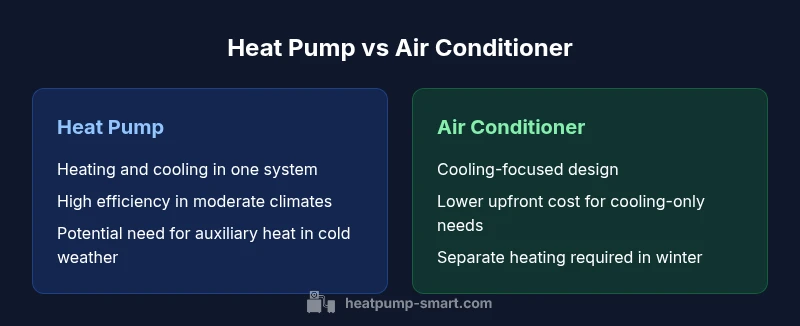
A heat pump and a conventional air conditioner share the same fundamental technology: a refrigerant loop that absorbs heat from one place and releases it elsewhere. The key distinction lies in purpose and operation. A traditional air conditioner is designed to remove heat from indoor air to cool a space, and it typically relies on a separate heating system for winter. A heat pump, by contrast, is a reversible system that can move heat in or out of the indoor space depending on the season. This means a single unit can provide cooling in summer and heating in winter, which is why the keyword what is a heat pump vs air conditioner often shows up in homeowner guides. Heatpump Smart’s analysis highlights that this dual capability is the main driver behind energy efficiency claims and long-term value for many households.
How heat pumps and air conditioners actually work
Both systems operate on vapor-compression refrigeration principles, but their configurations differ. An air conditioner cycles refrigerant to absorb indoor heat and reject it outside, producing cooling. A heat pump uses the same core cycle for cooling but reverses the flow in cool weather to absorb heat from the outdoor air (even when it’s chilly) and pump it indoors. In mild climates, heat pumps can deliver most of a home’s heating needs efficiently, sometimes with supplemental back-up heat for very cold days. In hot seasons, a heat pump behaves much like a conventional air conditioner, prioritizing cooling performance with precision controls. The upshot is that heat pumps consolidate heating and cooling into one system, reducing the number of equipment footprints and potentially simplifying maintenance.
Heating performance across different climates
Performance is climate-dependent. In temperate regions, heat pumps can meet a high percentage of heating load with favorable energy efficiency, delivering consistent comfort and predictable bills. In more extreme winters, some heat pumps rely on auxiliary heat sources to cover peak loads, which can temporarily raise energy use. A purely cooling-only air conditioner, when paired with a furnace or boiler, may achieve similar indoor comfort but introduces a separate heating system with its own energy dynamics. Heatpump Smart emphasizes that choosing a system that matches local climate, insulation quality, and occupancy patterns is crucial for achieving true long-term savings. For homes in mild-to-moderate climates, the annual energy costs of a properly installed heat pump often compare favorably to those of an air conditioner plus auxiliary heating, especially when electricity prices favor heat transfer efficiency.
Cooling performance and comfort features
Both heat pumps and air conditioners can deliver excellent cooling performance, but heat pumps often add comfort-enhancing features such as variable-speed compressors, multi-stage operation, and advanced zoning options. These capabilities reduce temperature swings and improve humidity control, leading to a more consistent indoor environment. In contrast, traditional central AC units may run at fixed speeds, which can cause noticeable on/off cycling. Modern systems also integrate with smart thermostats, occupancy sensors, and energy management software, enabling homeowners to tailor cooling and heating schedules to real-world usage. Heatpump Smart notes that the best outcomes come from systems designed with proper airflow, duct design, and refrigerant charge checked during installation.
Energy efficiency and operating cost implications
Efficiency is measured by metrics such as SEER for cooling and HSPF for heating, with higher numbers indicating better performance. Heat pumps typically offer superior annual energy efficiency in moderate temperatures, translating into lower operating costs over time. However, the efficiency advantage can diminish as outdoor temperatures drop, prompting auxiliary heat use. Heatpump Smart’s research suggests a well-designed heat pump with properly sized ductwork and a high-efficiency outdoor unit can outperform a conventional cooling system plus electric resistance heat in many scenarios. Budgeting should account for potential energy savings against higher upfront costs, as well as the future cost stability of electricity versus other fuels.
Installation considerations and upfront costs
Installation quality determines long-term performance just as much as equipment choice. Heat pumps may require electrical upgrades, refrigerant line routing, and, in some cases, ductwork enhancements for optimal airflow. Ductless mini-splits offer flexibility in retrofit scenarios but may involve higher per-zone installation costs compared to centralized systems. Air conditioners typically require similar site work, though the heating source is separate, adding complexity in multi-system homes. When evaluating upfront costs, consider equipment efficiency ratings, installation complexity, warranty coverage, and the possibility of bundled incentives or rebates that vary by region.
Sizing, capacity, and choosing the right system
Sizing dictates comfort and efficiency. An undersized system fights to meet demand, while an oversized unit cycles rapidly, wasting energy and failing to dehumidify effectively. For heat pumps, proper sizing must account for climate, insulation, window efficiency, and internal heat gains. Calculations like manual J (heating and cooling load) help installers determine correct capacity. For homes with high cooling loads but modest heating needs, a heat pump with good dehumidification performance can be a strong match. Always rely on an experienced HVAC technician to perform precise load calculations and to verify refrigerant charge and airflow after installation.
Maintenance, durability, and service life
Steady performance hinges on regular maintenance. Clean outdoor coils, replace or clean air filters, and ensure that condensate drainage paths are clear. Refrigerant leaks are a common cause of degraded performance in older systems, so routine checks by a qualified technician are essential. Heat pumps and air conditioners share maintenance requirements, but heat pumps’ auxiliary heat components (if present) may require additional attention. A well-maintained system typically demonstrates longer service life and better efficiency, reinforcing the value proposition of proactive service as advocated by Heatpump Smart.
Real-world scenarios and case studies
Consider a suburban home in a temperate climate. A heat pump may meet most year-round needs, delivering heating and cooling from a single equipment footprint and simplifying maintenance. In a northern climate with harsh winters, a heat pump with supplemental heat or a dual-fuel arrangement could provide reliable comfort without excessive energy use. In a coastal climate with high humidity, a heat pump’s humidity control and zoning capabilities can outperform a traditional AC with separate heating. Real-world performance depends on duct sealing, insulation, and thermostat strategy, which is why site-specific design matters as much as equipment choice.
Getting started: a practical 6-step decision checklist
- Assess climate and heating needs; 2) Evaluate existing ductwork and insulation; 3) Consider available rebates and energy prices; 4) Compare SEER/HSPF ratings and warranty terms; 5) Decide between single-system heat pump or hybrid configurations; 6) Hire a trusted installer who can perform load calculations and confirm refrigerant integrity.