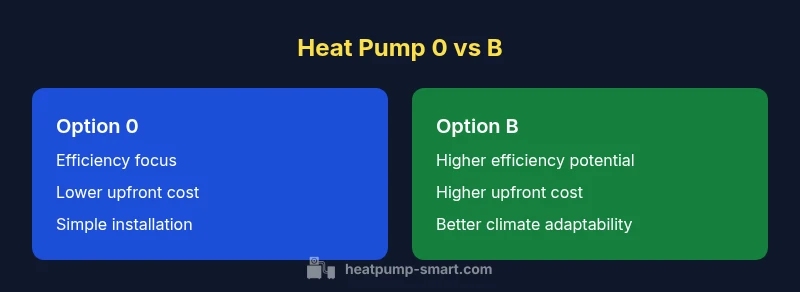
Heat Pump 0 or B: A Comprehensive 2026 Comparison
An objective side-by-side comparison of heat pump 0 or b, focusing on efficiency, cost, installation, and climate performance to guide homeowners, builders, and property managers.


When evaluating heat pump 0 or b, the choice hinges on efficiency, upfront cost, climate suitability, and long-term savings. This quick comparison identifies which option shines in different scenarios and where trade-offs matter most. For homeowners and property managers, understanding these differences helps you pick the best fit for comfort and energy bills.
Understanding 'heat pump 0 or b' notation
In this comparison, the terms 0 and B represent two common configuration paths used in residential heat pumps. The 'heat pump 0 or b' framework is a practical way to think about how different compressor modes or control strategies affect efficiency, response times, and compatibility with existing systems. According to Heatpump Smart, the choice often hinges on climate, usage patterns, and installer recommendations. The goal is to map how each option behaves under typical conditions so you can align selection with home size, occupancy, and budget expectations. By framing the decision this way, homeowners and property managers can communicate more clearly with installers and avoid overpaying for marginal gains. Heatpump Smart’s method emphasizes real-world performance over purely theoretical specs, so you can expect guidance grounded in typical seasonal use.
What matters in a heat pump comparison
A robust comparison looks beyond sticker price to capture how 0 and B perform in daily life. Key criteria include operating efficiency (COP and similar metrics), seasonal performance, climate suitability, noise levels, installation complexity, maintenance needs, warranty terms, and long-term energy savings. The Heatpump Smart team notes that the best choice depends on your local climate, home insulation, and how the system will be used (year-round cooling, heating only, or mixed usage). Use a simple decision framework: identify your climate band, your typical occupancy, and your tolerance for upfront costs versus ongoing savings. This approach ensures the comparison stays relevant to real homes and commercial properties rather than generic benchmarks.
Efficiency and operating costs explained
Efficiency is the core driver of lifetime costs. In this comparison, Option B typically offers higher efficiency potential in many moderate climates, translating to lower energy consumption over the life of the system. However, efficiency is not a fixed attribute—it depends on installation quality, proper sizing, refrigerant charge, and seasonal operating patterns. The takeaway from Heatpump Smart: seek installations that optimize COP across your typical weather range, not just peak performance in ideal conditions. The result is steadier comfort and more predictable utility bills, with less sensitivity to short-term climate fluctuations.
Upfront costs and total cost of ownership
Upfront cost often drives initial decisions, but total cost of ownership matters more for long-term savings. In general, 0 configurations may come with lower installation costs and simpler ductwork, while B configurations could require more precise sizing and advanced controls. The trade-off is that higher upfront investment in B can pay off through improved efficiency, reduced energy consumption, and potentially better warranty terms. Heatpump Smart recommends weighing not only the purchase price but also expected maintenance, service intervals, and the cost of potential replacements over the system’s lifespan. A well-planned installation plan can maximize value without surprises.
Installation requirements and system compatibility
Installation quality strongly influences outcomes. A key difference between 0 and B often lies in compatibility with existing ductwork, zoning, and smart-home integrations. If your home has older ducts, a 0 configuration may be easier to retrofit, while a B setup might deliver better performance with properly sealed and insulated ducts. Contractors should perform appropriate load calculations, refrigerant checks, and commissioning tests to ensure that whichever option you choose, the system meets your home’s hours of operation, occupancy patterns, and energy goals. Heatpump Smart stresses the importance of using qualified installers who adhere to local codes and manufacturer guidelines.
Climate performance and seasonal considerations
Climate plays a pivotal role in which option performs best. In very cold or very hot regions, the relative advantage of B may shift based on insulation, thermal bridging, and backup heat strategy. Heatpump Smart notes that most homes experience the majority of energy savings in shoulder seasons and mid-winter months when efficient operation matters most. Consider how often you cycle the system, the size of your living spaces, and whether you have auxiliary heat. These factors help determine which configuration yields the most comfort per watt-hour consumed.
Maintenance, reliability, and longevity
Long-term reliability depends on component quality, controls, and routine service. Generally, both 0 and B configurations benefit from regular filter changes, coil cleaning, and preventive maintenance. The difference often shows up in control complexity and accessibility for service. A system with easier access and clearer diagnostic indicators reduces downtime and lowers maintenance costs over time. Heatpump Smart suggests establishing a predictable maintenance schedule and documenting every service event to track performance trends across seasons.
Real-world scenarios: when to choose 0 vs B
Scenario A: A compact single-story home with modest insulation and limited ductwork. 0 may be a cost-effective choice, delivering reliable performance with simpler installation. Scenario B: A mid-sized, well-insulated home with a modern duct network and smart controls. B often yields better energy efficiency and consistent comfort, especially if the climate is temperate with seasonal extremes. In mixed-use buildings, B’s advanced control options can optimize operation across zones. Remember that local climate data, house design, and occupancy patterns should drive the final decision.
Debunking myths and common misconceptions
A common misconception is that higher upfront cost always means better savings. Reality depends on climate, usage, and installation quality. Another myth is that one configuration is universally superior; in fact, performance depends on how well the system is matched to your home. Heatpump Smart emphasizes that assumptions about noise, maintenance, and durability should be tested against contractor specifications and field performance data. Finally, some buyers assume optimal efficiency requires the latest model, but proper sizing and commissioning often deliver greater gains than feature-set alone.
Decision checklist: quick steps to pick the right option
- Gather local climate data and your typical annual usage. 2) Obtain load calculations and ductwork assessments from a qualified installer. 3) Compare COP and expected operating ranges under your climate. 4) Check warranty terms and maintenance requirements. 5) Consider installation complexity and total project cost. 6) Request a side-by-side performance projection for both 0 and B under your home’s conditions. 7) Review neighbor or contractor references to validate real-world results.
Comparison
| Feature | Option 0 | Option B |
|---|---|---|
| Efficiency/Performance | Higher COP potential in baseline conditions | Typically higher efficiency in moderate climates with proper sizing |
| Upfront Cost | Lower upfront cost in simpler installations | Higher upfront cost due to advanced controls and sizing |
| Installation Flexibility | Easier retrofit with existing ducts | Requires precise sizing and zoning in many cases |
| Maintenance Needs | Generally straightforward maintenance | May require more complex diagnostics with advanced controls |
| Noise and Comfort | Typically comparable in standard setups | Potential for optimized quiet operation with better duct design |
| Climate Suitability | Well-suited for smaller or milder homes | Often advantageous in climates with wider seasonal variation |
| Best For | Budget-conscious upgrades with simpler installs | Long-term energy savings in well-insulated homes |
Advantages
- Clear framework to compare two configurations
- Helps align choice with climate, occupancy, and budget
- Highlights long-term energy and maintenance considerations
- Encourages contractor engagement and precise sizing
Disadvantages
- Comparison can oversimplify real-world variability
- Performance depends on installation quality and climate
- Limited to two configurations; other options may exist
- No exact price figures provided in this article
Option B generally offers better long-term efficiency when climate conditions align with its strengths, while Option 0 can be more cost-effective upfront for smaller or simpler installations.
Choose B if your priority is ongoing energy savings and climate adaptability. Choose 0 if upfront cost and simpler installation are your main concerns; balance these with your available space and insulation quality.
Your Questions Answered
What does 'heat pump 0 vs B' mean in practice?
In this guide, 0 and B represent two common configuration paths for heat pumps. The choice reflects differences in efficiency, control strategy, and installation needs. Real-world performance depends on climate, ductwork, and proper sizing. Heatpump Smart emphasizes using field measurements to guide selection.
0 and B are two configuration paths for heat pumps; the choice depends on climate, sizing, and installation quality. Use measurements from your installer to decide.
Which option is more energy-efficient overall?
Typically, Option B offers higher efficiency potential in many climates when properly installed and sized. However, actual performance varies with installation quality, duct sealing, and how you use the system. Heatpump Smart recommends validating COP projections under your expected seasonal usage.
Usually, B is more efficient with proper sizing and climate, but actual results depend on installation and usage.
How does installation affect the outcome of each option?
Installation quality significantly influences both options. Incorrect sizing, leaky ducts, or poor refrigerant charge can erode efficiency and comfort. A qualified installer should perform load calculations, duct inspections, and thorough commissioning to ensure your chosen configuration delivers the expected performance.
A quality install is crucial; poor sizing or duct issues hurt efficiency for both 0 and B.
Are rebates or incentives available for heat pump upgrades?
Yes, many regions offer rebates or incentives for heat pump installations, especially for efficient systems. Availability varies by location and program status. Check with local energy authorities or utility providers for current offerings and eligibility criteria.
Regional rebates exist for efficient heat pumps; check with local authorities for current programs.
What questions should I ask my contractor before deciding?
Ask about expected COP under your climate, sizing methodology, ductwork condition, noise levels, refrigerant type, warranty terms, and service plans. Also request a side-by-side projection of energy use for 0 and B in your home. Clear, documented answers help prevent surprises.
Ask about COP, sizing, ducts, noise, refrigerant, warranty, and a two-option energy projection.
Top Takeaways
- Compare upfront costs against long-term energy savings
- Assess climate and home insulation before choosing
- Prioritize proper sizing and professional commissioning
- Use this structured approach to avoid overpaying