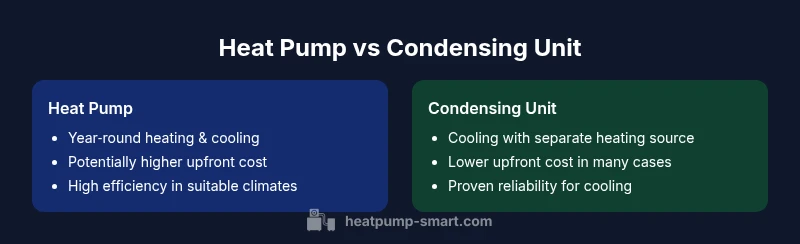
Heat Pump vs Condensing Unit: A Practical Comparison for 2026
A detailed, objective comparison of heat pumps and condensing units, covering efficiency, climate suitability, installation, costs, and when to choose each for homeowners, builders, and property managers.


When comparing heat pump vs condensing unit, the heat pump typically delivers year‑round heating and cooling with higher overall efficiency in moderate climates, while a condensing unit (air conditioner) can be cheaper upfront and easier to install for cooling‑only needs. The best choice depends on climate, existing ductwork, electricity costs, and long‑term goals for comfort and savings.
Why homeowners compare heat pump vs condensing unit
The decision between a heat pump and a condensing unit is not just about price—it's about year‑round comfort, annual energy use, and long‑term reliability. According to Heatpump Smart, most homeowners weigh climate, electricity rates, and the complexity of installation when choosing between these two paths. In many homes, a heat pump offers the advantage of both heating and cooling, while a traditional condensing unit (the outdoor component of a central AC system or a standalone cooling system) excels in cooling with a simpler, often cheaper, upfront setup. This section starts from the premise that the keyword heat pump vs condensing unit will shape your expectations and decisions, and it frames the core factors you should evaluate first.
Core definitions: heat pump vs condensing unit
A heat pump is a single system that moves heat between indoors and outdoors, providing both heating in winter and cooling in summer. A condensing unit, in contrast, is the outdoor component of an air conditioning system (or the outdoor portion of a split system) that provides cooling; heating typically requires a separate furnace or boiler. Understanding this distinction helps homeowners assess whether they want integrated year‑round climate control or a cooling system with separate heating equipment. The Heatpump Smart team emphasizes that the logical starting point is to identify climate needs, existing infrastructure, and your comfort priorities before considering retrofits or upgrades.
How heating and cooling work in practice
Heat pumps extract ambient heat from the outside air (or ground, in geothermal installations) and move it indoors for heating. In cooling mode, they reverse the process, removing indoor heat to the outside. Condensing units function as efficient outdoor radiators for air conditioning; they do not provide heat unless paired with a separate heating source. In practice, a heat pump can replace both a furnace and an AC system in many homes, delivering a simpler, more compact solution with a single refrigerant loop. For homes with limited ductwork, mini‑split heat pumps offer a flexible alternative.
Efficiency and performance metrics you should track
When evaluating heat pump vs condensing unit options, look beyond upfront price to long‑term efficiency indicators. For heat pumps, COP (Coefficient of Performance), HSPF (Heating Seasonal Performance Factor), and SEER (Seasonal Energy Efficiency Ratio) gauge heating and cooling efficiency. Condensing units are typically rated by SEER for cooling efficiency and may tie into a separate heating system with its own efficiency metrics. The key is to compare systems using the same climate assumptions and to consider how efficiency translates into annual energy costs for your household.
Climate considerations and performance expectations
Climate is a primary factor in choosing between heat pumps and condensing units. In milder winters, heat pumps tend to deliver reliable heating with low operating costs. In very cold climates, some heat pump models rely on auxiliary heat to meet peak demand, which can raise energy use during cold snaps. Conversely, condensing units paired with a traditional furnace or boiler can provide consistent heating in all winter conditions but may miss out on the potential efficiency gains of heat transfer during shoulder seasons. Heatpump Smart notes that choosing the right model—especially one designed for cold climates—can significantly affect comfort and cost.
Installation considerations and compatibility
Installation challenges differ between these options. A heat pump, especially a full system replacement, often requires ductwork assessment, electrical upgrades, and refrigerant line routing. A condensing unit may be easier to install if you already have a central cooling system and compatible indoor air handling. Regardless of choice, ensure proper system sizing, refrigerant line integrity, and outdoor unit clearance. Space, noise considerations, and local codes influence installation feasibility and long‑term maintenance. A thoughtful plan also accounts for future energy goals and potential rebates or incentives.
Costs and lifecycle value without guessing exact prices
Upfront costs for a heat pump can be higher than a stand‑alone condensing unit due to the dual heating/cooling capability and the need for compatible indoor components. However, operating costs may be lower in many climates because heat pumps transfer heat rather than generate it. A condensing unit typically has a lower upfront cost but may incur higher energy costs if used for heating in winter without an auxiliary heating source. Consider lifecycle value: energy savings, maintenance needs, reliability, and compatibility with future home upgrades.
Rebates, incentives, and financing considerations
Many regions offer rebates or tax credits for heat pump installations because of their higher efficiency and emissions reductions. The availability and size of incentives depend on local programs and energy policies. Heatpump Smart notes that incentives can meaningfully reduce payback periods and improve overall project economics. When evaluating heat pump vs condensing unit, factor incentives into your net price and consider financing options to manage upfront costs while maximizing long‑term savings.
Maintenance requirements and service expectations
Maintenance is a fixed cost in both scenarios, but the nature of service differs. Heat pumps require periodic refrigerant checks, filter maintenance, and coil cleaning, plus attention to auxiliaries in cold climates. Condensing units require routine cooling system maintenance, refrigerant checks when applicable, and attention to the indoor heating system it supports. Regular professional inspections help ensure efficiency, avert breakdowns, and extend equipment lifespan. A proactive maintenance plan can preserve performance and comfort across seasons.
Noise, durability, and reliability considerations
Outdoor units contribute noise, especially in compact lots or shared walls. Modern designs emphasize quieter operation, but placement matters for comfort and property values. Durability depends on climate exposure, installation quality, and routine maintenance. Heat pumps today feature robust compressors and variable‑speed fans that optimize acoustics and efficiency, while condensing units rely on the reliability of the air conditioning compressor and refrigerant components. Each option benefits from a proper, code‑compliant installation and consistent maintenance.
Choosing for new construction vs retrofit projects
New builds offer a clean slate to plan for year‑round comfort with a heat pump system that can simplify duct design and reduce energy bills. Retrofitting, especially in older homes, requires careful assessment of existing ductwork, insulation, and electrical capacity. In retrofit scenarios, a ducted heat pump or a hybrid approach (heat pump plus traditional furnace) can balance upfront costs with long‑term efficiency. Heatpump Smart emphasizes testing for load, heat loss, and duct leakage to set realistic expectations before purchase.
Myth‑busting: common misconceptions
A frequent myth is that heat pumps always perform poorly in cold weather. Cold‑climate heat pumps exist and improve performance with advanced refrigerants and defrost cycles, but results vary by model. Another misconception is that heat pumps cannot cool as effectively as a dedicated AC; in fact, heat pumps designed for cooling can meet modern comfort expectations. Finally, some assume that efficiency automatically means cost savings; cost savings depend on climate, electricity rates, and the system’s proper sizing and installation.
Comparison
| Feature | Heat pump | Condensing unit |
|---|---|---|
| Primary function | Heating and cooling in one compact system | Cooling (air conditioning) with separate heating source |
| Efficiency and metrics | High seasonal efficiency when climate allows; COP and HSPF relevant | Cooling efficiency rated by SEER; heating depends on paired system |
| Climate suitability | Best in moderate winters; compatible with cold‑climate models | Strong for cooling; heating performance depends on furnace/boiler choice |
| Installation complexity | Often requires ductwork assessment, electrical upgrades, refrigerant lines | Typically easier if existing AC ductwork is compatible; outside unit only |
| Maintenance needs | Regular service, coil clean, refrigerant checks, and system balance | Cooling system maintenance; separate heating system maintenance as needed |
| Upfront vs long‑term cost | Higher upfront cost but potential long‑term energy savings | Lower upfront cost; higher energy costs possible over time |
Advantages
- Year‑round comfort with a single system
- Potentially lower lifetime energy costs in mild climates
- Space‑saving and reduced ductwork in many designs
- Strong eligibility for energy rebates and financing options
Disadvantages
- Higher upfront investment than a cooling‑only unit
- Cold winters may require auxiliary heat depending on model
- Installation complexity can affect cost and timing
- Performance depends on climate, model selection, and proper sizing
Heat pumps generally offer better long‑term efficiency and year‑round comfort in moderate climates; condensing units can be simpler and cheaper upfront for cooling or in retrofit scenarios with separate heating.
Choose heat pumps when you want integrated heating and cooling and strong energy savings in suitable climates. Opt for condensing units when upfront cost and simplicity are primary drivers, or when a separate heating system already exists and climate demands are more cooling‑focused.
Your Questions Answered
Which is more energy‑efficient, a heat pump or a condensing unit?
In many climates, a heat pump delivers higher overall efficiency due to the way it moves heat rather than generating it. Efficiency depends on model, climate, and proper sizing. A condensing unit can be highly efficient for cooling when paired with an efficient indoor system, but it doesn’t provide heating efficiency on its own.
Heat pumps often win on energy efficiency in moderate climates, but efficiency depends on the model and climate. For cooling alone, a condensing unit can be very efficient when paired with a good indoor system.
Can I switch from a heat pump to a condensing unit mid‑stream?
Switching from a heat pump to a straight cooling unit is possible but requires reassessment of heating needs, ductwork, and the indoor unit. You may end up needing a separate heating source and new refrigerant lines. Budget for potential compatibility work and permits.
Yes, but you’ll likely need to rework the heating setup and ducts, so plan for compatibility and permits.
Are heat pumps effective in cold climates?
Many modern cold‑climate heat pumps perform well in low temperatures, especially when paired with modern defrost controls and auxiliary heat. Performance varies by model, so select a unit rated for your climate and check the expected COP at low outdoor temperatures.
Cold‑ climate heat pumps exist and work well in many regions, but pick a model rated for your winter conditions.
What installation considerations should I plan for?
Plan for ductwork or space needs, electrical capacity, and refrigerant line routing. Outdoor location, noise, and weather exposure matter. Ensure proper sizing, smart controls, and professional commissioning for optimal performance.
Ducts, electrical load, and outdoor placement matter—get professional sizing and commissioning.
Do heat pumps qualify for rebates or tax credits?
Yes, heat pumps often qualify for energy‑efficiency rebates or tax incentives in many regions. Availability varies by location and program year. Check local utilities and government programs for current offers.
Heat pumps commonly qualify for energy rebates; check local programs for current offers.
Which is better for a new build?
For a new build, a heat pump can simplify HVAC design and deliver year‑round comfort efficiently. If climate requires, a hybrid approach or a heat pump with auxiliary heat can provide reliable performance while keeping options open for future upgrades.
For new construction, a heat pump is often the simplest, most efficient path when climate conditions suit it.
Top Takeaways
- Assess climate to determine heating needs vs cooling emphasis
- Compare efficiency metrics (COP/HSPF vs SEER) for annual cost estimates
- Factor ductwork and electrical upgrades into installation planning
- Explore rebates and financing to improve payback
- Plan for maintenance to preserve efficiency and comfort