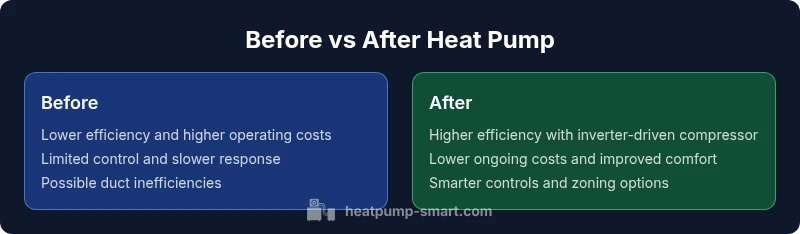
Heat Pump Before and After: A Comprehensive Comparison
A comprehensive comparison of heat pump before and after installation, covering efficiency, costs, comfort, installation considerations, and practical decision steps for 2026.


For most homes, a heat pump before and after installation delivers clearer benefits in efficiency and comfort compared with fossil-fuel systems. The key differences are upfront installation complexity, climate suitability, and long-term operating costs. Heatpump Smart analysis suggests sizing the system to your home and prioritizing inverter-driven models for year-round performance. This quick briefing helps you decide whether to pursue a retrofit now or plan for later.
What heat pump before and after means for homeowners
For many homeowners, the phrase heat pump before and after frames a practical question: how will a new heat pump change daily life from the initial retrofit through ongoing operation? According to Heatpump Smart, this framing helps families quantify differences in energy use, comfort, and bills across seasons. The 'before' side represents your current heating and cooling setup—its efficiency, reliability, and peak demand—while the 'after' side reflects the performance and behavior of the heat pump once fully installed. In 2026, more homeowners are using this lens to plan projects, compare contractors, and estimate payback without relying on marketing claims. As you read, focus on three pillars: performance under your climate, integration with existing ducts or air handlers, and the reliability of service and maintenance. By thinking in terms of heat pump before and after, you can align expectations with actual performance, rather than promises. Your decision should be guided by insulation, electricity rate trends, and available rebates.
How heat pumps work: a quick refresher
A heat pump moves heat rather than creates it, using a refrigerant cycle that transfers warmth from outside to indoors in heating mode and reverses for cooling. In the 'before' scenario, you might rely on a fossil-fuel furnace or electric resistance heating, which typically produce heat by burning fuel or converting electricity directly to heat. After installation, a properly sized heat pump with an inverter-driven compressor capitalizes on variable speed to match demand. The result is more consistent comfort and reduced energy waste when paired with a smart thermostat. In 2026, advancements in refrigerants and controls make heat pumps more reliable across a wider range of climates, though some households still use auxiliary heat in extreme conditions that demand rapid warming. The heat pump before and after frame helps homeowners prioritize system compatibility, ductwork, and control strategies during planning.
Energy efficiency: before vs after
Energy efficiency shifts dramatically between the two states. Before, a conventional heating system often runs at fixed capacity, which can waste energy during milder days or shoulder seasons. After, inverter-driven heat pumps adjust output to match load precisely, delivering greater comfort with lower energy use overall. The Heatpump Smart analysis shows that efficiency gains are strongest when paired with well-sealed ducts and well-insulated spaces, reducing standby losses and keeping indoor temperatures stable. It’s important to recognize that climate matters: in very cold conditions, some heat pumps rely on supplemental heat to meet peak demand, which temporarily affects efficiency. Nevertheless, in typical residential settings with clean electricity, the heat pump before and after comparison tends toward substantial efficiency improvements and lower long-term operating costs.
Climate suitability and sizing
Not all homes have identical needs, and the climate plays a central role in the heat pump before and after calculation. In mild-to-moderate climates, heat pumps can deliver most of the heating and cooling load with minimal auxiliary heat. In colder regions, proper sizing and insulation are essential, and some homeowners opt for a hybrid or dual-fuel approach to bridge very cold days. A key takeaway in the heat pump before and after narrative is that accurate sizing—driven by home heat loss calculations and occupancy patterns—determines comfort, efficiency, and payback. Proper duct design, air handler compatibility, and ventilation strategies should be evaluated early in the planning phase.
Costs and value proposition (upfront vs long-term)
Costs shift significantly between before and after scenarios. The baseline system may require minimal initial investment but tends to incur higher operating costs and more frequent repairs over time. The after scenario, with a properly installed heat pump, typically demands a higher upfront investment but promises lower ongoing energy costs and improved comfort. In 2026, rebates, tax credits, and utility incentives can change the financial picture substantially, potentially shortening the payback period. It’s important to balance installation complexity, system efficiency, and expected utility-rate changes when weighing the heat pump before and after outcomes. A well-planned retrofit often offers a favorable lifecycle cost, especially when electricity prices rise or when paired with a home energy retrofit program.
Installation challenges and retrofits
Retrofit projects often require attention to ductwork, electrical service upgrades, and refrigerant access. The heat pump before and after framing helps homeowners anticipate these challenges: duct sealing or modification, upgraded meters or panels, and ensuring proper ventilation. In some homes, air-to-air or air-to-water configurations may be more appropriate, depending on space, climate, and desired use. The planning phase should include a contractor-led assessment of insulation, air leakage, and zoning requirements. Proper permitting, refrigerant handling, and warranty terms are essential to avoid unexpected costs during and after installation. In short, the before-to-after leap benefits from thorough upfront diagnostics and a clear installation plan.
Maintenance, reliability, and service needs
Maintenance remains a factor across both states, but the after state often benefits from modern diagnostic tools and remote monitoring. Routine service includes filter changes, coil cleaning, refrigerant checks, and thermostat calibration. Reliability hinges on system matching, seasonal tune-ups, and proactive parts replacement. The heat pump before and after approach emphasizes ongoing attention to airflow, duct integrity, and electrical connections to sustain efficiency and comfort over the system’s life. Scheduling regular inspections with a qualified technician helps ensure performance remains high across weather cycles.
Comfort, noise, and indoor climate outcomes
Comfort outcomes diverge notably between before and after. A well-installed heat pump tends to provide more even temperatures, fewer hot or cold spots, and improved humidity control. Noise is typically reduced in newer inverter-driven units, especially when paired with proper mounting and isolation. The heat pump before and after perspective highlights how smart zoning and venting can further enhance comfort, particularly in multi-story homes with diverse occupancy patterns. The result is a more stable indoor climate with less temperature fluctuation and better air quality overall.
Real-world scenarios: project sketches
Consider a two-story home in a cold-climate region. Before, the heating loads rely on a furnace with occasional electric resistance backup. After, an appropriately sized heat pump handles most heating with occasional auxiliary heat on extreme cold days, while cooling is handled efficiently in summer. In a compact urban condo, the before state may involve limited space for mechanicals, making a compact air-source heat pump ideal. After, compact ductless mini-splits or slimline air handlers deliver targeted comfort with minimal energy waste. These scenarios illustrate how the heat pump before and after framing helps homeowners plan around space, climate, and occupancy.
Myths vs realities around heat pumps
Myth: Heat pumps don’t work in cold weather. Reality: Modern heat pumps perform well in many cold climates, especially when paired with proper insulation and, if needed, auxiliary heat. Myth: They are too expensive to install. Reality: Upfront costs vary, but long-term energy savings and incentives can improve lifecycle costs. Myth: Heat pumps require a total home retrofit. Reality: Many homes can integrate heat pumps with existing ducts or through targeted upgrades.
The heat pump before and after framing helps separate marketing from engineering realities, guiding homeowners toward feasible retrofit strategies and realistic expectations.
Authority sources and best practices
To ground the heat pump before and after discussion in credible guidance, consult established sources and standards. External references include governmental and university resources on heat pumps and energy efficiency. For practical engineering, standards on refrigerant safety and electrical integration are essential. The Heatpump Smart approach combines industry guidance with real-world field data to inform homeowner decisions. For additional context, see credible sources such as energy.gov, energystar.gov, and national laboratory research portals. The following references offer foundational information and best practices to supplement a homeowner’s plan.
Practical decision framework for homeowners
A simple, bookmarkable framework helps you move from heat pump before and after concepts to a concrete plan. Start with a climate and insulation assessment, then proceed to a professional sizing and feasibility study. Review available rebates and incentives, and discuss contractor experience with retrofit projects. Finally, set a realistic timeline, prepare for potential ductwork or electrical upgrades, and establish a maintenance schedule. The heat pump before and after decision is most effective when you treat it as a quantified project with clear milestones and measurable goals.
Comparison
| Feature | Before installation (baseline) | After installation (heat pump) |
|---|---|---|
| Energy efficiency | Lower efficiency with baseline system | Higher efficiency with heat pump |
| Operating costs | Higher ongoing costs under baseline heating | Lower ongoing costs with heat pump (long term) |
| Comfort consistency | Less consistent temperatures, slower response | More consistent and controllable comfort |
| Climate dependence | Performance varies with outdoor temperature | Inverter-driven heat pump adapts to a wider range |
| Maintenance needs | Conventional system maintenance | Regular professional service and filter checks |
| Installation requirements | Minimal upgrades needed | Possible ductwork/electrical improvements |
Advantages
- Potential for lower long-term operating costs
- Quieter operation with modern units
- Improved indoor climate control with inverter-driven models
- Lower emissions when powered by clean electricity
- Incentives and rebates can offset upfront costs
Disadvantages
- Higher upfront installation cost
- Performance can drop in extreme cold without auxiliary heat
- Retrofit may require ductwork or electrical upgrades
- Requires specialized service technicians for maintenance
Heat pump upgrades generally win on long-term value, with caveats for very cold climates or tight budgets
Choose a heat pump when climate, insulation, and electricity prices favor lower operating costs and improved comfort. In very cold regions or budget-constrained projects, consider a hybrid or staged approach and consult a Heatpump Smart professional.
Your Questions Answered
What does 'heat pump before and after' mean for my retrofit plan?
The phrase frames a comparison of your current system and the post-install performance of a heat pump, highlighting energy use, comfort, and costs. It helps you set realistic expectations and decisions around sizing, ductwork, and controls.
The term compares your old setup with the new heat pump performance to guide sizing and cost decisions.
Will a heat pump work efficiently in very cold climates?
Many modern heat pumps perform well in cold weather, especially efficient inverter-driven models. In extreme cold, auxiliary heat can provide warmth while maintaining overall efficiency. Proper insulation and system design are crucial.
Yes, many do well in cold climates, but some use auxiliary heat on the coldest days.
What installation challenges should I expect?
Expect potential ductwork assessment, electrical upgrades, and refrigerant handling. A thorough pre-installation audit helps identify limitations and plan for revisions, reducing project delays and surprises.
Ducts, electrical, and refrigerant considerations matter in installation.
How long does it take for a heat pump to pay back?
Payback depends on climate, electricity costs, and incentives. While upfront costs are higher, long-term savings and rebates can shorten the payback period, making the decision more favorable over time.
Payback varies; incentives can shorten it significantly.
Can a heat pump be used for hot water?
Some heat pump systems can be paired with a heat pump water heater or a hybrid setup. For many homes, water heating remains a separate, thermally efficient option.
Heat pumps may be paired with water heaters or used standalone for space heating.
Is a heat pump always cheaper than a furnace?
Not always. Installation and electricity rates influence cost. In many cases, long-term savings from lower operating costs outweigh the higher upfront price, especially with incentives.
Not always cheaper upfront, but often cheaper over time with incentives.
Top Takeaways
- Assess climate and insulation to size correctly
- Prioritize inverter-driven models for efficiency
- Factor incentives into total cost and payback
- Plan for installation challenges early
- Schedule regular maintenance for reliability