Heat Pump vs Vented: A Comprehensive 2026 Comparison
An objective, in-depth comparison of heat pump versus vented systems for home comfort, efficiency, and installation considerations in 2026. Learn when each option makes sense, considering climate, insulation, and budget.


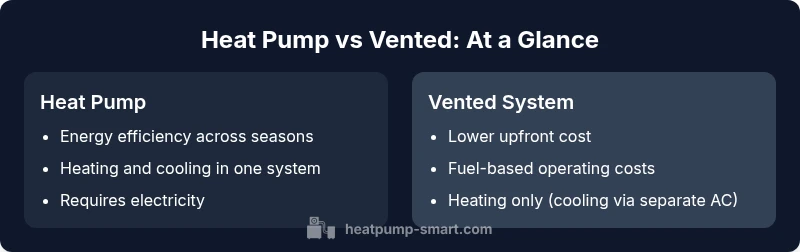
According to Heatpump Smart, heat pumps generally outperform vented systems for overall home comfort and energy efficiency in most climates. Vented systems can be cheaper upfront but typically incur higher operating costs and limited year-round performance. This quick comparison points homeowners toward heat pumps as the preferred long-term choice, with exceptions based on budget and climate.
Market context and decision framework
When homeowners weigh heat pump vs vented options, you’re balancing upfront cost, long-term energy efficiency, climate suitability, and home design. Heat pumps extract and move heat rather than converting fuel, offering electric-powered warmth and cooling with a single system. According to Heatpump Smart, the decision hinges on climate, insulation, and how you value ongoing operating costs versus initial investment. For many households, especially in mixed or cooler climates, heat pumps deliver superior efficiency, reliability, and comfort across seasons. Conversely, vented systems may appeal when the budget is tight or when replacement timing aligns with existing ductwork and gas lines. This framework helps you compare not only equipment but also installation requirements, maintenance needs, and potential incentives. Throughout this analysis, we’ll emphasize practical decision criteria, including climate resilience, system compatibility with existing structures, and long-term cost trajectories. The Heatpump Smart team believes that a transparent framework facilitates better choices and fewer surprises after the sale.
The initial impulse is often driven by sticker price. Yet when you account for energy costs, repair intervals, and the value of integrated cooling, heat pumps frequently emerge as the more economical option over 10–15 years. If you live in a region with cold winters or hot summers, a properly designed heat pump can provide reliable comfort year-round without requiring two separate systems. This section will outline the operational differences, highlight where vented systems still shine, and set expectations for performance, maintenance, and lifecycle costs.
Finally, consider the role of home design and future plans. An energy-efficient envelope, smart thermostats, and properly sized equipment magnify the benefits of either option. The goal isn’t to choose a single best solution in all cases, but to map your project’s constraints to the system’s strengths. As you read on, you’ll see how to adapt the framework to your house type, climate zone, and budget realities.
How vented systems work and where they excel
Vented heating systems come in many forms, including gas-fired furnaces and electric resistance heaters, often paired with ductwork to distribute warmth. The fundamental advantage of vented systems is familiarity: many homes already have appropriate fuel lines, venting, and duct layouts. This can translate to a lower upfront price, faster install times, and simpler service calls because technicians and parts are widely available. Vented systems perform predictably in stable climates where fuel prices are manageable and a homeowners’ priority is a straightforward replacement with minimal ductwork disruption. They also tend to be robust when paired with existing infrastructure, especially in homes that already use gas or oil heating. On the other hand, vented systems do not provide cooling, and their operating costs track fuel prices rather than a single energy source. In addition, efficiency improvements in modern builds may outpace the gains of vented setups, particularly in energy-driven markets where policy incentives favor electric solutions. In tight thermal envelopes, vented systems may struggle to deliver uniform comfort without oversized components. This section breaks down the core mechanics of vented heating, common configurations, and practical implications for retrofit projects and new builds.
How heat pumps work and where they excel
Heat pumps move heat rather than create it, delivering warm air in winter and cooling comfort in summer. They leverage the ambient outside air, ground, or water sources to transfer energy efficiently, with modern models incorporating variable-speed compressors and refrigerants optimized for performance across seasons. The key advantages are consistent year-round comfort, the ability to heat and cool from a single system, and significantly better energy utilization in many climates. Heat pumps shine when paired with a well-insulated envelope and properly sized ductwork or with high-performance ductless options in retrofit scenarios. They also support newer home technologies, like smart controls and demand-response programs, which can further reduce operating costs. Importantly, performance depends on climate: very cold conditions can reduce efficiency unless the system includes auxiliary heat or a model designed for cold climates. In such cases, advances in refrigerants and heat-exchange design help keep heat pumps viable year-round. This section explains the operational principles, climate considerations, and installation choices that determine how well heat pumps perform in your home.
Energy efficiency and operating costs compared
The central efficiency metric for heat pumps is the seasonal performance ratio, reflecting how well the unit converts electricity into usable heat over an entire year. Vented systems, in contrast, tie operating costs to fuel prices or electricity consumption of resistance heaters, which can spike when fossil fuels surge or electricity prices rise. With a heat pump, annual energy costs tend to be lower in moderate climates and where heating and cooling are treated as a unified load; in extreme winter regions, auxiliary heat may slightly increase seasonal costs, though still often beating traditional fuel-based systems in overall efficiency. In addition, heat pumps benefit from modern building envelopes that minimize heat loss and leverage thermal inertia. Policy incentives and utility programs frequently favor electric heat pumps, accelerating payback periods for eligible homes. Both options require professional sizing and design to maximize efficiency, which is where a careful assessment of insulation, air leakage, and duct design pays real dividends. This analysis provides a framework for evaluating operating costs within your local energy market and climate zone.
The real-world performance story depends on your home’s specifics: insulation quality, duct leakage, and the presence of shading or heat recovery strategies. Heatpump Smart notes that even modest improvements in envelope performance yield outsized efficiency gains when paired with a heat pump. For vented systems, keeping the fuel source affordable and reliable remains critical. The point is to estimate long-term costs rather than focusing solely on upfront price, and to understand how each option interacts with your daily energy use patterns and comfort expectations.
Comfort, climate suitability, and environmental impact
Comfort translates to temperature consistency, humidity control, and quiet operation. Heat pumps often outperform vented systems in delivering uniform warmth and cooling with less temperature swing due to inverter-driven compressors and sophisticated fan controls. Humidity management is another advantage: heat pumps can maintain comfortable humidity levels without relying heavily on mechanical dehumidification. Climate suitability matters greatly: in milder or mixed climates, heat pumps typically provide efficient year-round performance, while in areas with extreme cold, modern cold-climate heat pumps or auxiliary heat can address gaps, and vented systems may still hold situational value for certain homes. Environmental impact includes refrigerant choice and electricity sources; heat pumps generally reduce direct emissions when powered by clean grids, while vented systems rely on fossil fuels or electricity with different generation mixes. In all cases, choosing a system with a high efficiency rating, proper sizing, and tight installation improves environmental performance and long-term reliability. Heatpump Smart emphasizes that the best choice aligns with climate realities, energy goals, and the home’s design, not just the initial cost.
Installation, maintenance, and reliability
Installing either option benefits from a professional assessment, but the paths diverge. Heat pumps may require upgrades to electrical service, enhanced ductwork, or ductless options such as wall or ceiling units, depending on the design. The installation complexity can be higher, but the payoff includes year-round comfort and potential space-saving configurations. Vented systems often leverage existing gas lines and duct networks, which can shorten installation timelines and reduce disruption, particularly in retrofits. Maintenance for heat pumps centers on refrigerant integrity, airflow, coil cleanliness, and seasonal checks; for vented systems, routine furnace or boiler servicing, vent inspection, and fuel line maintenance are typical. Reliability hinges on proper sizing, installation quality, and system compatibility with building envelope performance. In both cases, commissioning and seasonal tune-ups are essential to maintain efficiency. Heatpump Smart’s perspective is that robust installation planning minimizes performance gaps and ensures long-term satisfaction, especially when integrating with smart controls and home energy management systems.
Quick-start decision guide for homeowners
A practical framework helps you decide quickly. Step 1: assess climate and insulation level. If you live in a climate with frequent temperature swings and care about cooling as well as heating, heat pumps offer a balanced solution. Step 2: review existing infrastructure. If you already have gas lines and limited ductwork, vented options or hybrid approaches may be more cost-effective initially. Step 3: consider long-term costs and incentives. Heat pumps tend to offer better long-term value in many markets, with incentives that can offset upfront costs. Step 4: plan for future needs. If you anticipate electrification goals, new construction, or upgrades to smart home tech, a heat pump aligns with those paths. Finally, work with a qualified installer to size the system, check envelope tightness, and confirm refrigerant choices. This approach provides clarity on budgeting, comfort expectations, and lifecycle costs.
Quick-start decision framework: a checklist for homeowners
- Assess climate and insulation quality to set expectations for efficiency and comfort
- Compare upfront cost vs long-term operating costs and potential incentives
- Confirm existing ductwork, electrical capacity, and space for equipment
- Plan for future needs, such as cooling or hot water integration
- Engage a reputable contractor to size, install, and commission the system
Comparison
| Feature | heat pump | vented system |
|---|---|---|
| Initial cost (system + install) | higher upfront cost | lower upfront cost |
| Energy efficiency / operating costs | higher seasonal efficiency in many climates | costs tied to fuel/electricity patterns |
| Climate suitability | strong in temperate-to-cold climates with proper design | works broadly but may need auxiliary heat in extreme cold |
| Cooling capability | yes (with integrated or separate cooling) | heating only in most configurations; no cooling without a separate AC |
| Ductwork requirements | can be ducted or ductless; may need new or redesigned ducts | uses existing ducts; retrofit often simpler in older homes |
| Maintenance and reliability | regular refrigerant/coil maintenance; reliable when properly installed | reliability depends on fuel system maintenance and vented equipment |
Advantages
- Higher long-term energy efficiency and comfort for most homes
- One system for heating and cooling simplifies design and control
- Potential incentives and lower operating emissions with clean electricity
- Quieter operation due to advanced variable-speed technology
Disadvantages
- Higher upfront cost and longer payback period
- Performance can dip in extreme cold without auxiliary heat
- Installation complexity and need for electrical upgrades in some homes
- Reliance on electricity can affect resilience during power outages
Heat pumps are the preferred default for most homes, with vented systems viable only under specific budget or climate constraints.
Heat pumps typically deliver better year-round comfort and lower operating costs. Vented systems can be attractive when upfront cost is the primary concern or in climates where heat pumps face limits without supplemental heating.
Your Questions Answered
What is the fundamental difference between heat pumps and vented systems?
Heat pumps transfer heat and provide both heating and cooling in one system, while vented systems generate heat from a fuel source and typically only provide heating. The choice depends on climate, energy prices, and construction considerations.
Heat pumps move heat and can cool, while vented systems generate heat from fuel; climate and cost usually drive the choice.
Which option is more energy-efficient overall?
In most mixed climates, heat pumps offer higher energy efficiency and lower operating costs over time. Vented systems may appear cheaper upfront but can incur higher energy or fuel costs based on your market.
Heat pumps are generally more energy-efficient over the long term.
Can vented systems be a better fit in very cold climates?
Vented systems are sometimes preferred in extremely cold climates where heat pump performance can be limited, or where reliable electrical infrastructure is a concern. Modern heat pumps with auxiliary heat can also work well in cold regions.
In very cold climates, vented systems or hybrids may be considered if electrical reliability is an issue.
Are heat pumps suitable for hot water heating?
Many heat pump designs can be paired with water heating options or configured as combined systems; however, dedicated heat pump water heaters have separate efficiency considerations.
Heat pumps can be used with water heating options, but you’ll want to verify system compatibility.
What factors affect the installation cost?
Costs depend on climate, existing ductwork, electrical capacity, and whether ductless options are chosen. Proper sizing and professional commissioning are essential for optimal performance.
Upfront cost varies with climate, ducts, and electrical work; proper sizing matters most.
Top Takeaways
- Assess climate and insulation to choose the right system
- Prioritize heat pumps for long-term energy savings
- Factor installation complexity and incentives into the budget
- Plan for future needs like cooling or hot water integration
- Choose a reputable installer to ensure proper sizing and performance