Heat Pump or a/c: A Comprehensive Comparison
Analytical, evidence-based comparison of heat pumps and traditional air conditioning to guide homeowners, builders, and property managers on climate suitability, efficiency, costs, and long-term value.


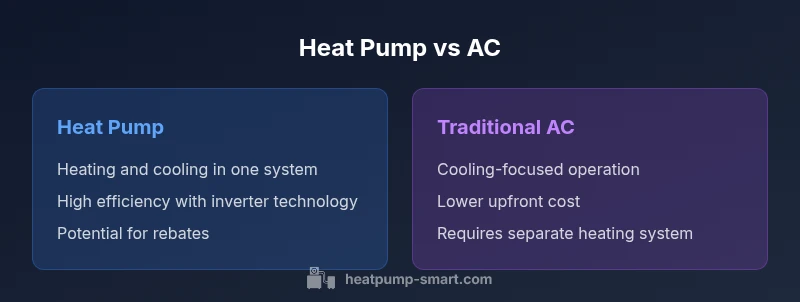
For most homes, a heat pump offers both heating and cooling, making it a versatile alternative to a traditional air conditioner. When weighing a heat pump or a/c, consider climate, efficiency, upfront costs, and long-term energy savings. A heat pump excels in mild to moderate climates and with modern inverter technology, but may require backup heat in very cold conditions.
Context and Definitions
According to Heatpump Smart, the distinction between a heat pump and a classic air conditioner becomes clear when you consider heating capability, climate, and total ownership costs. When homeowners ask about a heat pump or a c, they are really choosing between a system that can both heat and cool and one that primarily cools (and requires a separate heater). The terminology can be confusing, but the practical implications are straightforward: the heat pump uses a reversible refrigeration cycle to move heat in or out of the home, while a conventional a/c focuses on cooling only. This difference affects sizing, installation, and long-term operating costs. For property managers overseeing multiple units, the decision also hinges on maintenance complexity and compatibility with existing heating infrastructure. The Heatpump Smart approach emphasizes analyzing the entire system—insulation, HVAC layout, and local climate—to estimate annual energy use rather than relying on peak efficiency ratings alone. This holistic view helps ensure comfort and value across seasons.
How a Heat Pump Works vs Conventional AC
A heat pump relies on a refrigerant loop, an outdoor condenser, and an indoor air handler to move heat. In heating mode, it extracts warmth from outdoor air (even when it’s cold) and delivers it indoors. In cooling mode, the cycle reverses, removing heat from inside the home. An air conditioner, by contrast, focuses on removing heat to a outdoors with no built-in mechanism to provide heat. If you want year-round comfort in a single package, a heat pump offers the advantage of both heating and cooling, often with a single energy source. When paired with a compatible thermostat and smart controls, heat pumps can adapt to occupancy patterns and weather variations, optimizing comfort and energy use. It’s important to note that some cold climates still call for auxiliary heat sources, such as electric resistance or a furnace, to sustain comfortable indoor temperatures on the coldest days. Heatpump Smart’s guidance emphasizes planning for such contingencies in place before installation.
Climate Considerations and Efficiency
Climate determines performance for both systems, but the impact is more pronounced for heat pumps in colder regions. In temperate climates, heat pumps typically deliver strong efficiency because the unit can be run at lower speeds thanks to inverter-driven compressors. In areas with sustained subfreezing temperatures, the heating efficiency may drop unless the system includes auxiliary heat or a supplemental furnace. For the ‘heat pump or a c’ decision, homeowners should compare Seasonal Energy Efficiency Ratios (SEER) and Heating Seasonal Performance Factor (HSPF) where available, while recognizing that inverter-based heat pumps often maintain better performance at partial loads. The Heatpump Smart team notes that proper insulation, sealed air leaks, and appropriately sized ducts can dramatically boost real-world efficiency and reduce energy costs over time. This is critical in multi-family buildings or retrofits where small gains compound across many units.
Sizing, Installation, and Ductwork
Sizing a heat pump or an air conditioner requires careful load calculations that account for climate, building envelope, and occupancy. An oversized unit will short-cycle, wasting energy and reducing comfort, while an undersized system won’t meet cooling or heating needs. With heat pumps, the installation often involves refrigerant line sets, an outdoor condenser, an indoor air handler, and possibly a heat source for backup heat. For new builds, smart zoning and properly designed ducts can maximize efficiency, reduce noise, and improve temperature consistency. Retrofitting existing ducts may be feasible, but it’s essential to assess duct leakage, insulation, and return air paths. The Heatpump Smart guidance emphasizes hiring qualified technicians who use industry-standard manual J load calculations and refrigerant handling procedures to ensure safety and performance.
Upfront Costs and Financing
Upfront costs for heat pumps are typically higher than for a conventional cooling-only system, due to the added heating capability and hardware. However, many homeowners see a lower total cost of ownership over the system’s lifetime because heating often accounts for a large portion of energy bills in winter. Financing options, rebates, and incentives can offset initial expenditure, especially in regions with aggressive energy-efficiency programs. When evaluating a heat pump or a c, compare installed price ranges and consider long-term value, including potential tax credits and utility rebates. The Heatpump Smart team recommends calculating payback based on both heating and cooling energy savings, rather than isolating cooling costs. A well-planned project may show faster payback in milder climates with good insulation and low air leakage.
Operating Costs, Energy Savings, and Longevity
Energy savings with heat pumps are highly dependent on climate, usage patterns, and the efficiency class of the unit. In moderate climates, heat pumps can deliver noticeable reductions in both heating and cooling energy use, especially when paired with a high-efficiency outdoor unit and an advanced thermostat. In hotter regions, cooling efficiency remains strong, while heating performance hinges on auxiliary heat strategies and climate. Traditional air conditioners may have lower upfront costs but lack a built-in heating function, potentially increasing long-term energy costs if a separate heating system is used. Longevity depends on maintenance, refrigerant integrity, and outdoor unit exposure. Regular cleaning, filter changes, and periodic professional checkups help maintain performance and extend equipment life. Heatpump Smart’s analysis emphasizes evaluating total energy use across seasons and ensuring components are appropriately sized for the home.
Maintenance and Reliability
Maintenance requirements for heat pumps and air conditioners share many similarities—filter changes, coil cleaning, and electrical connections call for periodic professional inspection. Heat pumps have additional considerations, such as refrigerant checks and the potential for auxiliary heating elements to be engaged during cold snaps. Reliability hinges on outdoor temperature exposure, proper drainage, and thermostat performance. In multi-zone systems, balancing airflow becomes more complex, requiring careful calibration. The Heatpump Smart guidance suggests scheduling annual or biannual service with a licensed technician who can verify refrigerant charge, compressor operation, and electrical safety. By staying current with manufacturer recommendations and local climate considerations, you can minimize downtime and optimize comfort across seasons.
Practical Scenarios: When to Choose Each System
There isn’t a one-size-fits-all answer to “heat pump or a c?” Instead, consider the following scenarios. For homes in moderate climates with year-round heating and cooling needs, a heat pump can deliver comfort and efficiency in a single package. If you live in a region with very cold winters, evaluate the availability of backup heat (furnace or electric coils) and the cost of running auxiliary heating. For new builds or major renovations, the simplicity of a single system that handles both tasks is appealing, especially when paired with zoning and smart controls. In rental or multi-family properties, a heat pump with well-designed ductwork or independent hydronic heating options can reduce maintenance complexity and improve tenant comfort. The Heatpump Smart team recommends analyzing occupancy patterns, climate data, and maintenance plans to decide which approach yields the best long-term value.
Rebates, Incentives, and Financing Options
Rebates and incentives for heat pump installations vary by region and program year, but they are frequently available for efficient heating and cooling equipment. When evaluating a heat pump or a c, don’t overlook utility-based rebates, government incentives, and manufacturer promotions. Some regions offer higher incentives for heat pumps with higher seasonal efficiency ratings or for ground-source variants. Financing options, such as low-interest loans or utility-embedded financing, can help spread the cost of a larger initial investment. The Heatpump Smart team advises collecting multiple quotes, verifying eligibility for each program, and ensuring that the installer provides proper permits and documentation. Tracking these incentives can shorten payback periods and improve project economics.
Smart Controls and Future-Proofing
Smart thermostats and system monitoring enable more precise climate control, zoned heating and cooling, and energy-use transparency. A heat pump paired with a thermostat that supports adaptive recovery, weather-based control, and occupancy sensing can dramatically reduce wasted energy. For an a/c-only setup, smart controls can still yield meaningful savings if the heating system is excluded, but the combined advantage shines with heat pumps. Look for compatibility with your existing home automation platform and for features like remote access, energy dashboards, and maintenance alerts. The Heatpump Smart guidance emphasizes choosing a controller that offers easy integration with solar, battery storage, and other energy-management tools to future-proof the investment.
Common Pitfalls and How to Avoid Them
Even well-planned projects can run into mistakes that erode value. Common pitfalls include underestimating the importance of proper insulation and air sealing, selecting a unit without considering climate-specific needs, and neglecting regular maintenance. Another frequent issue is mismatched ductwork or poor zoning, which can lead to uneven temperatures and higher energy consumption. Finally, assuming that bigger is always better can backfire; oversized units short-cycle and waste energy, reducing comfort and increasing wear. The Heatpump Smart approach encourages a holistic assessment that considers envelope performance, climate zone, and usage patterns to avoid these missteps.
Comparison
| Feature | Heat pump | Traditional air conditioner (central AC) |
|---|---|---|
| Heating capability | Provides heating via reversible cycle | Cooling only (requires separate heating) |
| Seasonal efficiency potential | High with inverter-based models | Typically optimized for cooling; heating depends on separate system |
| Installation complexity | Requires outdoor unit, indoor air handler, refrigerant lines | Typically simpler if part of existing heating/AC setup |
| Upfront cost | Higher upfront investment | Lower upfront cost for cooling-only setups |
| Maintenance considerations | Refrigerant checks and auxiliary heat considerations | Standard cooling maintenance; no heating function |
| Best climate | Moderate to warm climates; versatile year-round use | Hot/humid climates primarily for cooling; heating depends on separate system |
Advantages
- Year-round comfort in one system
- Higher energy efficiency with inverter technology
- Potential rebates and tax incentives
- Quiet operation with modern designs
- Advanced controllability and zoning options
Disadvantages
- Higher upfront cost
- Performance can decline in extreme cold without backup heat
- Longer installation time and potential ductwork changes
- Requires skilled technicians for refrigerant handling
Heat pump wins for most homes seeking year-round comfort and energy savings.
In temperate climates, a heat pump delivers heating and cooling with strong efficiency and flexible control. For very cold climates, verify backup heating options and insulation. The Heatpump Smart team recommends tailoring the choice to climate, house envelope, and long-term energy goals.
Your Questions Answered
What is the main difference between a heat pump and a traditional AC?
The heat pump provides both heating and cooling by reversing the refrigerant cycle, while a traditional air conditioner focuses on cooling and relies on a separate heating source. This dual capability affects installation, efficiency, and long-term cost of ownership.
A heat pump can heat and cool in one system, while a traditional AC only cools and uses another heater for warmth.
Are heat pumps effective in very cold weather?
Heat pumps perform well in moderate cold with modern variable-speed technology, but efficiency can drop in extreme cold unless backed up by an auxiliary heater. In such climates, assess backup heating needs and insulation.
They work well in cool weather, but very cold days may require extra heating.
Can a heat pump replace my furnace or boiler?
Yes, in many homes a heat pump can replace a furnace or boiler, especially with a high-efficiency model and proper insulation. In colder regions, a supplemental heat source is often recommended.
It can replace a furnace in many cases, though cold climates may need extra heat during extreme cold.
What rebates or incentives are available for heat pumps?
Rebates and incentives vary by location and program year. Check utility programs, government tax credits, and manufacturer promotions. Your installer can help assemble eligible documentation.
Look for utility rebates and government incentives to reduce upfront costs.
What maintenance is required for heat pumps?
Regular filter changes, coil cleaning, and annual professional inspections of refrigerant levels and electrical components are recommended. Maintenance helps sustain efficiency and extend equipment life.
Keep filters clean and schedule regular professional checkups.
How do I size a heat pump for my home?
Sizing uses a professional load calculation, considering insulation, windows, and climate. An oversized or undersized unit hurts efficiency and comfort. Always rely on a qualified contractor for a Manual J analysis.
A pro will calculate your load to pick the right size.
Top Takeaways
- Assess climate before choosing system
- Prioritize inverter-driven heat pumps for efficiency
- Factor total cost of ownership over upfront price
- Plan for expert sizing and proper ductwork
- Explore rebates and smart controls for best value
- Match system features to occupancy patterns