Heat Pump or Space Heater: A Practical Comparison
Comprehensive comparison of heat pumps and space heaters to help homeowners decide based on climate, space, costs, and safety. Learn where each shines, typical use cases, and a practical decision framework.


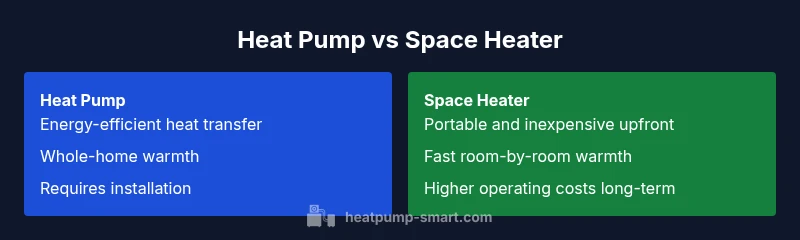
Compared head-to-head, a heat pump generally offers better overall efficiency and year-round comfort, while a space heater provides fast, targeted warmth at a lower upfront cost. For many homes, the heat pump is the better long-term solution, with space heaters serving as portable back-up heat or spot heating where needed.
What heat pump vs space heater mean for your home
The phrase heat pump or space heater describes two very different approaches to warming a space. A heat pump is a single, integrated system designed to move heat between outside and inside your home, delivering steady, even warmth over the entire living area. A space heater is a portable device that generates heat locally, often with plug-in convenience. For homeowners evaluating options, the core questions are: Do you need whole-home heating or focused warmth in a single room? What climate do you live in, and how much upfront investment can you tolerate? According to Heatpump Smart, the choice often hinges on climate, home size, and long-term energy goals. This guide aims to help you weigh those factors without oversimplifying the decision. You’ll find a clear framework, practical scenarios, and a path to a decision that respects both comfort and budget.
wordCount":160},
bodyBlocks[1]
How heat pumps work (and why they can outpace space heaters)
A heat pump operates on a refrigerant cycle that physically transfers heat from one place to another. In heating mode, outdoor air is absorbed by a condenser, compressed to increase temperature, and released into your home via an indoor coil. The key idea is energy transfer rather than generation: you move heat from outside to inside, which can produce more warmth than the electricity consumed. This heat transfer method yields a higher effective efficiency than simple electric resistance heating. Heat pumps excel when the outside air still contains usable heat and the home is well-insulated. They also offer cooling in warmer months when reversed to air conditioning. Unlike space heaters, a heat pump typically services multiple rooms through a central or zoned system and requires professional installation and a dedicated electrical circuit. The result is a stable, uniform comfort level across living spaces rather than hot spots near a single device.
wordCount":159}
How space heaters work and where they shine
Space heaters convert electrical energy directly into heat with heating elements. They’re portable, plug into standard outlets, and can heat a small room quickly. That portability makes them ideal for short-term or supplemental warmth, spot-heating a home office, a chilly bathroom, or a drafty corner. Space heaters come in various forms—from compact ceramic units to radiant panels and infrared heaters—each with its own heat distribution pattern. Because they operate independently of your home’s heating system, they’re flexible for interim needs or when you’re renting and can’t install a larger system. However, they don’t provide uniform warmth across a space and are best used to target specific zones rather than to heat an entire house.
wordCount":124}
Energy efficiency and ongoing costs
Energy efficiency is the central differentiator between heat pumps and space heaters. A heat pump uses electricity to move heat rather than to generate it, which typically results in a higher effective efficiency (often described by a coefficient of performance, COP). This means lower operating costs per unit of heat over time, especially in moderate climates and well-insulated homes. Space heaters convert electricity into heat with near-100% efficiency at the point of use, but the cost of electricity makes long-term operation expensive if used as the primary heat source. For households where the electricity price is stable and the home is sized for a heat pump, the long-term savings can be meaningful. Heatpump Smart Analysis, 2026 highlights how usage patterns and climate influence overall cost effectiveness. When used strategically—as a primary home heating system or as a supplemental heat strategy—the economics of each option shift.
wordCount":164}
Climate considerations and performance realities
Climate plays a pivotal role in choosing between a heat pump and a space heater. Heat pumps are highly effective in temperate to mild winters and cool summers, offering year-round climate control and even heat distribution. In colder climates, heat pumps may rely on auxiliary or backup heat to maintain comfort during the coldest spells. Some models are designed for cold climates and can operate efficiently down to low temperatures, but this often comes with higher upfront costs or greater reliance on backup heat. Space heaters, by contrast, perform consistently in any climate but are best suited for single rooms or small spaces. In very large homes or spaces with poor insulation, relying solely on a space heater for heating can be impractical and costly. For most homeowners, the climate dictates not just which device to use, but how to structure a hybrid approach that blends efficiency with practical warmth.
wordCount":164}
Safety, maintenance, and installation considerations
Safety is a core factor in any heating decision. Heat pumps require proper installation and regular maintenance by a licensed professional, with attention to refrigerant health, airflow, and system charging. Routine service can extend life and preserve efficiency. Space heaters, while inexpensive upfront, carry more immediate fire and burn risks if used improperly. Always follow the manufacturer’s clearance recommendations, unplug when unattended, and avoid placing heaters near curtains or bedding. With heat pumps, you’ll typically enjoy a quieter operation and fewer hotspots; with space heaters, you gain portability and fast warmth but at the potential expense of consistency and safety if not managed carefully. In both cases, optimizing insulation and sealing reduces the heating burden on any chosen device, improving overall comfort and efficiency.
wordCount":160}
Practical sizing and room-level strategies
Sizing a heating solution involves understanding the space, occupancy, and usage patterns. For heat pumps, proper sizing is essential to achieve even warmth across living areas and to avoid short cycling. A well-sized system moves enough heat to meet demand without overworking the compressor. For space heaters, the approach is more room-centric: assess the square footage to pick a unit with adequate watts or BTU output for the space, and use a heater in rooms where you spend the most time if a full-house system isn’t feasible. Consider zoning, draft elimination, and furniture placement to maximize efficiency. In all cases, a simple rule of thumb is to match device capacity to the room’s size and intended use, then observe comfort and energy use over a full seasonal cycle to refine the choice.
wordCount":150}
Case scenarios: small apartment vs large home
Scenario A: A small apartment in a temperate city may benefit from a compact heat pump or a panel heater for spot warmth, combined with good insulation. The compact unit can manage space heating with relatively low energy input, and the expense is spread over the year. Scenario B: A larger, multi-room home in a cool climate may justify a mid-sized heat pump with zoning to balance comfort and efficiency. Here, space heaters could provide supplemental heat in rooms that see extra usage (home office, den) during peak cold snaps. Scenario C: A rental or retrofit project might start with a flexible space heater strategy while planning a longer-term upgrade to a heat pump system, balancing immediate warmth with future energy goals.
wordCount":142}
Hybrid approaches and backup heat strategies
A practical strategy for many homes is a hybrid approach: install a heat pump as the primary heating system and use portable space heaters as needed for temporary demand or in spaces that are used intermittently. This can optimize both comfort and affordability while reducing the risk of over- or under-heating large areas. Some households use space heaters in rooms that aren’t connected to the main HVAC zone or in homes where a full heat pump retrofit isn’t feasible right away. With careful placement and safety measures, you can achieve reliable warmth without sacrificing energy efficiency or safety.
wordCount":120}
Financial considerations: upfront costs, rebates, ROI
Upfront costs for heat pumps include the equipment and installation, which can be a consideration for many households. Space heaters generally carry lower initial costs and no professional installation. While heat pumps represent a larger initial investment, their long-term operating costs can be lower, particularly in climates with moderate winters and high electricity prices. Many regions offer rebates, tax credits, or utility incentives that can improve the return on investment for a heat pump. Space heaters, while inexpensive to buy, do not typically offer rebates and may incur higher electricity bills if used as a primary heating source over time. A careful ROI analysis should weigh installation costs, energy prices, climate, and how you actually use heat in your home.
wordCount":168}
Environmental impact and sustainability considerations
Environmental impact depends on the energy source and the efficiency of the heating system. Heat pumps, when powered by low-carbon electricity, can significantly reduce greenhouse gas emissions compared to electric resistance heating or fossil-fuel-based heating. The overall carbon footprint hinges on the electric grid mix in your region and the efficiency of the chosen heat pump model. Space heaters, while useful for immediate warmth, may contribute more emissions per unit of heat if electricity is produced from carbon-intensive sources or if they are used extensively. In practice, a transition to heat pumps in combination with a cleaner electrical grid often yields the best sustainability outcomes, especially as grids decarbonize over time.
wordCount":154}
Step-by-step decision framework
- Define the heating needs: daily warmth in a full home vs. targeted spot heating.
- Assess climate and insulation: determine if an all-house solution is feasible and efficient.
- Consider budget and incentives: evaluate upfront costs vs. long-term savings and available rebates.
- Plan installation: decide on a heat pump system with professional installation, or a portable strategy using space heaters.
- Test and monitor: track comfort, energy use, and safety, then adjust usage patterns as needed.
wordCount":83}
Authority sources and further reading
- Energy.gov (official guidance on heat pumps and efficient home heating)
- energystar.gov (certified efficiency standards and tips)
- NIST.gov (safety and standards related to home heating devices)
wordCount":46}
Notable myths and quick tips
- Myth: Heat pumps won’t work in cold climates. Tip: Cold-climate models exist and work with supplemental heat as needed.
- Myth: Space heaters are always inexpensive. Tip: Long-term operation costs can exceed a heat pump in many homes.
- Quick tip: Improve insulation and reduce drafts to maximize whichever system you choose.
wordCount":94}
Comparison
| Feature | heat pump | space heater |
|---|---|---|
| Energy efficiency | high (COP-based heat transfer) | low-to-moderate (electric resistance) |
| Operating cost | lower over time in moderate climates | higher if used long-term in larger spaces |
| Upfront cost | moderate to high (equipment + install) | low (unit purchase, no install) |
| Maintenance | low (fewer moving parts; service as needed) | low maintenance but higher fire risk if misused |
| Best for | whole-home comfort with climate control | spot heating and portable warmth |
| Climate suitability | excellent in mild to moderate winters | works anywhere but best in small spaces |
| Heat distribution | even, zoned distribution via HVAC | point heat focused on one area |
| Noise | low to moderate (indoor unit) | variable (depends on unit) |
Advantages
- Heat pumps offer higher long-term energy efficiency and uniform comfort across spaces
- Heat pumps reduce carbon footprint when powered by clean electricity
- Space heaters provide immediate warmth with very low upfront costs
- Space heaters are portable and ideal for temporary needs or rentals
Disadvantages
- Heat pumps require professional installation and higher upfront investment
- Heat pumps can rely on backup heat in very cold climates
- Space heaters carry higher operating costs if used as primary heat for extended periods
- Space heaters pose fire and burn risks if not used correctly
Heat pumps are generally the better all-around choice for whole-home heating; space heaters excel as portable backup or spot heating.
Choose a heat pump when you want consistent, efficient warmth across your home and long-term energy savings. Use space heaters for targeted warmth, temporary needs, or to bridge gaps while planning a larger heating upgrade.
Your Questions Answered
What is the main difference between a heat pump and a space heater?
A heat pump moves heat from outside to inside using a refrigerant cycle, providing whole-home heating with high efficiency. A space heater generates heat from electrical resistance and is typically used for single rooms.
Heat pumps move heat from outdoors to indoors; space heaters convert electricity into heat for a single room.
Can a space heater replace a heat pump entirely?
In most homes, a space heater cannot replace a heat pump for full-home heating, especially in cold seasons or larger spaces. Space heaters are best as supplemental warmth.
Not usually; space heaters are for supplemental warmth in specific rooms.
What climates are best for heat pumps?
Heat pumps perform best in moderate climates and with proper insulation. In very cold climates, many homes use auxiliary heat or a backup system.
Best in moderate climates; very cold winters may require backup heat.
Are space heaters safe?
Space heaters can be safe with proper usage and built-in safety features, but they pose fire risks if left unattended or placed near flammable materials.
Yes, with precautions; always follow instructions and keep clearances.
What about installation and maintenance costs?
Heat pumps require professional installation and can have higher upfront costs, while space heaters have low upfront costs but higher ongoing electricity use if used long-term.
Heat pumps cost more upfront; space heaters cheaper initially.
How do I compare ROI between the two?
ROI depends on climate, energy prices, and usage. Heat pumps generally offer better long-term ROI for whole-home heating, while space heaters provide flexibility and lower initial spend for short-term needs.
Long-term efficiency favors heat pumps; space heaters offer flexibility.
Top Takeaways
- Assess climate and home size to decide between full-system heat pumps and portable space heaters
- Choose heat pumps for long-term energy savings and stable comfort
- Reserve space heaters for spot warming, backups, or temporary needs
- Consider insulation upgrades to maximize efficiency of either option
- Check for rebates or incentives to improve ROI