Heat Pump vs Baseboard: An Analytical Comparison
An analytical guide from Heatpump Smart comparing heat pumps and baseboard heating for efficiency, cost, climate suitability, and installation considerations to help homeowners choose the right system.


Heat pump vs baseboard: In most homes, a properly sized heat pump delivers higher year-round comfort and lower running costs than baseboard heaters, especially in moderate climates. Baseboards offer simple, reliable warmth with lower upfront costs but higher long-term operating costs and limited heating when outdoor temps plummet. Climate, insulation, and usage patterns determine the best fit.
What heat pump vs baseboard means for your home
When weighing heat pump vs baseboard heating, the decision hinges on how you value energy efficiency, comfort, and long-term costs. Heat pumps move heat using a refrigerant cycle, offering year-round warmth and the potential for cooling in summer. Baseboard heaters convert electricity directly to heat, delivering simple, reliable warmth with fewer moving parts. According to Heatpump Smart, the best choice often hinges on climate, insulation, and long-term goals for comfort and energy bills. In many homes, a properly sized heat pump can deliver reliable warmth during shoulder seasons and winter, while baseboard heating remains a simple, robust option for small zones or retrofit projects. This section sets the stage with practical distinctions, so you can evaluate the two side by side without relying on marketing claims. We’ll cover how each system operates, what to expect in daily use, and how your house features influence performance. Expect to see how much comfort you gain per dollar and where each system shines in real-world scenarios.
How heat pumps and baseboard heaters work
Heat pumps extract heat from outside air or the ground and transfer it indoors via a refrigerant cycle; some designs can also reverse to provide cooling in warm months. An indoor coil, outdoor unit, and a heat exchanger form the core of the system. Baseboard heaters operate on the principle of electric resistance or hot-water circulation in baseboard ducts or walls. Electric resistance baseboards convert electricity directly into heat with minimal moving parts, while hydronic baseboards circulate hot water from a boiler. The relative complexity of the system influences installation time, space requirements, and potential for future expansion. The Heatpump Smart team notes that electronics and ductwork play a critical role in overall performance. In practice, the differences in control strategies—thermostats, zoning, and smart controls—greatly affect perceived comfort. This section clarifies the technical basics so you can translate hardware terms into everyday experience.
Energy efficiency and running costs
Energy efficiency is central to the heat pump vs baseboard decision, but it hinges on climate, insulation, and how you use heat. Heat pumps deliver high efficiency by moving existing heat rather than generating it, often yielding a higher effective heating output per unit of electricity in moderate climates. In well-insulated homes, their efficiency remains strong year-round, and many models can cool spaces in the summer as well, broadening value. Electric resistance baseboard heaters run at nearly 100% efficiency at the point of use, but that efficiency translates into higher operating costs when electricity prices are high or when the heating load is sustained for long periods. The Heatpump Smart analysis shows that energy costs are highly context-dependent: you can see meaningful savings in temperate regions with good air sealing and insulation, while very cold climates may require supplemental heat. This is why cost comparisons must consider total energy use, climate, and thermostat behavior, not just headline efficiency ratings.
Climate suitability and comfort
Climate considerations are decisive in heat pump vs baseboard negotiations. Heat pumps excel in milder and moderately cold climates where the outdoor temperature seldom dips below the unit’s efficient range, especially if paired with a well-insulated envelope and a smart control strategy. They also offer the potential for air conditioning in summer, which improves overall comfort and single-system efficiency. In very cold climates, performance can decline, and many homes add a supplemental heat source or switch to a backup system during peak demand. Baseboard heaters are robust in extreme cold and require less upfront planning; they are often easier to retrofit into older homes that lack ductwork, and they provide reliable dry heat that can feel instant when the thermostat calls for warmth. The trade-off is slower adjustment to rapid temperature swings and higher operating costs if electricity prices rise. The Heatpump Smart team emphasizes evaluating how your house loses heat, which affects whether a heat pump or baseboard solution will maintain comfort with minimum energy use.
Installation, maintenance, and lifecycle costs
Installing a heat pump typically involves outdoor equipment, indoor air handlers, refrigerant lines, and often ductwork or a micro-distribution approach. This means higher upfront costs and longer project timelines, but the payoff can be lower operating costs and extended comfort. Baseboard heating installation is usually simpler and quicker: you place electric baseboards along walls or install hydronic bases fed by a boiler. Maintenance for heat pumps includes annual professional checkups, coil cleaning, and filter changes; some components require specialized service. Baseboard maintenance is relatively light, mainly dusting to maintain airflow and periodic checks of thermostat operation. The HVAC system’s lifecycle depends on usage and climate; heat pumps typically last 10-15+ years with proper care, while baseboard components may have longer mechanical life but face thermal cycling and wiring issues. Budgeters should plan for potential retrofits, such as adding smart thermostats, zoning, or backup heat, which can affect total cost of ownership.
Real-world scenarios: when to pick heat pump vs baseboard
- A modestly insulated two-story home in a mixed climate: heat pump likely offers stronger yearly energy savings and comfort, possibly with a small supplemental heat source. 2) An older single-family home with radiators or no ductwork in a cold climate: baseboard or hydronic systems may be easier to install and more cost-effective initially. 3) A new build in a temperate climate with ambitions for cooling: a heat pump with year-round climate control provides both heating and cooling efficiency. 4) A rental property with predictable usage: baseboard may provide predictable upfront costs and simpler maintenance. 5) A homeowner aiming for rapid, zone-specific heat: baseboard zoning can be a straightforward approach, whereas heat pumps require more planning to achieve even zoning. The Heatpump Smart team again stresses the importance of professional load calculations to avoid over- or under-sizing.
Common myths and misconceptions
- Myth: Heat pumps don’t work in cold climates. In truth, many modern air-source heat pumps perform well in cool weather, especially with insulation and thermostat controls; extreme cold may warrant supplemental heat.
- Myth: Heat pumps are noisy. Most modern systems are designed for quiet operation, particularly the indoor units, with outdoor fans minimized by placement and insulation.
- Myth: Electric baseboards are cheaper to install than heat pumps. While upfront baseboard costs can be lower, long-term energy use and maintenance can offset initial savings.
- Myth: You must replace ductwork to switch to a heat pump. Ductless or mini-split heat pumps offer alternatives when ductwork is impractical.
- Myth: A bigger system always saves more. Oversizing reduces efficiency and comfort; precise load calculations are essential. The Heatpump Smart team emphasizes balancing capacity with actual heating needs and thermostat strategy.
Decision checklist: a practical approach
- Gather climate data and assess your insulation level; better envelopes improve heat pump performance.
- Run a formal load calculation (HVAC professional) to determine accurate sizing for both heat pump and baseboard options.
- Consider zoning needs and whether you want cooling in the summer; heat pumps offer integrated cooling in many setups.
- Evaluate upfront costs, financing options, and the long-term energy savings.
- Plan for backup heat in very cold spells or power outages, especially in colder regions.
- Review maintenance requirements and warranty coverage to estimate lifetime costs. The goal is to identify a system that meets comfort targets, energy goals, and budget constraints with minimal compromises.
Authoritative sources and further reading
For authoritative guidance on heat pumps and electric heating, consult government and energy agency sources. These resources provide background on efficiency metrics, climate considerations, and best-practice design:
- https://www.energy.gov/energysaver/heating-and-cooling/heat-pumps
- https://www.energy.gov/eere/buildings/articles/how-heat-pumps-work
- https://www.energystar.gov/products/heating_cooling/heat_pumps
These sources support readers in understanding performance expectations and how to approach a home upgrade with confidence.
Comparison
| Feature | Heat pump | Baseboard heater |
|---|---|---|
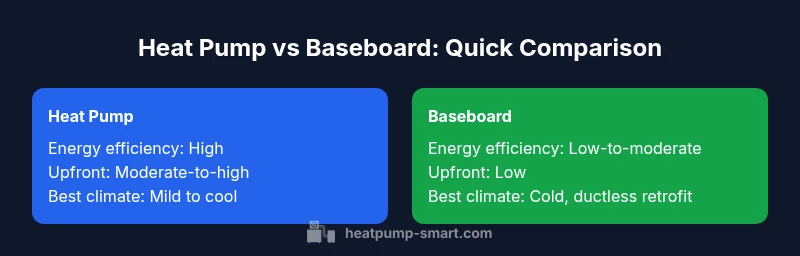
| Energy efficiency | High efficiency in temperate to cool climates with proper insulation | Low-to-moderate efficiency (electric resistance heat) |
| Operating costs | Typically lower over time with correct sizing and controls | Typically higher due to electricity-only heating, depending on usage |
| Upfront installation | Moderate-to-high (outdoor unit, wiring, ductwork or zoning) | Low-to-moderate (simpler installation, no outdoor unit) |
| Best climate | Mild to cool with good insulation; cooling capability in summer | Cold climates or retrofit projects without ductwork |
| Maintenance | Annual service, coil cleaning, filter changes | Minimal maintenance; dusting and thermostat checks |
| Zoning potential | Excellent with smart controls and multiple indoor units | Good in zones with baseboards but less flexible than heat pumps |
Advantages
- Higher long-term energy savings with proper sizing
- Year-round comfort and potential cooling capability
- Single system for heating and cooling (where applicable)
- Improved heat distribution and reduced drafts in many homes
Disadvantages
- Higher upfront cost and installation complexity
- Performance can drop in extreme cold without backup heat
- Requires professional sizing and potential ductwork or retrofits
Heat pumps are the better long-term choice for most homes seeking energy savings and reliable comfort.
The Heatpump Smart team recommends starting with a precise load calculation and climate-aware sizing to maximize benefits. For extremely cold climates or tight budgets, consider a hybrid or baseboard backup as a practical compromise. Ongoing maintenance and professional installation are crucial to achieving the projected energy savings.
Your Questions Answered
Can heat pumps fully replace baseboard heating in all homes?
Heat pumps can replace baseboards in many homes, but climate, insulation, and heating loads matter. In very cold regions, supplemental or backup heating may be needed.
Yes in many homes, but climate and load must be considered.
Do heat pumps work in winter?
Most modern air-source heat pumps operate effectively in cool to cold weather, especially with good insulation and a backup heat plan. In extreme cold, performance may decline without auxiliary heat.
They work in winter with proper sizing and backup heat.
What is the cost difference between heat pumps and baseboards?
Upfront costs for heat pumps are higher due to equipment and installation, while baseboards typically have lower upfront costs. Long-term costs depend on climate, electricity prices, and usage.
Heat pumps cost more upfront but can save over time.
Can baseboard heating be paired with a heat pump?
Yes, hybrid or dual-fuel systems are common in climate zones where extreme cold affects heat pump performance. A professional can design a system that uses baseboard heat as backup.
Hybrid setups are possible and common.
What maintenance do heat pumps require?
Heat pumps need annual professional checkups, coil cleaning, and filter changes. Thermostat settings and airflow should be monitored for efficiency.
Routine professional checks and simple upkeep keep performance high.
Which lasts longer, heat pumps or baseboards?
Heat pumps typically last 10-15+ years with proper care; baseboard components can have long mechanical life but depend on usage and electrical components.
Life expectancy depends on usage and maintenance.
Top Takeaways
- Assess climate and insulation before deciding
- Size the heat pump correctly to maximize efficiency
- Factor total cost of ownership, not just upfront price
- Hybrid options can balance cold-climate needs and budget
- Plan for zoning and smart controls to maximize comfort