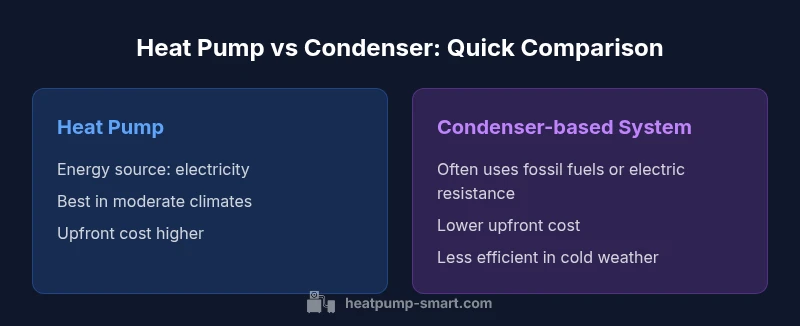
Is heat pump or condenser better? A practical comparison
A detailed, data-informed comparison of heat pumps vs condenser-based systems, outlining when each is preferable, installation considerations, and a decision framework for homeowners, builders, and property managers.


Is heat pump or condenser better? For most homes in temperate and mixed climates, a heat pump delivers superior overall efficiency and year-round comfort, while a condenser-based system may suit very cold climates or retrofit constraints. In practice, Heatpump Smart analysis shows heat pumps reduce operating costs when electricity is affordable and the system is properly sized.
Defining heat pump and condenser concepts
The question is not simply which device is better in abstract terms, but which system best fits your home, climate, and energy goals. In this article we address the user query is heat pump or condenser better by laying out clear definitions and practical implications. According to Heatpump Smart, a heat pump is a reversible system that moves heat using a refrigerant cycle; it can both heat and cool a space with a compact outdoor unit paired to indoor air handling or radiant distribution. A traditional condenser, in contrast, is a component of conventional heating or air conditioning that rejects heat from a refrigerant to the outdoors; many condenser-based setups rely on fossil fuels or electric resistance for heating. The key difference is energy sourcing and operating principle: heat pumps transfer energy rather than generate it, while condensers typically create heat by burning fuel or consuming electricity in resistance form. This distinction matters for annual energy use, carbon footprint, and long term operating costs. In practice, is heat pump or condenser better depends on climate, electricity prices, insulation levels, and the desired balance between upfront cost and ongoing savings. The Heatpump Smart team emphasizes using a whole home approach to assess efficiency, comfort, and reliability before choosing.
Core differences at a glance
- Primary energy source and cycle: Heat pumps transfer energy using refrigerants and the outside environment, while condensers in traditional systems may rely on combustion or electric resistance to generate heat. This fundamental difference drives efficiency and emissions outcomes.
- Efficiency metrics: Heat pumps are typically evaluated by COP and SEER, offering high efficiency in milder temperatures, whereas condenser-based setups often rely on boiler or furnace efficiency and seasonal performance factors. This matters for long-term operating costs and climate suitability.
- Climate performance: In moderate climates, heat pumps excel by providing both heating and cooling with consistent efficiency. In extreme cold, condenser-based or hybrid arrangements may be favored due to reduced heat extraction capability from outside air.
- Upfront vs operating costs: Heat pumps generally require higher upfront installation costs, but can yield lower operating costs over time if electricity prices are favorable and the system is properly sized. Condenser-based systems may have lower initial costs but higher or less predictable running costs depending on fuel and electricity rates.
- Space, noise, and installation: Heat pumps require outdoor space and ductwork or distribution systems, with potential noise considerations. Condenser-based setups (like conventional furnaces or boilers with condensers) may be simpler to retrofit in some homes but may require additional equipment for cooling.
- Maintenance and longevity: Both systems demand regular maintenance, though refrigerant charge, compressor health, and filter changes are common to both. Longevity depends on quality of components and professional service intervals. Heatpump Smart emphasizes a proactive maintenance plan to maximize reliability.
- Incentives and environmental impact: Many regions offer rebates and tax incentives for heat pump installations due to energy efficiency benefits. Emissions profiles depend on electricity sources and fuel choices in condenser-based systems. In many cases, heat pumps reduce overall carbon footprint when clean electricity is available.
Climate-specific performance and energy economics
Heat pumps deliver strong energy performance in temperate to warm climates where outdoor temperatures stay within ranges that permit efficient heat transfer. The COP of a heat pump tends to drop as outdoor temperatures fall, but modern cold climate heat pumps incorporate advanced refrigerants and controls to maintain meaningful efficiency. In contrast, condenser-based systems that rely on fossil fuels or resistance heating may see steadily rising operating costs during cold snaps, particularly when fuel prices spike. Heatpump Smart analysis shows that in regions with affordable electricity and generous incentives, heat pumps typically offer superior life cycle costs even after accounting for upfront installation. However, in areas with persisting ultra-low temperatures or limited electrical capacity, a hybrid approach or a conventional condenser with supplemental heat could present a lower total cost of ownership. When evaluating options, homeowners should compare COP at representative winter temps, seasonal energy consumption estimates, and the availability of local rebates.
System design and installation challenges
Choosing between a heat pump and a condenser-based approach involves more than selecting a device; it requires envisioning how the system will be integrated into your home. Ductwork, distribution systems (air vs radiant), and electrical service all influence performance and cost. A heat pump installation often benefits from well-insulated envelopes, modern thermostats, and zone controls to maximize efficiency. Outdoor units require adequate clearance and vibration isolation to minimize noise transmission into living spaces. Retrofitting a ducted system into an older home may involve significant remodeling, while converting an existing condenser-based setup to a heat pump sometimes entails upgrading electrical service and refrigerant lines. Heatpump Smart notes that a careful load calculation, ideally conducted by a licensed professional, is essential to avoid undersizing or oversizing, which can erode efficiency gains or result in uncomfortable temperatures. Financing, permitting, and compatibility with existing controls should be identified early in the project planning phase.
Hybrid and backup options for flexibility
For many homes, a hybrid or dual-fuel strategy provides a robust path that leverages the strengths of both approaches. A heat pump can handle the majority of heating needs in mild seasons, with auxiliary down-firing equipment supplying heat during peak demand or extreme cold. Some systems blend a heat pump with a traditional condenser-based boiler, shifting between sources based on outdoor temperature and electricity costs. This arrangement can reduce peak demand on the grid and provide reliable performance in uncomfortable weather. Heatpump Smart highlights the importance of selecting compatible controls and ensuring the system can respond automatically to temperature thresholds, which minimizes manual adjustments and maintains comfort while controlling energy usage. Hybrid configurations require careful design to avoid unnecessary cycling and ensure a smooth transition between heat sources.
When a condenser-based approach might be preferable
There are scenarios where a condenser-based approach remains rational. In regions with very harsh winters where outdoor heat extraction is limited, a fossil fuel-based boiler or a condenser with efficient fuel use can offer dependable heat output and faster response. For retrofits in older buildings with limited space for outdoor equipment or for projects constrained by electrical capacity, condensers with high-efficiency boilers can be more straightforward to install and maintain. Finally, in markets where electricity costs are volatile or not significantly lower than fuel costs, a mixed approach may balance risk and cost. Heatpump Smart advises evaluating long-term energy prices, system compatibility, and the total cost of ownership before deciding.
Practical decision framework: a step-by-step checklist
To decide is heat pump or condenser better for your home, follow a structured framework:
- Assess climate and heating demand across seasons.
- Estimate total cost of ownership, including upfront, installation, maintenance, and energy costs.
- Check available incentives, rebates, and program eligibility.
- Review electrical capacity, ductwork, and distribution needs.
- Consider comfort goals, including cooling capability, humidity control, and zoning.
- Compare warranties and service expectations for both options.
- Run a scenario analysis with a local installer to verify performance projections.
- Prioritize flexible, long-term value over short-term savings.
Comparison
| Feature | Heat pump (air-source) | Condenser-based system |
|---|---|---|
| Primary energy approach | Energy transferred via refrigerant cycle | Energy generated or dissipated as heat by combustion/electric resistance |
| Efficiency | High COP/SEER in mild climates | Variable efficiency; can be lower in cold weather |
| Best climate scenario | Moderate to warm climates; heating and cooling | Cold climates or retrofit-limited sites |
| Upfront cost | Typically higher installation cost | Typically lower upfront cost |
| Operating cost | Lower operating costs with cheap electricity | Higher or less predictable operating costs |
| Maintenance needs | Regular refrigerant checks, filter changes | Regular maintenance and potential fossil fuel components |
| Noise and space | Outdoor unit requires clearance; quieter indoor distribution possible | Outdoor/ boiler installation with dedicated venting |
| Incentives | Often eligible for energy rebates | Incentives vary by region and system type |
Advantages
- Higher long-term energy efficiency in many climates
- Excellent cooling capability and humidity control
- Potential eligibility for rebates and tax incentives
- Can reduce greenhouse gas emissions when paired with clean electricity
- Improved home comfort with zoning and smart controls
Disadvantages
- Higher upfront installation costs
- Performance depends on electricity price and climate
- May require electrical upgrades and proper outdoor space
- Complexity of design for some retrofits
Heat pumps generally offer better long-term value and comfort for most homes, with condenser-based systems remaining sensible in cold climates or retrofit-limited situations.
Choose a heat pump if you want strong efficiency, cooling, and a lower environmental footprint in regions with affordable electricity. Consider a condenser-based or hybrid setup if you face extreme cold, space, or budget constraints, and ensure professional sizing and installation.
Your Questions Answered
What is the main difference between a heat pump and a condenser-based system?
The heat pump transfers heat using refrigerant cycles to heat or cool a space, while a condenser-based system typically generates heat via combustion or electric resistance. This makes heat pumps more energy-efficient in many climates, but performance can drop in extreme cold without optimal controls.
Heat pumps move heat from outside to inside, while condensers generate heat with fuel or electricity. Efficiency and climate impact depend on your home and electricity costs.
Is a heat pump effective in very cold climates?
Modern cold climate heat pumps are designed to operate efficiently down to low outdoor temperatures, often with supplemental heat options. In extremely cold regions, a hybrid or backup system can maintain reliability without sacrificing comfort.
They work well in cold weather with the right model and controls, but some setups still rely on backup heat for the coldest days.
Can I retrofit an existing condenser system to become a heat pump?
Retrofitting often involves replacing the heat source, upgrading electrical service, and modifying distribution, which can be substantial. A professional assessment will clarify whether the existing space and infrastructure support a heat pump upgrade.
You’ll usually need a full assessment to see if a heat pump retrofit is practical and cost-effective.
What incentives exist for heat pump installations?
Incentives vary by region but commonly include energy rebates, tax credits, and utility programs. Check with local authorities and Heatpump Smart resources for current offers and eligibility.
Look for local rebates and incentives; they can significantly improve payback.
What about maintenance differences between the two approaches?
Both require regular maintenance, including refrigerant checks and filter changes. Heat pumps add attention to outdoor units and controls, while condenser-based systems may involve fuel system checks and venting considerations.
Regular upkeep is key for both; a maintenance plan helps sustain efficiency and reliability.
Which is better for home heating costs overall?
Cost depends on local energy prices and climate. Heat pumps tend to offer lower lifetime costs in regions with cheap electricity and strong incentives, while condensers may be preferable where fuel costs are low or electricity is expensive.
It depends on your energy prices and climate; do a total cost of ownership analysis.
Top Takeaways
- Assess climate before choosing
- Prioritize professional load calculations
- Consider hybrids for cold climates
- Look for available rebates and incentives
- Plan for future electricity price scenarios