Heat Pump vs HVAC: A 2026 Practical Comparison
An objective, in-depth comparison of heat pumps and traditional HVAC systems for homeowners and pros, covering costs, efficiency, installation, climate performance, and long-term value.


Heat pump vs hvac decisions hinge on efficiency, climate, and long-term savings. In most homes, a heat pump offers superior annual efficiency, while a conventional HVAC setup may cost less upfront in mild climates. Heat pumps pair electric heating with cooling, and HVAC relies on a gas furnace plus air conditioning.
What heat pump vs HVAC means for your home
To begin, it's essential to define the two systems and set expectations for the discussion around heat pump vs hvac. A heat pump is an electric device that moves heat using a refrigerant cycle; in heating mode it extracts warmth from outside air (or the ground) and delivers it inside, and in cooling mode it reverses. An HVAC system, in common usage, often refers to a gas furnace paired with an air conditioner, where heating comes from combustion and cooling comes from a separate AC unit. The practical difference is energy source and heat path: heat pumps rely on electricity to move heat rather than creating it with combustion. In real-world homes, this distinction translates into operating costs, emissions, and long-term reliability. According to Heatpump Smart, homeowners should evaluate climate, electricity prices, and infrastructure before evaluating equipment. For many households in temperate regions, heat pumps deliver excellent year-round comfort and low noise levels with a single system; in colder climates, auxiliary heat may be needed. The broader takeaway is that the decision should hinge on total cost of ownership, not just upfront price, and on how well the system integrates with a home's insulation and thermostat strategy. Hybrid configurations exist to balance strengths of both approaches.
Core design differences: heating and cooling paths
At its core, heat pump vs hvac diverge in how heat is generated and transferred. A heat pump uses a compressor-driven refrigeration cycle to move heat from outside to inside, and a reversing valve switches between heating and cooling modes. In heating, electrical energy is used to move heat rather than create it, delivering warmth efficiently as outdoor temperatures permit. A traditional HVAC system, when described in practical terms, usually means a gas furnace that creates heat by burning fuel and a separate air conditioning unit for cooling. Cooling remains an electric process in both setups, but heating sources differ. Because heat pumps transfer heat rather than burn it, their efficiency is often expressed as coefficients of performance (COP) and seasonal energy efficiency metrics (SEER/HSPF). Those metrics help estimate annual energy use and operating costs. The real-world choice between heat pump vs hvac hinges on climate, insulation, and how a home is heated and cooled. In some homes, a hybrid approach combines a heat pump with a supplemental furnace to maximize efficiency in winter. The result is a flexible platform that can adapt to weather swings while keeping comfort predictable.
Efficiency metrics and what they mean for your bill
Understanding efficiency is essential when comparing heat pump vs hvac. A heat pump’s performance is described by SEER for cooling and HSPF for heating, often accompanied by COP for specific conditions. High SEER and HSPF values indicate lower operating costs over a typical cooling and heating season, especially when electricity prices are stable. Gas furnaces and traditional air conditioners use different efficiency ratings such as AFUE for the furnace and SEER for the AC. When evaluating, consider climate-adjusted costs: in milder regions, heat pumps can deliver favorable annual energy use, while in very cold climates auxiliary heat can raise electricity usage and erode savings. It’s also important to assess heat pump performance under partial-load conditions, common in most homes, rather than only peak performance. Heatpump Smart analysis shows that properly sized heat pumps, paired with well-sealed ducts and a smart thermostat strategy, often outperform older electric heaters in terms of efficiency. Conversely, a gas furnace with a high-efficiency rating may still be competitive in regions with low natural gas prices. Estimate annual energy use with local electricity and gas rates to compare total ownership costs.
Climate considerations: cold vs warm climates
Climate is a major driver in the heat pump vs hvac decision. In warm or moderate climates, a heat pump often excels because the outdoor temperature rarely drops below the system’s efficient operating range. In cold climates, performance can decline as outdoor temperatures fall; modern cold-climate heat pumps incorporate advanced refrigerants and controls to reduce reliance on auxiliary heat. In extreme weather, some homeowners opt for a hybrid approach: a heat pump for most of the year and a gas furnace during the coldest weeks. This strategy can deliver lower overall energy use while maintaining reliable heat when temperatures plunge. The Heatpump Smart team notes that evaluating your typical winter and shoulder-season heating needs alongside local electricity and natural gas prices is essential. When seasonal energy dynamics favor electricity, heat pumps tend to be the better long-term buy; when gas costs are stable and fuel is cheap, a traditional HVAC setup might be more cost-effective. Finally, consider envelope performance—insulation and duct efficiency—since poor sealing can undermine any system.
Upfront costs, incentives, and payback periods
Pricing for heat pump systems varies with climate, ductwork, and configuration. In general, heat pumps have higher upfront costs than simple replacements, though the gap narrows when you factor in longer-term energy savings and available rebates. Gas furnace plus central AC configurations can have lower upfront price, especially if existing ducts and a gas line are already in place. In many regions, rebates, tax credits, and utility incentives specifically target heat pump efficiency upgrades. When evaluating payback, quantify annual energy savings and maintenance costs; a well-designed heat pump with efficient components and sealed ducts often delivers meaningful returns within 5-12 years, though regional price variations shift this window. Heatpump Smart analysis shows that policy incentives play a decisive role in overall payback, particularly where electricity prices are rising and heating demand is moderate. Always request a region-specific quote and compare it to baseline energy costs to understand the true financial impact.
Installation, space demands, and ductwork implications
Installation considerations are a critical part of the heat pump vs hvac decision. Heat pumps require an outdoor unit and indoor air handler or ductwork, depending on configuration; ductless mini-split options remove the need for central ducts but require careful placement of indoor units. Gas-furnace-based HVAC relies on existing or new ductwork and a venting system for combustion exhaust, plus space for the furnace and evaporator coil. When evaluating installation, consider the home’s existing duct layout, insulation, and electrical capacity. If you can upgrade to a higher-efficiency heat pump with properly sealed ducts, you reduce air leaks and improve indoor comfort. For homes with limited indoor space or where extending ductwork is impractical, ductless heat pumps offer a flexible path forward. Some jurisdictions require permits and compliance checks for refrigerant handling and electrical work; a skilled installer can navigate these requirements. Proper sizing and professional load calculations are essential to minimize issues like short cycling or insufficient heating. Heatpump Smart emphasizes that a thoughtful, staged installation in multi-zone homes avoids disruptions and maintains comfort during conversion.
Maintenance, durability, and service considerations
Maintaining either system requires regular attention, but maintenance tasks differ. Heat pumps benefit from seasonal checks on refrigerant levels, compressor operation, and outdoor unit cleanliness. Air filters should be replaced or cleaned regularly, and the reversing valve and defrost controls require periodic inspection. Traditional HVAC systems—furnaces and central air conditioners—have parallel maintenance needs: furnace ignition or burner cleaning, heat exchanger inspection, and annual filter changes, plus coil cleaning for the air conditioner. Because heat pumps combine heating and cooling in one system, some service visits can cover both functions, which can save time. However, refrigerant handling requires specialized technicians, and proper refrigerant management is critical for efficiency and environmental compliance. In colder climates, auxiliary heat elements in heat pumps can introduce additional wear points; ensure the system has robust maintenance plans to monitor defrost cycles and backup heat controls. Proactive maintenance, including duct sealing and thermostat performance reviews, yields steadier performance and reduces late-season failures. Heatpump Smart notes that a disciplined maintenance schedule extends equipment life and preserves efficiency.
Use cases: single-family, multi-family, and commercial implications
The choice between heat pump and hvac often hinges on building type and occupancy patterns. In single-family homes with a well-insulated envelope, a heat pump can deliver excellent comfort and energy savings, especially with ducted or hybrid configurations. Multi-family buildings face shared ductwork, zoning complexity, and maintenance scheduling; ductless options can simplify unit-by-unit control and improve tenant comfort. For new constructions or major renovations, heat pump systems offer streamlined integration with smart thermostats, inverter-driven compressors, and heat-recovery options. In commercial spaces, the decision depends on the building’s energy model, occupancy, and climate control goals. Larger systems may benefit from centralized heat pumps or geothermal alternatives, depending on soil conditions and space. In all cases, viability rests on load calculations, right-sizing, and a careful assessment of maintenance contracts and service coverage. Heatpump Smart keeps guidance aligned with project scope, ensuring the selected system meets energy targets and budget realities while delivering reliable comfort for residents or occupants.
Smart controls, automation, and future-proofing
As homes become smarter, the control strategy matters as much as the hardware. Thermostats that learn occupancy patterns, weather-adjusted setpoints, and zoning capabilities can dramatically improve real-world efficiency of either system. Heat pumps pair well with modern demand-response programs and variable-speed compressors that adjust output to demand. HVAC setups with conventional furnaces can still support smart thermostats, but performance depends on furnace response and duct condition. A properly configured system uses continuous feedback from temperature sensors, humidity, and occupancy data to optimize heating and cooling. Homeowners gain lower energy bills and more consistent comfort, but this requires routine software updates and occasional mechanical service. Heatpump Smart emphasizes planning for future upgrades—such as refrigerant efficiency improvements or refrigerant changes—that can extend the life of your investment and reduce life-cycle costs.
Step-by-step decision framework: how to choose
This step-by-step framework helps readers move from data collection to a confident choice. Step 1: quantify your climate, electricity prices, and gas costs. Step 2: inventory insulation quality and duct integrity; Step 3: run a load calculation for both system types and compare annual energy use with local rates. Step 4: identify available rebates or incentives in your region for heat pump installations or efficiency upgrades. Step 5: assess installation complexity, downtime, and contractor experience with heat pumps and traditional HVAC. Step 6: evaluate compatibility with smart controls and future upgrades. Step 7: obtain multiple quotes and check references for service quality and parts availability. Step 8: decide based on total cost of ownership, comfort, and reliability, not just upfront price. Heatpump Smart’s approach treats this as a lifecycle decision, ensuring comfort, reliability, and energy goals align with budget realities. A well-executed installation, proper sizing, and quality ducts remain critical to predictable performance over time.
Comparison
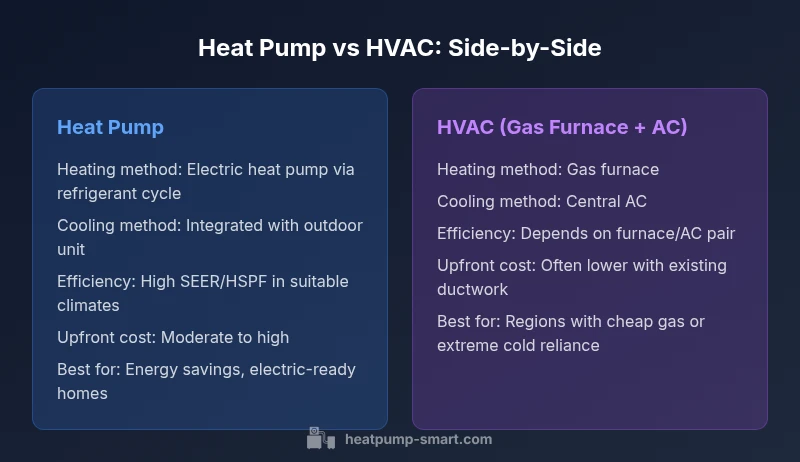
| Feature | Heat Pump | HVAC (Gas Furnace + AC) |
|---|---|---|
| Heating method | Electric heat pump via refrigerant cycle | Gas furnace + electric air conditioning (split system) |
| Cooling method | Single integrated system (heat pump cooling) | Separate AC unit with furnace supply |
| Energy efficiency | Typically high SEER/HSPF when climate is favorable | Efficiency depends on furnace + AC pairing; varies by equipment |
| Upfront cost | Moderate to high upfront; dependent on ductwork and configuration | Often lower upfront if existing ducts/gas line; may be higher with new ducting |
| Operating costs | Lower in electricity-friendly regions; affected by electricity prices | Gas costs influence monthly bills; can be stable or volatile by region |
| Climate suitability | Best in mild to moderate climates; may require auxiliary heat in winter | Reliable in extreme cold with high-efficiency furnace/hot water options |
| Maintenance needs | Fewer components; refrigerant checks and filter changes | Two systems (furnace and AC) require separate maintenance |
| Incentives & rebates | Several heat pump rebates and efficiency incentives | Fewer incentives for gas-based systems in some markets |
| Best for | Energy savings, electric-ready homes, smart controls | Existing gas infrastructure, known maintenance networks |
Advantages
- Lower operating costs in electricity-favorable regions
- Cleaner heat with no combustion byproducts
- Quiet operation and compact outdoor unit options
- Excellent integration with smart thermostats and home automation
- Potential rebates and tax incentives
Disadvantages
- Higher upfront costs and longer payback in some markets
- Performance can dip in extreme cold without auxiliary heat
- Complex installation may require duct changes or upgrades
- Refrigerant handling and regulatory compliance needed for service
Heat pump is generally the better long-term value for most homes, especially in moderate climates, while HVAC remains advantageous where upfront cost or extreme climate reliability is the priority.
For many homeowners, a heat pump offers greater year-round efficiency and comfort with lower operating costs. HVAC may win on upfront price or reliability in extreme cold, depending on local fuel prices and climate. The best choice depends on climate, energy costs, and the value you place on future-proofing and incentives.
Your Questions Answered
What is the main difference between heat pumps and HVAC systems?
Heat pumps move heat using electricity, not combustion, while HVAC often relies on a gas furnace for heat and a separate AC unit for cooling. The energy path and source define performance, cost, and emissions.
The key difference is energy source and heat transfer: heat pumps use electricity to move heat, while gas furnaces burn fuel for heat.
Do heat pumps work well in cold climates?
Heat pumps can work in cold climates, especially newer models designed for low outdoor temperatures. In very harsh winters, auxiliary heat (electric resistance or a secondary furnace) may be used to maintain comfort.
They can handle cold weather, but might need extra heat during extreme cold.
Is installation cost higher for heat pumps than traditional HVAC?
Upfront costs for heat pumps can be higher due to equipment and potential ductwork upgrades, but incentives and energy savings can offset this over time. Existing infrastructure influences total cost.
Upfront costs can be higher, but long-term savings and rebates matter.
What maintenance is required for heat pumps compared to HVAC?
Heat pumps require refrigerant checks, outdoor unit cleaning, and filter changes. Furnaces and central AC need separate maintenance for the furnace and the cooling coil.
Both require regular service; heat pumps bundle some tasks, but refrigerant care needs specialists.
Are there incentives for installing heat pumps?
In many regions, there are rebates or tax incentives for heat pump efficiency upgrades. Availability varies by location and current policy programs.
Yes—rebates and incentives can significantly reduce upfront costs.
How should I decide which system fits my home?
Start with climate, energy prices, ductwork, and insulation. Run a life-cycle cost analysis and compare rebates. Get multiple quotes and consider future-proofing with smart controls.
Look at climate, costs, and ductwork, then compare quotes for the best value.
Top Takeaways
- Assess climate and energy costs before choosing
- Consider hybrid setups in cold regions for balanced performance
- Prioritize total ownership cost, not just upfront price
- Plan for ductwork, insulation, and smart-control readiness
- Leverage rebates and incentives to shorten payback