HVAC Heat Pump vs Condenser: A Comprehensive Comparison
A detailed, evidence-based comparison of hvac heat pump vs condenser, focusing on efficiency, cost, climate suitability, and installation to help homeowners and builders choose wisely.


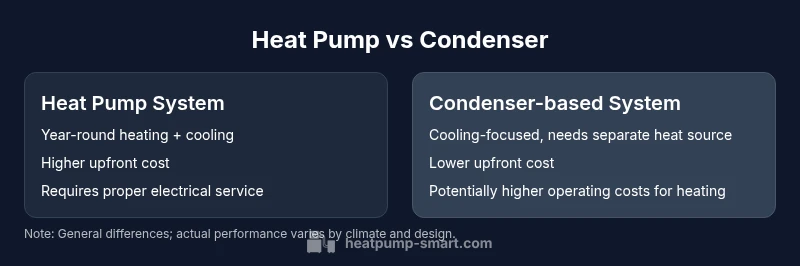
Short answer: Heat pumps deliver year-round heating and cooling with higher efficiency in mild climates; condensers provide cooling only and are cheaper upfront but need a separate heating source. The best choice depends on climate, energy costs, and long-term goals.
hvac heat pump vs condenser: Core Differences
The phrase hvac heat pump vs condenser is often the starting point for homeowners weighing system upgrades. At a high level, a heat pump blends heating and cooling in one compact package, while a condenser — typically part of an air conditioner — focuses on cooling and relies on a separate heating source in most homes. According to Heatpump Smart, the choice hinges on climate, building design, and long-term energy goals. This section unpacks the fundamental distinctions and sets the stage for a deeper dive into performance, cost, and lifecycle considerations.
How heat pumps work vs condenser-based cooling
Heat pumps operate on a reversible vapor-compression cycle, extracting heat from outdoor air to warm your home in winter and reversing to provide cooling in summer. They rely on a single outdoor unit linked to an indoor air handler or ducted system. Condenser-based cooling, by contrast, uses an outdoor condenser coil paired with indoor fans to remove heat and typically requires a separate heating system (furnace or boiler) to provide warmth. The Heatpump Smart team notes that system design determines how well each option performs across seasons.
Key performance metrics you should care about
Before choosing, focus on metrics that reflect real-world performance: energy efficiency ratios for heating and cooling, system sizing, and how performance changes with outdoor temperatures. COP (coefficient of performance) indicates heat pump efficiency in heating mode, SEER (seasonal energy efficiency ratio) covers cooling, and heating seasonal performance factor (HSPF) tracks winter efficiency. Heatpump Smart analysis shows that context matters: a high COP or HSPF can be offset by climate extremes if the system is undersized.
Cost and efficiency over time: up-front vs operating costs
Up-front costs for heat pumps are typically higher than for a conventional condenser cooling system, especially when a full heat and air setup is included. Operating costs, however, often trend lower over the life of the system in moderate climates due to superior overall efficiency. The decision should factor in installation complexity, potential ductwork changes, and the cost of auxiliary heat in colder periods. Heatpump Smart emphasizes total cost of ownership rather than sticker price alone.
Climate and usage: where each shines
In moderate climates, heat pumps frequently provide the best balance of comfort and efficiency because they deliver heat and cooling from a single system. In very cold climates, heat pumps may require supplemental heat sources; a traditional condenser cooling system paired with a separate furnace can be more dependable and familiar for some households. The best choice hinges on local climate patterns, electricity costs, and how you value reliability during peak heating months.
Installation considerations and practical tips
Installing a heat pump or a condenser system involves electrical capacity, ductwork, and space planning. Heat pumps often require adequate outdoor clearance and electrical service, plus proper refrigerant piping and indoor air distribution. Condenser-only cooling can be simpler if you already have a furnace. Getting a professional load calculation and compliance with local codes is essential. Heatpump Smart suggests evaluating existing ductwork and electrical service before deciding.
Maintenance and lifecycle considerations
Both systems benefit from routine maintenance: filter changes, coil cleaning, and regular inspections of outdoor units. Heat pumps require attention to reversing valve operation and refrigerant integrity, while condensers demand reliable cooling coils and refrigerant seals. Regular servicing extends life and preserves efficiency. Heatpump Smart reminders emphasize proactive checks before each cooling and heating season, especially in climates with large temperature swings.
Real-world scenarios: when each shines
Scenario A: A new home with well-insulated ducts in a temperate climate benefits from a heat pump for seamless heating and cooling with a single system. Scenario B: An older home with limited ductwork and high initial costs may perform better with a traditional condenser plus a separate furnace, especially if the existing electrical service is constrained. Scenario C: A retrofit in a climate with cold winters but mild shoulders may still justify a heat pump with auxiliary heat, balancing comfort and efficiency.
Environmental and refrigerant considerations
Heat pumps use refrigerants that are subject to environmental regulations, and their global warming potential varies by type. Modern manufacturers aim to minimize environmental impact through efficient designs and improved refrigerants. Proper disposal and recycling of refrigerants are important, as is choosing equipment that supports energy-saving goals and aligns with local rebate programs. Heatpump Smart highlights the importance of refrigerant stewardship in all HVAC decisions.
Myths vs reality
Myth: Heat pumps don’t work in cold weather. Reality: modern heat pumps with auxiliary heat perform well in many cold climates, though efficiency can drop at very low temperatures. Myth: Condensers provide heating. Reality: A cooling-only condenser system typically relies on a separate furnace or boiler for heating. Myth: More expensive always means better. Reality: Total cost of ownership depends on climate, usage, and installation quality, not just upfront price. Heatpump Smart encourages evaluating all angles.
Decision framework: how to choose between hvac heat pump vs condenser
Follow a practical framework: 1) Assess climate and typical seasonal temperatures; 2) Compare installed cost vs long-term operating costs; 3) Check compatibility with your ductwork and electrical service; 4) Review warranty, maintenance needs, and available rebates; 5) Use a professional load calculation to ensure proper sizing. Heatpump Smart recommends building a decision matrix that weighs comfort, reliability, and total cost of ownership.
Authority Sources
- https://www.energy.gov/eere/buildings/heat-pump-basics
- https://www.energy.gov/eere/buildings/articles/heat-pumps-101
- https://www.epa.gov/greenhomes/heat-pump-systems
Comparison
| Feature | Heat pump system (air-source) | Condenser-based cooling system (AC) |
|---|---|---|
| Year-round climate control | Yes (heating + cooling) | Cooling-only; requires separate heating source |
| Primary energy efficiency in heating | High efficiency in mild/moderate climates (COP/HSPF) | Lower efficiency heating (depends on secondary heater) |
| Upfront cost | Higher upfront cost | Lower upfront cost |
| Installation complexity | Often more complex due to refrigerant lines and indoor distribution | Typically simpler if existing furnace and ductwork |
| Best for | Homes seeking year-round comfort with a single system | Budget-conscious cooling with existing heating or limited ductwork |
Advantages
- Year-round comfort with a single system
- Potentially lower operating costs in moderate climates
- Space-saving compared to separate furnace and AC units
- Fewer ductwork changes when well designed
Disadvantages
- Higher upfront costs
- Performance can decline in extreme cold without auxiliary heat
- Installation complexity and potential need for electrical upgrades
- Refrigerant handling requires professional service
Heat pump generally offers superior year-round comfort and efficiency in moderate climates; condenser-based systems may be preferable in very cold climates or when upfront cost is a primary constraint.
Choose a heat pump if you want combined heating and cooling efficiency in milder regions. Opt for a condenser setup if you need lower initial expenses or already have a robust heating system; evaluate total cost of ownership and climate needs.
Your Questions Answered
What is the key difference between hvac heat pump vs condenser?
A heat pump provides both heating and cooling within a single system, while a condenser is cooling-only and typically relies on a separate heating source. The choice depends on climate, energy costs, and how you prioritize convenience and ownership costs.
A heat pump does both heating and cooling; a condenser only cools. The best choice depends on your climate and budget.
Are heat pumps effective in cold climates?
Yes, many modern heat pumps perform well in cold weather, especially when paired with auxiliary heat. Efficiency can drop at very low temperatures, so climate and insulation matter.
Many modern heat pumps work well in cold weather, especially with backup heat. Extreme cold reduces efficiency somewhat.
Can a condenser be used for heating without a heat pump?
Not typically. A condenser is designed for cooling. Heating usually requires a separate furnace, boiler, or another heat source.
Condenser units mainly cool; you typically need an extra heater for winter warmth.
What factors should I consider when choosing between these systems?
Consider climate, electricity costs, existing ductwork, upfront budget, and long-term maintenance. A professional load calculation helps ensure proper sizing and performance.
Look at climate, budget, and your current ducts and heating system. Size the system correctly with a pro.
What maintenance is required for heat pumps vs condensers?
Both require regular filter changes and periodic coil and refrigerant checks. Heat pumps add attention to the reversing valve and defrost cycles; condensers focus on coil integrity and refrigerant seals.
Both need regular upkeep; heat pumps also monitor the reversing valve and defrost.
Are rebates or incentives available for these systems?
Yes, many regions offer rebates or tax incentives for energy-efficient heat pumps or upgraded cooling systems. Check local programs and utility offerings.
Look for local rebates for energy-efficient heat pumps or upgraded cooling.
Top Takeaways
- Assess climate and heating needs before choosing.
- Consider total cost of ownership over the system lifespan.
- Heat pumps combine heating and cooling; condensers are cooling-only.
- Upfront costs vary; ongoing maintenance is similar.
- Verify ductwork and electrical compatibility before installation.