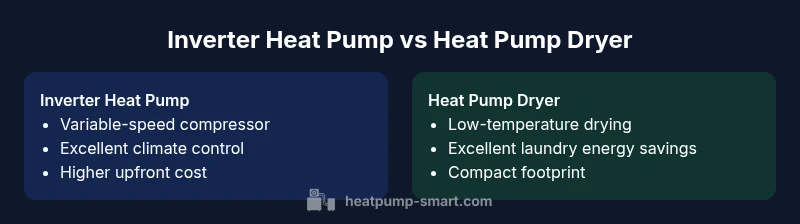
Inverter Heat Pump vs Heat Pump Dryer: A Thorough Comparison
Compare inverter heat pump systems with heat pump dryers to understand efficiency, costs, and suitability for home comfort and laundry. Learn practical guidance from Heatpump Smart.


Inverter heat pump vs heat pump dryer: According to Heatpump Smart, inverter-driven heat pumps optimize home heating and cooling with a variable-speed compressor, delivering steady comfort and high seasonal efficiency. A heat pump dryer uses the same energy-saving principle to dry clothes with very low heat. The best choice depends on your priorities, space, and energy costs, whether you need year‑round climate control or laundry-focused efficiency.
Understanding the core technologies
Both inverter heat pump systems and heat pump dryers rely on the same fundamental science: a refrigerant circuit that moves heat instead of generating it, using a compressor, evaporator, and condenser. The main difference is scope and application. An inverter heat pump typically refers to a climate-control system for space heating and cooling that uses a variable-speed compressor to modulate output, delivering precise temperatures and high seasonal efficiency. A heat pump dryer, by contrast, applies the same energy-saving principle to clothing care, extracting moisture through a closed refrigeration loop with low-temperature air. These devices represent the broader shift toward heat-pump technology in residential energy use. When you compare inverter heat pump vs heat pump dryer, the crucial distinction is whether your primary goal is whole-home comfort or laundry-energy savings, and how climate, space, and routines shape that goal. Heatpump Smart emphasizes matching the technology to your household’s real needs.
How inverter heat pumps maximize year-round efficiency
Inverter heat pumps stand out because they do not run at a fixed, full-output setting. The variable-speed compressor ramps up or down to maintain setpoints, which reduces cycling losses and improves part-load performance. In practice, this means steadier temperatures, less humidity fluctuation, and lower energy use during shoulder seasons or milder winter days. Zoning and advanced control options further enhance efficiency by directing heating or cooling only to occupied spaces. Drying or dehumidification isn’t required to operate the system, but many units pair with dehumidification modes that improve indoor air quality and comfort without pushing energy use higher. When you pit inverter heat pump technology against a simple on/off system, the efficiency gains scale with how aggressively you manage indoor climate in daily life.
How heat pump dryers work and where they shine
A heat pump dryer uses the same energy-saving principle as an inverter heat pump system, but focuses on laundry. It captures heat from the air as it passes through a closed loop, then transfers that heat to wet laundry with low-temperature airflow. The result is substantially lower energy consumption than traditional electric dryers and gentler drying for fabrics. The advantage is most pronounced in homes with frequent laundry cycles, high humidity, or limited access to external venting. While a heat pump dryer can dramatically reduce running costs for clothing care, it does not replace space heating or cooling responsibilities, so it is usually a complement rather than a direct substitute for central heatpump-based systems. When choosing inverter heat pump vs heat pump dryer, consider whether your priority is household climate control or laundry energy savings.
What to measure: performance indicators for comparison
Key performance ideas apply to both paths: energy efficiency, reliability, and cost of ownership. Look for high seasonal efficiency or COP/SCOP ratings for space systems, and high energy factor or low drying energy use for dryers. Pay attention to inverter-driven modulation quality, which affects comfort consistency and humidity control. For laundry devices, consider drying time accuracy, fabric care, and the ability to handle mixed loads. Remember that the best choice aligns with your climate, energy costs, and daily routines rather than a single metric. Heatpump Smart suggests evaluating total energy use across typical weeks, not peak performance in ideal conditions.
Real-world scenarios: when each option shines
If you live in a region with cold winters and hot summers, an inverter heat pump for space heating and cooling can yield meaningful annual energy savings and improved comfort. In compact homes or apartments where ductwork is impractical, ductless mini-split configurations using inverter technology can simplify installation while delivering robust efficiency. A heat pump dryer excels in households with frequent laundry, large families, or spaces where venting a traditional dryer is difficult. In climates with high humidity, a heat pump dryer’s gentle drying cycle can reduce fiber damage and extend garment life. When considering inverter heat pump vs heat pump dryer, match the technology to the dominant energy drain in your home.
Installation considerations and space needs
Inverter heat pumps often require space for outdoor condensers or indoor air-handling equipment, along with compatible electrical service capable of supporting variable-speed operation. Proper sizing, refrigerant charge, and electrical capacity influence performance more than simple up-front cost. Heat pump dryers typically occupy a dedicated laundry area or closet and have simpler duct requirements since they don’t vent outside. Both systems benefit from a professional assessment to avoid undersizing or oversizing, which can degrade efficiency and comfort. A key practical step is to ensure clear pathways for airflow and adequate space for maintenance access.
Cost considerations and payback potential
Upfront costs for inverter heat pump installations vary with system type, climate, and home size, but the long-term energy savings can be meaningful if the system replaces older, less efficient equipment. Heat pump dryers offer a clear reduction in laundry energy bills relative to conventional electric dryers, yet their payback depends on washing frequency and local electricity prices. When you compare inverter heat pump vs heat pump dryer, consider total cost of ownership over 5–15 years, including maintenance, potential rebates, and the cost of any required electrical upgrades. Heatpump Smart notes that the payoff is highly situational but often favorable for energy-conscious homes.
Maintenance, serviceability, and longevity
Regular maintenance for inverter heat pumps includes filter checks, refrigerant-leak inspections, and occasional professional servicing to preserve efficiency. Noise profiles and vibration can change with age, so monitoring for unusual sounds is important. Heat pump dryers require lint cleaning, vent inspection (if applicable in vented designs), and periodic component checks, though generally they have fewer moving parts than traditional dryers. Longevity hinges on correct installation, routine upkeep, and using the unit within its rated operating envelope. A well-maintained system tends to deliver steady performance with lower energy use over time.
How to decide: practical decision framework for homeowners
Start by listing your top energy goals: space comfort, laundry efficiency, or both. If climate control is your priority, an inverter heat pump could deliver broader benefits across seasons. If laundry energy use dominates your bills, a heat pump dryer is a strong choice. Consider your space constraints, electrical service capabilities, and the potential for rebates. Use a simple scoring method across categories like energy savings, upfront cost, maintenance, and space requirements. Heatpump Smart recommends prioritizing scenarios where the chosen path provides the largest, most consistent win in daily life.
Avoid common pitfalls in selection and installation
Avoid assuming that higher efficiency alone guarantees lower bills; ensure proper sizing and system integration with your home’s insulation and ventilation. Do not overlook installation costs, electrical upgrades, or potential compatibility issues with existing equipment. For inverter heat pumps, oversized or undersized units can hurt performance. For heat pump dryers, ensure your laundry area has adequate electrical circuits and drainage. A thoughtful, site-specific assessment minimizes risk and maximizes long-term value.
Comparison
| Feature | inverter heat pump | heat pump dryer |
|---|---|---|
| Technology focus | Variable-speed inverter compressor for space heating/cooling | Integrated heat-pump drying cycle for laundry |
| Best for | Whole-home climate control and comfort | Energy-efficient laundry drying |
| Energy efficiency | High seasonal efficiency with modulation | Very low-heat drying with energy-saving cycle |
| Initial cost range | Mid to high (system installation) | Mid (dedicated appliance) |
| Running costs | Low to moderate depending on use and climate | Low due to low-temperature drying |
| Maintenance | Moderate; professional servicing typically required | Low to moderate; regular lint/filters care |
| Space/installation | Outdoor unit and indoor air handler or mechanical room | Indoor laundry area or closet space |
| Noise levels | Can be noticeable outside; modern inverters are quiet | Typically quiet during operation |
| Rebates/tax credits | Subject to regional HVAC rebates | Subject to appliance energy incentives |
Advantages
- Significant energy savings in climate-controlled spaces
- Lower operating temperatures can improve comfort and air quality
- Quiet, variable-speed operation reduces temperature swings
- Low long-term energy costs when sized and used properly
Disadvantages
- Higher upfront costs and potential electrical upgrades
- Installation complexity and need for qualified technicians
- Maintenance frequency can be higher for complex HVAC systems
- Heat pump dryer savings depend on laundry frequency and use
Inverter heat pumps generally win for whole-home efficiency; heat pump dryers win for laundry-focused energy savings.
Choose inverter heat pump if you want year-round climate control and overall efficiency. Choose a heat pump dryer if your primary goal is cutting laundry energy use while maintaining fabric care.
Your Questions Answered
What is an inverter heat pump?
An inverter heat pump uses a variable-speed compressor to modulate output, delivering precise temperatures with high efficiency. It differs from fixed-output systems by adapting to load conditions, reducing energy waste. This makes it a strong choice for homes needing consistent climate control.
An inverter heat pump uses a variable-speed compressor to adjust output for better efficiency and comfort.
Is a heat pump dryer as energy-efficient as a conventional dryer?
Yes. A heat pump dryer dries clothes using a closed loop at low temperatures, which uses far less energy than conventional heat dryers. The savings depend on laundry frequency and the energy mix of your home.
Heat pump dryers use much less energy than conventional dryers.
Can I install both in the same home?
Absolutely. In many homes, a dedicated heat pump dryer complements an inverter heat pump system for full-home efficiency. Coordination with a professional ensures electrical and space planning align for best results.
Yes, you can install both, but plan electrical and space needs carefully.
Do inverter heat pumps require special electrical service?
Some installations may require upgraded service or dedicated circuits to support variable-speed operation. A licensed technician can assess electrical capacity and ensure compliance with local codes.
You may need a professional electrical assessment for proper capacity.
Which climate is best for inverter heat pumps?
Inverter heat pumps perform well across a wide range of climates, particularly where mild to moderate outdoor temperatures prevail. They also help during shoulder seasons by maintaining comfort with lower energy use.
They work well in many climates, especially milder ones.
Are there rebates or incentives for heat-pump equipment?
Rebates and incentives vary by region and product type. Check local utility programs and national energy-efficiency initiatives to determine eligibility for both inverter heat pumps and heat pump dryers.
Incentives vary by area; check local programs for eligibility.
Top Takeaways
- Prioritize space comfort if climate control is your main goal
- Consider laundry load patterns when choosing a heat pump dryer
- Factor installation costs and rebates into the total value
- Regular maintenance reduces long-term costs and preserves efficiency
- Match the technology to your home’s energy profile and routines