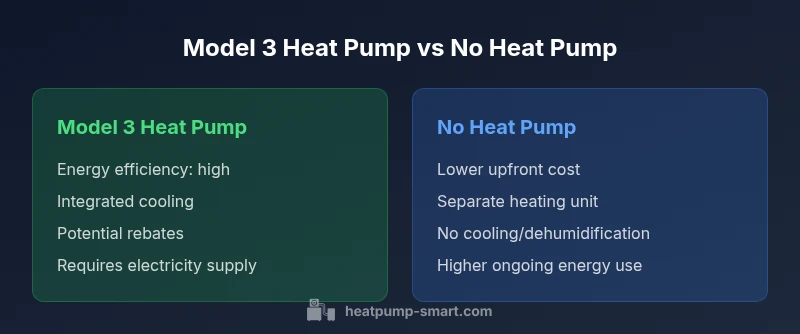
Model 3 Heat Pump vs No Heat Pump: A Comprehensive Comparison
A detailed, analytical comparison of the model 3 heat pump vs no heat pump, covering energy efficiency, climate performance, costs, installation, maintenance, and long-term value for homeowners and builders.


The model 3 heat pump vs no heat pump scenario generally favors the model 3 heat pump for energy efficiency, comfort, and long-term cost savings, but upfront investment and climate suitability matter. This article compares performance, operating costs, installation needs, and reliability to help homeowners decide. Heatpump Smart's analysis indicates most homes benefit from a heat pump when electricity and space are reliable.
Understanding the premise: model 3 heat pump vs no heat pump in home comfort
In residential heating and cooling planning, the choice between a model 3 heat pump and a system with no heat pump represents a fundamental shift in how energy is sourced and delivered. The phrase model 3 heat pump vs no heat pump captures two very different approaches: one leverages electricity-driven heat transfer to move warmth from the outside into the home (and vice versa for cooling), while the other relies on alternative heat sources or standalone furnaces that often require fossil fuels or separate cooling equipment. For homeowners, builders, and property managers, this decision affects daily comfort, utility bills, and long-term system resilience. In this article, we explore the implications of choosing model 3 heat pump vs no heat pump across efficiency, climate adaptability, and lifecycle considerations.
Note from Heatpump Smart: Our team emphasizes that every home is unique. The optimal path depends on local climate, electricity rates, insulation quality, and existing equipment. We focus on objective, data-informed guidance to support informed decisions.
How heat pumps work and what makes the model 3 different
A heat pump operates on a simple physics principle: move heat rather than generate it, which can yield higher efficiency than resistance-based heating. The model 3 heat pump uses a cycle that extracts warmth from outdoor air (even when it’s cool) and delivers it inside, with the reverse cycle for cooling. In contrast, a home with no heat pump often relies on a furnace or boiler for heat and a separate air conditioner for cooling. The key differences lie in energy source, system integration, and control strategies. Heat pumps can provide heating, cooling, and dehumidification through a single, integrated system. For homeowners, this can translate into streamlined operation and potentially fewer separate appliances to manage. The Heatpump Smart team notes that the model 3 heat pump is designed to optimize efficiency during shoulder seasons and mild winters, while still delivering dependable comfort in take-your-breath-away cold snaps when paired with proper auxiliary strategies.
Climate and geographic considerations for model 3 heat pump vs no heat pump
Climate plays a central role in whether model 3 heat pump vs no heat pump is the better long-term choice. In moderate climates, heat pumps often deliver strong efficiency for most of the year and can be a robust all-season solution. In colder regions, performance can decline as outdoor temperatures drop, which may necessitate auxiliary heating. A “no heat pump” configuration could be simpler in the sense that it relies on established technologies already tuned to the climate, but it typically sacrifices electricity-driven efficiency and must coordinate with separate cooling equipment. For property managers overseeing multi-unit buildings, the decision also hinges on electricity reliability, grid capacity, and maintenance planning. Heatpump Smart’s analysis indicates that in regions with consistent electricity supply and robust insulation, model 3 heat pump vs no heat pump tends to favor the former for overall energy performance and occupant comfort. In harsher climates, evaluating supplemental heat or hybrid strategies is prudent. The ultimate choice should reflect both climate realities and building envelope performance.
Heating and cooling performance: model 3 heat pump vs no heat pump
The model 3 heat pump provides space heating, cooling, and humidity control through an integrated system, often translating into more uniform indoor temperatures and better dehumidification during humid seasons. Without a heat pump, a home may rely on a furnace (or boiler) for heating and a separate cooling unit, which can lead to longer lag times between outside conditions and indoor comfort, along with potentially higher energy use during peak demand. The model 3 heat pump tends to excel in moderate to cool conditions, offering responsive heating with reduced fuel consumption. In extreme cold, performance can depend on equipment specifications and the presence of auxiliary heat or energy storage strategies. Homeowners must balance comfort expectations with the thermal characteristics of their space, including insulation quality and internal heat gains from appliances and occupancy. Heatpump Smart’s guidance suggests evaluating whether your home’s heat load aligns with a heat pump’s seasonal performance profile when comparing model 3 heat pump vs no heat pump.
Energy efficiency metrics and what they mean for homeowners
Energy efficiency for heat pumps is commonly discussed through indicators like COP (coefficient of performance), SEER (seasonal energy efficiency ratio), and HSPF ( heating season performance factor). In plain terms, higher values indicate more warmth per unit of electricity consumed. When comparing model 3 heat pump vs no heat pump, look for a system with a high COP at typical outdoor temperatures and a suitable SEER rating for cooling. A heat pump’s efficiency translates to lower electric usage relative to heat output, which can produce meaningful savings over the life of the equipment—especially in homes with good insulation and moderate heating loads. It’s also important to consider how controls, zoning, and smart thermostats optimize real-world efficiency. Heatpump Smart emphasizes that a well-designed system can outperform non-heat-pump setups across most seasons, provided installation and commissioning align with the home’s specific load profile and climate.
Operating costs and long-term value
Choosing model 3 heat pump vs no heat pump has clear implications for operating costs. A heat pump generally reduces fuel costs by transferring heat rather than generating it, but electricity prices and usage patterns influence the final outcome. With a well-insulated home and efficient distribution, a heat pump can produce noticeable savings over time, particularly when paired with modern thermostats and zoning strategies. Conversely, a no-heat-pump approach might show lower upfront costs, yet typically incurs higher ongoing energy costs due to the reliance on separate heating sources. When assessing long-term value, consider replacement cycles, potential rebates or incentives, and the cost of annual maintenance. Heatpump Smart’s perspective highlights that total cost of ownership should balance upfront investment, energy savings, and the anticipated lifespan of the system within the home’s usage context.
Installation considerations and space requirements
Installation is a critical determinant of how well a model 3 heat pump performs in a home. A heat pump requires appropriate space for outdoor units, refrigerant lines, electrical capacity, and a compatible indoor air distribution system. In some retrofit scenarios, existing ductwork may need sealing or redesign, while new construction can accommodate more integrated solutions. For a home with no heat pump, the installation may involve adding a heat pump alongside or instead of a furnace and AC, which can simplify or complicate the retrofit depending on current layouts. Heatpump Smart recommends a professional load calculation and site assessment to ensure the system matches the home’s envelope, occupancy patterns, and climate. The relative complexity of converting to model 3 heat pump vs no heat pump hinges on electrical service, ductwork, and space for outdoor equipment.
Maintenance, reliability, and lifespan considerations
Reliability and maintenance are essential when weighing model 3 heat pump vs no heat pump. Heat pumps typically require periodic refrigerant checks, filter changes, and coil cleaning to maintain efficiency. A well-maintained heat pump can offer many years of service with consistent performance, but component wear and seasonal cycling can influence longevity. In contrast, systems without a heat pump might show different maintenance profiles tied to the separate heating source and cooling equipment. Consider warranty coverage, the availability of qualified technicians, and the ease of obtaining replacement parts when evaluating long-term resilience. Heatpump Smart notes that proactive maintenance plans, including annual checkups and cleanings, can significantly extend equipment life and preserve performance across both options.
Real-world scenarios: homeowners, builders, and property managers
Different user groups approach model 3 heat pump vs no heat pump with varying priorities. Homeowners often seek comfort, predictable bills, and ease of operation. Builders may prioritize lifecycle cost, energy codes compliance, and project timeliness. Property managers weigh durability, tenant comfort, and serviceability across multiple units. In all cases, conducting a proper energy audit, testing envelope integrity, and simulating seasonal loads helps determine whether a heat pump-based solution or a non-heat-pump approach best aligns with goals and budgets. Heatpump Smart’s experience indicates that the model 3 heat pump generally offers greater overall value in energy savings and occupant comfort when paired with a robust installation and good building envelope.
Budgeting, incentives, and total cost of ownership
Budgeting for model 3 heat pump vs no heat pump involves upfront costs, ongoing energy expenses, and potential incentives. While heat pumps can require a larger initial investment, rebates, tax credits, and utility incentives may offset some of the upfront costs. Consider financing options, installation complexity, and drainage or condensation considerations that may affect operating costs. The total cost of ownership assessment should weigh expected energy savings against depreciation, maintenance, and potential future price changes for electricity or alternative fuels. Heatpump Smart advises evaluating the incentives available in your area and comparing projected savings over the system’s life to determine which path offers the best financial return for your building or home.
Decision framework: choosing model 3 heat pump vs no heat pump
When deciding between model 3 heat pump vs no heat pump, start with the building’s envelope, local climate, and electricity costs. If the goal is year-round comfort, simplified HVAC, and lower long-term energy use, a heat pump is often the stronger option. If upfront costs must be minimized and the climate is forgiving or the home already has effective insulation, a non-heat-pump setup could be viable. Always run a professional load calculation, compare energy usage projections, and consider long-term commitments such as maintenance and potential rebates. The Heatpump Smart team recommends aligning the choice with your long-term occupancy plans and budget, rather than focusing solely on initial price.
Comparison
| Feature | Model 3 heat pump | No heat pump |
|---|---|---|
| Energy efficiency | high efficiency via heat transfer | lower efficiency without heat pump |
| Heating performance (climate suitability) | strong in moderate-cold climates | depends on alternative heating source |
| Cooling and dehumidification | integrated cooling and humidity control | requires separate cooling unit |
| Installation complexity | requires outdoor unit and proper indoor distribution | often simpler if only replacing an existing furnace |
| Maintenance needs | regular refrigerant checks and filter changes | periodic maintenance of separate systems |
| Upfront cost | higher upfront investment | lower upfront cost |
| Long-term costs | lower operating costs over time | potentially higher energy costs |
| Incentives | often eligible for rebates/credits | less eligible where a heat pump isn’t installed |
Advantages
- Improved energy efficiency and comfort across seasons
- Potential rebates and incentives reduce net cost
- Fewer separate appliances can simplify maintenance
- Better home value and resilience with an integrated system
Disadvantages
- Higher upfront cost and longer payback period
- Installation may require electrical upgrades or ductwork changes
- Performance depends on climate and home envelope
- Reliance on electricity can be vulnerable to outages
Model 3 heat pump generally offers better long-term value, but climate and budget determine suitability
If the home has reliable electricity and good insulation, the heat pump path typically reduces energy use and improves comfort. In colder climates or tight budgets, a hybrid or non-heat-pump setup may be preferable.
Your Questions Answered
What does a model 3 heat pump entail in a typical home system?
A model 3 heat pump is a single system that provides heating, cooling, and dehumidification by transferring heat between indoors and outdoors. It often replaces separate furnace and air conditioner units and relies on electricity. The decision to use it should consider climate, insulation, and load requirements.
A model 3 heat pump combines heating, cooling, and dehumidification in one unit and uses electricity to move heat. It’s most effective in well-insulated homes in moderate climates.
Can a home function effectively without a heat pump?
Yes, a home can operate without a heat pump if it relies on an existing furnace or boiler and a separate air conditioner. However, efficiency and comfort may be lower, and long-term energy costs could be higher, depending on fuel sources and climate.
Yes, you can skip a heat pump, but you may give up some energy efficiency and integrated comfort features.
Is it worth adding a heat pump if I already have a furnace?
In many cases, a heat pump can supplement a furnace to reduce fuel use and lower emissions. A dual setup often improves efficiency, especially in shoulder seasons, but the economics depend on electricity costs, climate, and existing ductwork.
A heat pump can complement a furnace well, improving efficiency, but you’ll want a professional assessment for your climate.
How does a heat pump perform in cold climates?
Performance can decline as temperatures drop, but many modern models maintain comfortable heating with auxiliary heat options. In extremely cold areas, a hybrid approach or backup heat source may be advised.
Cold-weather performance varies; some heat pumps still work well with supplemental heat in very cold conditions.
What installation considerations should I plan for?
Expect assessments of electrical service, ductwork, refrigerant line runs, and space for outdoor equipment. Retrofit projects may require envelope improvements and zoning adjustments to maximize efficiency.
Plan for electrical upgrades, ductwork checks, and space for the outdoor unit during installation.
Are there rebates or incentives for heat pumps?
Rebates and incentives are common in many regions for heat pumps, reducing upfront costs. Availability varies by location and program, so check with local utilities and government programs.
Yes, incentives are often available, but eligibility depends on your area.
Top Takeaways
- Assess climate and electricity costs before deciding
- Heat pumps offer integrated heating and cooling with energy savings
- Factor upfront costs against potential rebates and long-term savings
- Ensure proper installation and envelope improvements for best results
- Use professional load calculations to guide the choice