Pros and Cons of Heat Pump vs AC: A Practical Guide
A thorough, objective comparison of heat pumps and air conditioners, focusing on efficiency, cost, climate suitability, and long-term value for homes and buildings.


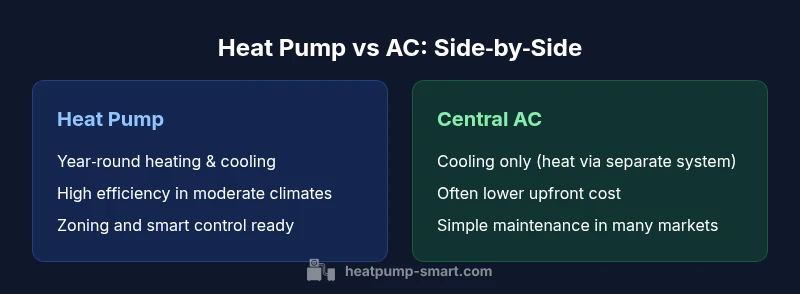
According to Heatpump Smart, the pros and cons of heat pump vs ac hinge on climate, electricity costs, and comfort priorities. Heat pumps provide both heating and cooling with high efficiency in moderate temperatures, and they can simplify systems by combining functions. Traditional central AC is typically cheaper to install upfront and may perform more predictably in very hot or dry climates.
The pros and cons of heat pump vs ac: an overview
In the heat pump versus air conditioning decision, homeowners and builders weigh comfort, cost, and long-term value. Heat pumps offer year‑round climate control with a single system, potentially reducing ductwork and simplifying controls. Yet upfront costs, the need for proper system sizing, and performance in extreme cold can influence the outcome. According to Heatpump Smart, the best choice is rarely a blanket recommendation; it hinges on climate, insulation quality, and how you value combined heating and cooling in a single package. For rental properties or multi‑unit buildings, the ability to zone and centrally manage thermostats can improve tenant comfort and reduce energy waste. Conversely, traditional central AC remains appealing for its predictable cooling performance, lower initial expense when a furnace already exists, and straightforward service in many markets. The decision becomes a lifecycle calculation rather than a one‑time purchase, so compare total cost of ownership, not just sticker price.
How heat pumps compare to traditional central air conditioning
Heat pumps and centralized air conditioners both rely on refrigerant cycles to move heat, but they serve different roles. A central air conditioner cools indoor air by moving heat outside, while a heat pump can reverse the cycle to provide heating as well. In cooling mode, both systems can be highly efficient if properly designed; heating mode is where heat pumps shine for many homes, especially in moderate climates. The key difference is that heat pumps pull heat from outside air or ground, which means performance depends on ambient temperature and system sizing. For renovations, a heat pump can consolidate equipment, reducing space requirements and enabling newer thermostat technology and zoning strategies. If the climate experiences very cold winters, pairing a heat pump with auxiliary heating or selecting a cold‑climate model may maximize reliability, but a traditional AC with a robust furnace can still offer dependable heating in those scenarios.
Energy efficiency and operating costs
Energy efficiency and operating costs are central to the heat pump vs AC comparison. A heat pump moves heat with high efficiency, often yielding lower electricity use for both heating and cooling in suitable climates. Efficiency is measured with COP for heating and SEER for cooling, alongside HSPF for heating in some datasets. When paired with a well‑insulated home and well‑sealed ducts, heat pumps can deliver meaningful energy savings over traditional AC systems that rely on separate heating sources. However, efficiency is climate dependent. In milder winters, monthly energy bills may drop substantially; in very cold weather, auxiliary heat can raise operating costs. For property managers, consider building envelope improvements and insulation upgrades as multipliers of any heating system’s efficiency. Heatpump Smart notes that local electricity rates and incentives can shift the payback period, so run a holistic cost‑benefit analysis that includes maintenance and potential repair costs.
Climate suitability and seasonal performance
Climate suitability drives the decision more than any other factor. In temperate regions, heat pumps typically deliver reliable heating and cooling with excellent comfort control. When winters are harsh, some homes benefit from hybrid or dual‑fuel configurations that switch to a furnace during very cold snaps, ensuring consistent warmth without excessive auxiliary heat use. In hot summers, heat pumps can outperform in energy efficiency and humidity management, especially when paired with modern, high‑SEER outdoor units and well‑insulated ductwork. For homes with little insulation or leaky ducts, the gains from any heat pump can be blunted by heat exchange with the outdoors, so envelope improvements are a prerequisite to maximize value. Ultimately, climate data and local utility incentives should guide the selection, with a caution to balance comfort expectations with upfront costs and maintenance needs.
Installation costs, complexity, and service life
Upfront installation costs for heat pumps tend to be higher than traditional AC, particularly if new ductwork or a new thermostat network is required. The savings come later through energy efficiency and the convenience of a single system. If your home already has a well‑matched furnace, a traditional AC with a compatible heating source can be less disruptive to install. The service life of heat pumps depends on usage, climate, and maintenance, but modern units are designed for long‑term reliability with periodic coil cleaning and refrigerant checks. Central AC may require less frequent specialized service in some markets, but a poorly insulated home can undermine efficiency. Choose a contractor who prioritizes proper sizing, refrigerant handling, and load calculations to avoid undersized or oversized equipment that undermines comfort and efficiency.
Comfort, dehumidification, and indoor air quality
Heat pumps deliver consistent cooling and dehumidification, often improving perceived comfort due to stable temperatures and better humidity control in cooling mode. Heating via heat pumps can also reduce cold spots compared with inconsistent furnace output, but performance depends on outdoor temperatures and heating demand. Indoor air quality benefits can include better filtration and zoning options, especially when paired with high‑efficiency air handlers and smart thermostats. With central AC alone, humidity control relies on the cooling cycle and duct design. When evaluating options, consider your home’s insulation, airflow balance, and whether you want granular control in different rooms. Heatpump Smart highlights the importance of a holistic approach that includes envelope tightening, duct sealing, and properly sized equipment to maximize comfort.
Noise, space needs, and aesthetics
Outdoor units generate noise during operation, and heat pumps can be more noticeable if multiple zones are active. Newer models emphasize quieter operation, but siting and clearance remain important to minimize sound transmission to living spaces. Space requirements vary; heat pumps may need outdoor space for the condenser and, in some setups, additional trim for refrigerant lines. Aesthetics matter for visible installations, particularly in compact lots or urban neighborhoods. Central AC with a furnace is often more discreet inside homes, but outdoor unit visibility remains. The best approach is to plan siting with a contractor who can point out noise ratings, vibration dampening, and the impact on nearby living spaces.
Maintenance, reliability, and warranties
Maintenance needs differ between heat pumps and central AC. Heat pumps require regular outdoor unit and coil cleaning, filter maintenance, and periodic refrigerant checks; some components are common with traditional cooling systems, while others are unique to heat pump operation. Reliability hinges on proper sizing, high‑quality components, and routine inspections. Warranties vary by brand and model and can cover compressors, coils, and electrical components for different periods. Investing in routine professional maintenance can extend equipment life and prevent costly repairs. When considering warranties, also evaluate the contractor’s service network and the availability of replacement parts.
Smart features, zoning, and integration
A major selling point for heat pumps is their compatibility with smart home ecosystems and zoning. Many heat pumps support advanced thermostats, variable‑speed compressors, and multi‑zone layouts, delivering tailored comfort in different rooms while maintaining energy efficiency. When paired with a well‑designed ventilation strategy, zoning can reduce energy waste and improve occupant satisfaction. Central AC systems paired with a furnace can also offer zoning via furnace controls, but heat pumps often provide more direct integration with modern HVAC software and analytics. If you value remote monitoring, automation, and fine‑grained control, heat pumps are typically a strong fit.
Real‑world budgeting and financing options
Financing considerations play a critical role in deciding between heat pump and AC. While heat pumps may involve higher upfront costs, many homeowners qualify for energy‑efficiency rebates and tax credits, which can shorten the payback period. Consider utility incentives, manufacturer promotions, and climate‑specific programs when budgeting. Insurance costs, installation timelines, and potential duct upgrades should also be factored into a comprehensive budget. For property managers, group purchasing programs and bulk installation pricing can improve economics. A staged approach that aligns with envelope improvements and planned renovations can maximize value and minimize disruption.
Comparison
| Feature | heat pump (air-source) | central air conditioner (AC) |
|---|---|---|
| Operation principle | Heat pump: heating and cooling via reversible refrigerant cycle | AC: cooling only; heating requires separate system |
| Energy efficiency | High efficiency in heating and cooling when climate is moderate | Strong cooling efficiency; heating efficiency depends on furnace pairing |
| Upfront installation cost | Typically higher due to equipment and controls | Typically lower if furnace exists and ductwork is in good condition |
| Heating performance | Provides heating with possible auxiliary heat in cold weather | Heating provided by separate furnace or boiler |
| Maintenance | Regular coil cleaning, filter changes, refrigerant checks | Filter changes and duct maintenance; fewer specialized components |
| Longevity | Depends on climate, usage, and maintenance | Depends on system quality and use; generally durable with good service |
| Noise | Outdoor compressor can be noticeable; newer models quieter | Outdoor unit can be noisy during operation |
| Climate suitability | Best in moderate to warm climates; cold‑climate variants exist | Best in hot climates; heating relies on separate source |
| Zoning and smart features | Strong zoning support; advanced thermostats common | Zoning possible via furnace controls; compatible with smart thermostats |
Advantages
- One system for year‑round heating and cooling
- Potential for substantial energy savings in the right climate
- Better integration with zoning and smart thermostats
- Fewer integration points when upgrading an existing home
- Can improve comfort consistency with modern controls
Disadvantages
- Higher upfront cost and longer payback period
- Performance can drop in very cold climates without auxiliary heat
- Requires careful sizing and professional installation
- Repair costs can be higher if refrigerant issues occur
Heat pumps offer strong long‑term value in moderate climates; AC remains the budget‑friendly, straightforward option in very hot or furnace‑rich homes.
Choose heat pumps for year‑round comfort and potential energy savings in suitable climates. Choose traditional AC when upfront cost and simple installation are the priority or in regions with extreme winter heating demands.
Your Questions Answered
What is the main difference between heat pump and AC?
Heat pumps deliver both heating and cooling using the same refrigerant system, while central AC cools only and relies on a separate heating system. The choice hinges on climate, efficiency goals, and installation considerations.
Heat pumps heat and cool with one system; central AC cools only and uses a separate heating source.
Are heat pumps more expensive to install than central AC?
Heat pumps often have higher upfront installation costs due to equipment and potential duct changes. Over time, energy savings can offset the initial expense.
Upfront costs are higher for heat pumps, but energy savings can offset this over time.
Do heat pumps work well in cold climates?
Air‑source heat pumps can be less efficient in very cold weather, but cold‑climate models and hybrid setups improve reliability. In very cold regions, plan for auxiliary heating.
In very cold weather, heat pumps may need extra heating, though cold‑climate models help.
What maintenance do heat pumps require?
Regular filter changes, annual coil cleaning, and periodic refrigerant checks are recommended. Schedule professional inspections to maintain performance and extend life.
Keep filters clean and have annual checks for peak performance.
Can I pair a heat pump with a gas furnace?
Yes, hybrid or dual‑fuel systems switch between heat pump and furnace to optimize efficiency and reliability across seasons.
Hybrid systems use the heat pump most of the time and switch to the furnace when needed.
Do heat pumps qualify for rebates or tax credits?
Many regions offer rebates or tax credits for energy‑efficient heat pumps; eligibility varies by location and program requirements.
Check local programs for incentives that can reduce cost.
Top Takeaways
- Consider climate first: heat pumps excel in moderate climates
- Total cost of ownership matters more than upfront price
- Insulation and duct work significantly affect performance
- Zoning and smart controls boost efficiency and comfort
- Check rebates and incentives to improve economics