reddit heat pump vs ac: objective comparison for home comfort
Explore the Reddit-driven debate between heat pumps and air conditioners. This objective guide compares efficiency, climate suitability, costs, installation, and long-term value to help homeowners decide which system best fits their needs.


Heat pumps provide heating and cooling, while air conditioners only cool. In temperate climates, heat pumps typically offer better year-round efficiency and lower operating costs, making them a strong long-term option. In extreme cold, supplemental heat or a dual-fuel setup can be more reliable. This guide distills reddit heat pump vs ac discussions into actionable choices.
reddit heat pump vs ac: What this guide covers
According to Heatpump Smart, reddit heat pump vs ac threads often overemphasize upfront costs and peak seasonal performance, while underestimating long-term efficiency and climate suitability. This guide distills the core differences between heat pumps and air conditioners, focusing on efficiency, climate compatibility, and long-term value. For homeowners, builders, and property managers evaluating a system swap or new installation, the goal is to translate forum chatter into actionable decisions. There is no one-size-fits-all answer; the best choice depends on climate, electricity costs, insulation, and how you use your space. By the end, you’ll have a clear framework to decide which path matches your needs.
Comparison
| Feature | Heat Pump | Air Conditioner |
|---|---|---|
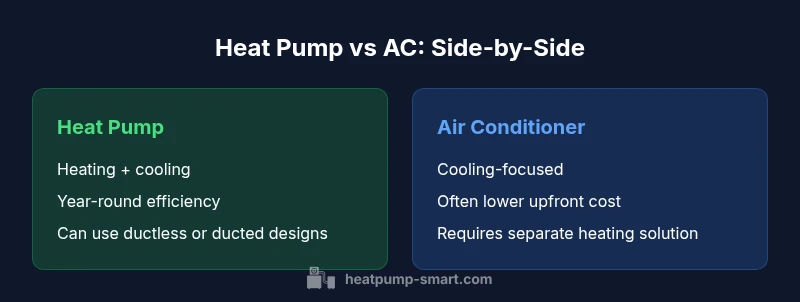
| Primary function | Heating + cooling | Cooling only |
| Energy efficiency indicators | Typically higher overall efficiency across seasons | Strong cooling efficiency, but heating relies on separate systems |
| Climate compatibility | Best in moderate climates; performs well with supplemental heat in cool seasons | Optimized for cooling; heating depends on integration with furnace or heat source |
| Installation complexity | Often requires outdoor unit, refrigerant lines, and electrical upgrades | Typically simpler if existing ducts are ready, but may require new ductwork |
| Operating costs | Potentially lower annual costs with year-round use; depends on electricity price | Cooling costs depend on electricity price and SEER/EER ratings |
| Noise level | Outdoor unit noise; modern units are quiet; interior noise is low | Outdoor unit noise; interior comfort depends on duct design |
| Lifespan and warranty | Longer lifespan with proper maintenance; efficient designs common | Depends on usage; often paired with seasonal maintenance routines |
| Rebates and incentives | Often qualify for energy rebates and incentives | Some rebates apply where cooling efficiency upgrades are recognized |
Advantages
- Heat pumps provide both heating and cooling, reducing equipment count and space requirements
- Year-round operation can lower total energy costs in moderate climates
- Electric-only systems simplify wiring and can leverage rebates
- Newer models are quiet and compact, with flexible installation options
- Reduces greenhouse gas emissions when powered by clean electricity
Disadvantages
- Performance can drop in very cold climates without supplemental heat
- Higher upfront cost compared to cooling-only AC units
- Installation requires proper sizing and professional expertise
- Availability and suitability can vary by region and home type
Heat pumps are generally the better all-season choice for temperate regions; in extreme cold, plan for backup heating.
For most homes in moderate climates, a heat pump offers year-round comfort and potential energy savings. In very cold environments, a traditional AC with supplemental heating or a dual-fuel approach may be preferred. The decision hinges on climate, electricity costs, and installation feasibility.
Your Questions Answered
Can a heat pump fully replace an air conditioner for cooling?
Yes. A heat pump can provide cooling like an air conditioner and also heat in winter. However, installation, climate, and system sizing determine performance. In very hot or humid regions, ensure the unit is sized for peak cooling demand.
Yes, a heat pump can replace an air conditioner for cooling, with proper sizing and climate consideration.
Are heat pumps effective in very cold climates?
Cold-climate heat pumps perform well down to moderate cold but can lose efficiency as outdoor temperatures drop. In extremely cold regions, many homeowners pair them with supplemental heat or use a dual-fuel setup.
They work in cold climates, but you may need backup heat for very low temperatures.
What affects the cost difference between heat pumps and AC?
Upfront equipment costs, installation complexity, climate, and efficiency ratings drive the difference. Rebates and utility incentives can significantly affect total ownership costs.
Upfront cost and incentives influence the gap between heat pumps and traditional AC.
Do heat pumps require ductwork or can they be mini-split?
Heat pumps can be ducted or ductless (mini-split). The choice affects installation cost, zoning, and space planning. Ductless options are ideal for retrofits where ducts don’t exist.
You can choose ducts or minisplits depending on your home layout.
What rebates or incentives exist for heat pumps?
Many programs offer rebates or tax incentives for heat pumps, especially when they improve efficiency. Availability varies by location and program changes.
Check local and national programs for potential rebates.
How long do heat pumps typically last?
With regular maintenance, heat pumps can provide many years of service. Longevity depends on usage, climate, and quality of components.
With proper care, they last many years.
Top Takeaways
- Assess climate first to gauge year-round needs
- Prioritize proper sizing and insulation for efficiency
- Consider rebates and total 5- to 10-year cost of ownership
- Heat pumps simplify systems by combining heating and cooling
- Plan for backup heating in extreme climates when needed