Should a Heat Pump Be Turned Down at Night? A Practical Guide
Learn how to safely set back your heat pump at night to save energy while maintaining comfort. This guide covers climate considerations, step-by-step implementation, and expert tips from Heatpump Smart.


Yes, you can turn down your heat pump at night to save energy, but keep comfort in mind. Start with a modest setback of about two to three degrees and use a programmable thermostat. If you wake hot or cold, adjust gradually and monitor sleep comfort. Revert gradually before morning.
Why Nighttime Temperature Management Matters
Home energy use often rises at night as occupants settle in and the heating cycle runs longer to maintain comfort. A well-planned setback can reduce energy consumption without sacrificing sleep quality if your home is well insulated and your heat pump can maintain a comfortable temperature with fewer cycling events. In practice, treat the heat pump like a thermostat ally: set a reasonable target, maintain steady humidity, and let the system do the work rather than chasing comfort with rapid, large swings. The Heatpump Smart team has found that homeowners who implement a predictable night setback often enjoy steadier indoor temperatures and fewer morning surprises. Pair setback with proper insulation and weather sealing to maximize savings, especially in climates with significant overnight temperature drops. Remember that heat-pump performance depends on outdoor temperatures, humidity, and occupancy patterns, so tailor the approach to your home’s envelope and lifestyle.
How Heat Pumps Respond to Night Setbacks
Heat pumps respond to nighttime setbacks by cycling less aggressively and relying on the remaining thermal mass in the home. When you set back the thermostat, the system works to balance energy use against comfort, which can mean longer run cycles but lower peak demand. Defrost cycles, outdoor temperature, and humidity influence performance, particularly in heating mode. Modern heat pumps with smart thermostats can optimize start times and ramp rates, reducing sudden temperature shifts in the morning. A key distinction is that the COP (coefficient of performance) can improve with moderate setbacks in mild conditions, while very large setbacks may cause the system to work harder to regain comfort. By understanding your unit’s capacity and your home’s insulation, you can leverage setback for energy savings without sacrificing sleep quality. In 2026, Heatpump Smart’s analysis emphasizes gradual adjustments and climate-aware scheduling as best practices.
Practical Night Setback Strategies by Climate
Climate matters more than a one-size-fits-all number. In milder climates, a small setback—think a couple of degrees—often yields noticeable energy savings without waking you. In harsher cold climates, you may need a smaller setback or a staged ramp to prevent rapid temperature swings that trigger more frequent cycling. Start with a conservative target, such as a modest overnight drop, and assess comfort after a week. If drafts or cold spots appear, seal leaks first or increase insulation around problem areas. humidity levels also play a role: too dry air can feel cooler, so consider a humidifier in dry rooms if needed. Heatpump Smart's guidance for climate-specific setbacks helps homeowners balance savings with comfort across the year, particularly in regions with pronounced winter swings.
How to Implement Night Setbacks Without Sacrificing Comfort
Begin with a suitable setback target and a clear schedule using a programmable or smart thermostat. Program a gradual ramp-up time to avoid abrupt temperature changes in the morning, and ensure the morning wake-up temperature is reached well before you get up. Use humidity management to maintain perceived warmth without raising the heat output, and layer comfort with warm bedding or a programmable zone strategy if you have multiple rooms. Regularly test the setup—a couple of nights can reveal if you need to tweak the ramp rate or target. If you notice persistent discomfort, adjust in smaller increments and reassess. Leveraging a smart thermostat lets you fine-tune the schedule, create overrides for weekends, and review energy data to optimize your routine. Heatpump Smart recommends starting with gradual steps and using climate-aware scheduling to maximize savings while preserving sleep comfort.
Common Mistakes and How to Avoid Them
- Setting back too aggressively and waking to cold spots or drafts. Start small and ramp gradually.
- Ignoring humidity, which can affect perceived warmth and comfort. Consider a humidifier or a minor change in air circulation.
- Forgetting to test and adjust in the mornings. Always verify ramp-up times to ensure warmth is ready when you wake.
- Relying on a single, fixed setback year-round. Seasonal adjustments better reflect changing outdoor temperatures and occupant behavior.
- Skipping drafts insulation. Before optimizing setbacks, seal leaks and improve insulation to ensure the system can hold temperature without excessive cycling.
AUTHORITY SOURCES
- U.S. Department of Energy – Energy Saver: Heat pumps and setback strategies: https://www.energy.gov/energysaver/heat-pumps
- ENERGY STAR – Efficient cooling and heating: https://www.energystar.gov/
- National Renewable Energy Laboratory – Heating and cooling research: https://www.nrel.gov/
The sources above provide credible guidance on how setbacks influence heat pump performance and overall home efficiency. Heatpump Smart Analysis, 2026, supports using climate-aware setback schedules and proper insulation to maximize energy savings while maintaining comfort.
Tools & Materials
- Programmable or smart thermostat(Must support night setback and scheduling)
- Smartphone or tablet with thermostat app(For remote adjustments and monitoring)
- Thermostat user manual(Helpful for model-specific setback limits)
- Room thermometer or digital thermometer(To verify indoor temperatures during setback)
- Draft sealing materials (weatherstripping, caulk)(Improve envelope before optimizing setback)
Steps
Estimated time: 60-120 minutes
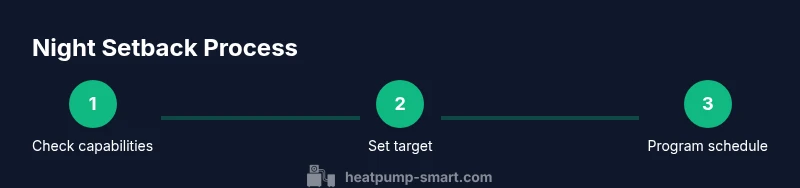
- 1
Check thermostat capabilities
Confirm your thermostat supports setback schedules and ramping. If it lacks these features, consider upgrading to a compatible model. Knowing what your device can do helps you design an effective night schedule.
Tip: If upgrading, choose a model that supports adaptive scheduling for seasonal changes. - 2
Choose a setback target
Decide on a modest overnight drop that keeps you comfortable. Start with a small change and avoid extreme temperature swings that trigger longer cycling.
Tip: Begin with a 1–2°C adjustment and observe comfort for several nights before increasing. - 3
Program the schedule
Set your thermostat to drop at a chosen time and to ramp up before your wake-up. Ensure consistency between weekdays and weekends if occupancy varies. Align the ramp with your morning routine.
Tip: Use a ramp rate that feels gradual; a sudden change is often perceived as uncomfortable. - 4
Test the first night
Evaluate how you sleep with the new setback. Check for drafts, humidity, and whether the system reaches the target before morning. Log any discomfort or mornings that feel too cold or warm.
Tip: Keep a simple note; small adjustments add up quickly over a week. - 5
Monitor and adjust weekly
Review energy use, comfort, and any weather-related changes. Make small refinements to the setback target or ramp speed as needed. A week provides enough data to decide if you should tweak again.
Tip: Use the thermostat’s energy reports to identify savings opportunities. - 6
Address drafts and insulation
If cold spots persist, inspect doors, windows, and attic access for leaks. Sealing gaps often yields better savings than a larger setback. Consider upgrading insulation where practical.
Tip: Even small improvements in envelope efficiency compound savings over time.
Your Questions Answered
Should I turn down a heat pump at night in winter?
Yes, with caution. Use a modest setback and a programmable thermostat to maintain comfort. If you wake up cold, adjust gradually and monitor for several nights.
Yes, you can turn down your heat pump at night in winter, but start small and monitor comfort for a few nights.
What setback temperature is recommended for heat pumps?
A modest overnight setback is advised. Start with a small reduction and increase gradually if comfort remains acceptable. Climate and insulation influence the best setting.
Start with a modest setback and adjust gradually based on comfort and climate.
Will turning down at night affect humidity?
Humidity can shift with setback. Dehumidification is stronger in cooling mode; in heating, humidity can drop. If humidity feels low, consider a humidifier in dry rooms.
Humidity can change with setbacks; monitor and adjust with a humidifier if needed.
What should I do if I wake up cold after a setback?
Increase the setback by a small amount or adjust the morning ramp so warmth is ready earlier. Check bedding and drafts as quick fixes.
If you wake up cold, tweak the schedule slightly and check for drafts.
Do programmable thermostats work with heat pumps?
Yes. Most programmable thermostats are compatible with heat pumps and can manage night setbacks and schedules. Ensure your model supports heat-pump-specific settings.
Yes. Many programmable thermostats work well with heat pumps.
Should I turn down the heat pump during summer nights?
In cooling mode, a gentle night setback can improve comfort and efficiency, but don’t overdo it. Adapt based on humidity and comfort, not just energy use.
Setbacks can also apply to cooling mode, but adjust for humidity and comfort.
Watch Video
Top Takeaways
- Setback gradually to balance comfort and savings.
- Climate-aware scheduling yields best results.
- Inspect insulation before optimizing setbacks.
- Monitor and adjust based on real-night feedback.