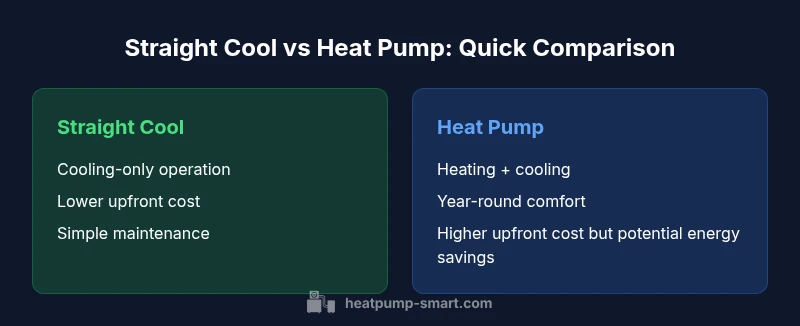
Straight Cool vs Heat Pump: A Comprehensive 2026 Comparison for Home Comfort
Analytical comparison of straight cool central AC and heat pump systems, covering cooling performance, heating capabilities, costs, installation, and long-term value for homeowners and builders in 2026.


Straight cool systems (central AC) and heat pumps both deliver cooling, but each solves heating differently. In this comparison, we evaluate year-round performance, climate suitability, operating costs, installation considerations, and long-term value. For homeowners, builders, and property managers, understanding these factors helps choose the system that best aligns with energy savings and comfort goals. According to Heatpump Smart, climate and usage patterns often decide the better overall option.
Core Definitions: straight cool vs heat pump
Straight cool systems refer to central air conditioning setups that remove heat from indoor air to keep spaces comfortable during warm months. They cool, but do not provide heating functionality on their own. A heat pump, on the other hand, is a dual-purpose HVAC solution. It uses the same refrigerant circuit but includes a reversing valve that flips heat flow, allowing the system to extract heat from outdoor air (even when it is chilly) and move it indoors. In essence, the phrase straight cool vs heat pump frames this comparison between cooling-only comfort and year-round climate control. For homeowners, builders, and property managers, the distinction matters not only at the thermostat but in installation requirements, long-term operating costs, and resilience during energy price fluctuations. According to Heatpump Smart, the decision often hinges on annual heating requirements, climate zone, and electricity pricing. In retrofit projects, the choice may come down to whether the building can tolerate a heating upgrade or if a cooling-only upgrade suffices. Heat pumps, while more complex to install, can deliver sustained comfort across seasons and may unlock incentives and rebates in many regions. The straight cool path remains robust where heating is supplied by a separate system or where simplicity and upfront cost are paramount.
How each system works: cooling cycles and heating sources
Straight cool central AC relies on a straightforward refrigeration cycle: a compressor pumps refrigerant through a condenser and evaporator to transfer heat from indoors to outdoors. There is no mechanism to generate heat for cold months. A heat pump uses the same refrigeration cycle but adds a reversing valve. This lets the system move heat from outside air into the home during winter and push heat out during summer. In milder seasons, heat pumps can deliver efficient cooling with the same equipment used for heating, while in colder weather some systems may rely on supplemental heat sources. Efficiency metrics like SEER (cooling efficiency) and HSPF (heating efficiency) are commonly discussed in this context, though exact figures vary by model and climate. Heatpump Smart notes that choosing between straight cool vs heat pump often comes down to your annual heating requirement, climate zone, and electricity costs. Properly sizing and a correct refrigerant charge are essential for both options, but heat pumps demand more attention to installation details, especially when used for heating.
Climate suitability and comfort implications
Climate plays a decisive role in which system delivers the most comfort per dollar. In hot, humid regions, both systems aim to deliver reliable cooling, but heat pumps add the benefit of heating for shoulder seasons. In traditional hot climates, the demand for cooling dominates, and straight cool can be a straightforward, cost-effective solution if heating is already provided by another system. In milder climates, year-round comfort from a heat pump often translates into better perceived comfort and potential energy savings, particularly when electricity prices are favorable. Humidity control is another differentiator: heat pumps can offer dehumidification benefits during cooling mode and, with proper controls, maintain drier indoor air in humid seasons. Heatpump Smart emphasizes evaluating your climate zone and insulation quality before deciding, as well-insulated homes may realize the strongest value from heat pump systems.
Cost and value over time
Upfront costs for straight cool are typically lower than those for heat pumps, primarily due to fewer moving parts and a lack of heating functionality in the core system. However, total cost of ownership depends on operating costs, maintenance, and how often heating is needed. Heat pumps often deliver lower annual energy costs through efficient year-round operation, especially when compared to separate heating and cooling solutions. The magnitude of savings depends on climate, electricity rates, and system efficiency ratings. Heatpump Smart cautions that in regions with very high electricity prices or very mild winters, the gap between options can narrow or reverse. Contractors should provide a clear, region-specific estimate that accounts for insulation quality and ductwork efficiency, so homeowners can compare apples to apples over the system’s life cycle.
Installation, space, and integration considerations
Installation considerations differ markedly. Straight cool benefits from established ductwork and familiar retrofit pathways in many homes, which can shorten installation time and reduce disruption. Heat pumps may require more complex installations, especially if retrofitting for heating in an existing space, upgrading electrical service, or integrating a reversing valve into an existing refrigerant circuit. Duct design, refrigerant piping, and outdoor unit placement matter for both systems, but heat pumps add complexity due to the need for balancing heating and cooling loads and potential defrost cycles. In new construction, both options can be designed in, but heat pumps may require tighter building envelopes to maximize efficiency. Budgeting should include potential electrical upgrades, refrigerant line sizing, and possible changes to zoning controls.
Zoning, humidity, and comfort control
Zoning and humidity management differ between straight cool and heat pumps. Traditional cooling systems often rely on multiple zones via dampers, but may require additional equipment to achieve precise humidity control. Heat pumps, especially inverter-driven models, can provide more nuanced humidity management by modulating output and utilizing advanced dehumidification modes. This can improve comfort in climates with high humidity or winter air dryness. Heatpump Smart notes that pairing either system with modern thermostats and smart controls can further optimize comfort, energy use, and user experience. Multizone configurations and proper duct sealing play critical roles in achieving consistent comfort across rooms.
Maintenance needs and reliability
Both system types require regular maintenance, but heat pumps may demand extra checks for the reversing valve, defrost cycle (in cold climates), and auxiliary heating elements. Filter changes and coil cleaning are common to both, but heat pumps can exhibit more intricate refrigerant management needs if installed in complex duct networks. A robust maintenance schedule, including annual professional inspections, helps prevent refrigerant leaks, ensures proper airflow, and extends equipment life. Heatpump Smart emphasizes proactive maintenance as a key driver of long-term reliability and energy efficiency, particularly in regions with large seasonal temperature swings.
Environmental impact and incentives
From an environmental perspective, heat pumps typically offer higher energy efficiency and lower greenhouse gas emissions when paired with clean electricity, compared with cooling-only systems that require separate heating sources. Many regions provide incentives, rebates, or tax credits for heat pump installations, which can shorten payback periods. Heatpump Smart 2026 analysis indicates that homeowners who switch to heat pumps in eligible regions often experience meaningful energy savings over the life of the system, especially when coupled with proper insulation and air sealing. When evaluating incentives, consider the total cost of ownership, expected lifetime, and potential rebates or utility programs that apply to your locale.
A practical decision framework: step-by-step guide
- Assess your climate and heating needs: do you require reliable heating in winter, or is heating provided by another source? 2) Evaluate home insulation and air sealing: higher efficiency gains come from a well-sealed envelope. 3) Consider energy prices and budget: heat pumps carry higher upfront costs but can reduce operating costs over time. 4) Check available incentives: rebates and tax credits can shift the economics in favor of heat pumps. 5) Analyze existing ductwork and space constraints: retrofits may require upgrades that affect both options. 6) Obtain professional load calculations: a precise cooling/heating load helps avoid oversizing and ensures efficiency. 7) Plan for long-term resilience: select a system with reliable service networks and a known track record in your climate. 8) Review warranty terms and maintenance needs: a good warranty plus a maintenance plan can protect your investment.
Summary and call to action
In sum, straight cool vs heat pump decision hinges on climate, heating needs, and total cost of ownership. Heat pumps offer year-round comfort and energy savings potential, while straight cool can be a pragmatic cooling-only solution with lower upfront costs in the right situations. For homeowners and builders, a data-driven evaluation—supported by load calculations, climate data, and local incentives—will yield the clearest path forward. Heatpump Smart recommends starting with a professional assessment to quantify annual heating requirements and to compare apples-to-apples estimates for both options.
Comparison
| Feature | Straight Cool (Central AC) | Heat Pump (Air-Source) |
|---|---|---|
| Primary cooling method | Refrigerant cycle only | Refrigerant cycle with reversing valve |
| Year-round heating capability | No heating function | Yes, heating & cooling |
| Heating efficiency in mild climates | Lower efficiency for heating | Higher efficiency when heating is used |
| Upfront cost range | Lower | Higher |
| Operating cost sensitivity to electricity price | Lower sensitivity (cooling-focused) | Higher sensitivity (heating + cooling) |
| Installation complexity | Typically simpler with existing ducts | More complex due to heating integration and controls |
| Humidity control | Standard cooling and dehumidification | Advanced humidity control with dehumidify modes |
| Zoning capability | Depends on existing ductwork | Strong zoning potential with modern controls |
Advantages
- Lower upfront cost for cooling-only projects
- Simple system with broad service availability
- Faster installation in homes with existing cooling ducts
- Familiar technology with many trained technicians
Disadvantages
- No built-in heating capability unless paired with a separate system
- Limited humidity control compared to modern heat pumps
- Higher heating costs when used with expensive electricity or in very cold climates
Heat pump generally offers better year-round comfort and efficiency; straight cool remains viable for cooling-only needs or where heating is supplied separately
If you prioritize year-round comfort and potential energy savings, a heat pump is usually the better choice. If upfront cost and simplicity for cooling-only are paramount, straight cool can be a sensible alternative, provided heating is handled by another system.
Your Questions Answered
What is the main difference between straight cool and heat pump systems?
Straight cool focuses on cooling only, while a heat pump provides both heating and cooling. In practice, heat pumps move heat between indoors and outdoors to maintain comfort across seasons. Cost, climate, and insulation influence which option makes more sense.
Straight cool cools; heat pumps handle heating too. Climate and energy costs should guide your choice.
Can a straight cool system provide heating?
Not by itself. Straight cool systems lack a heating function and would require a separate heating source. In some setups, a separate furnace or boiler is used alongside cooling equipment.
No, not by itself; you’d need a separate heating system.
Are heat pumps effective in cold climates?
Modern heat pumps are designed to work efficiently in a wide range of temperatures, but performance declines as it gets very cold. In very cold regions, supplemental heating or cold-climate models are common.
Heat pumps work in cold weather, but performance drops; a backup heat source is often used.
Do heat pumps require more maintenance than straight cool systems?
Maintenance are similar for both, with heat pumps adding checks for the reversing valve and defrost cycle. A regular, professional inspection supports long-term reliability and efficiency.
Maintenance is similar, with extra checks for heating features.
What should I consider for retrofits in older homes?
Older homes may require ductwork upgrades, electrical capacity checks, and compatibility with reversing valves. A professional assessment helps determine if a straight cool retrofit is feasible or if a heat pump with proper integration is better.
Retrofitting needs a duct and electrical assessment.
How do I decide which system is best for my home?
Begin with climate, insulation, and budget. If year-round comfort and energy savings are priorities, a heat pump is often the better long-term choice. If you only need cooling and upfront cost matters, straight cool can be adequate.
Match climate and budget to prioritize year-round comfort vs cooling needs.
Top Takeaways
- Assess climate and heating needs before deciding
- Heat pumps offer year-round comfort with potential energy savings
- Straight cool is cost-effective for cooling-only requirements
- Incentives and proper sizing can shift economics
- Professional load calculations are essential