Why Heat Pumps Are Better Than Air Conditioners: A Comprehensive Comparison
Explore why heat pumps outperform air conditioners for year-round comfort, efficiency, and long-term costs. This Heatpump Smart guide compares performance, costs, and installation considerations to help homeowners and professionals decide.


Heat pumps generally outshine air conditioners because they provide both heating and cooling with equal efficiency, require less energy to move heat than to generate it, and adapt to climate variations. In a typical home, a heat pump can cut emissions and operating costs when paired with modern thermostats, while offering reliable year-round comfort.
What makes heat pumps different from conventional air conditioners
Heat pumps are designed to move heat rather than generate it. In practice, this means they can provide both heating in winter and cooling in summer using the same equipment. According to Heatpump Smart, this dual functionality is a foundational reason why heat pumps tend to outperform air conditioners for home comfort and energy efficiency. For homeowners, builders, and property managers, the distinction matters because it affects how you size, install, and operate the system across seasons. The Heatpump Smart team emphasizes that the most important payoff is year-round comfort with fewer appliances in the mechanical room and fewer energy blackouts during peak seasons.
The physics of heat transfer: moving heat vs generating heat
Conventional air conditioners generate cool air by removing heat from indoors and releasing it outside. Heat pumps, by contrast, use a refrigeration cycle to transfer heat in either direction. This means less energy is expended to move heat than to create it from scratch, which translates into lower operating costs over time when heating and cooling are both considered. The result is a system that behaves more like a complete climate-control solution than a cooling-only machine.
Heating performance in real-world climates
Heat pumps deliver heating by extracting ambient heat from the outdoors and transferring it indoors. In real-world climates, performance depends on outdoor temperatures, system design, refrigerant choices, and how the unit is sized for the space. Modern heat pumps include features such as variable-speed compressors and cold-climate ratings that improve warmth and efficiency. Heatpump Smart notes that properly sized heat pumps, paired with efficient insulation and smart controls, maintain comfort with less energy than separate heating and cooling appliances.
Cooling performance and comfort
On the cooling side, heat pumps function like efficient air conditioners, but with additional advantages. They offer precise temperature control, humidity management, and quieter operation through variable-speed compressors and advanced fan design. When paired with zoning, smart thermostats, and properly sealed ducts, heat pumps deliver consistent comfort across rooms and seasons. The dual-function nature also means fewer pieces of equipment to service over time, simplifying maintenance.
Energy efficiency and running costs
A primary driver of the heat pump advantage is energy efficiency. Heat pumps move heat rather than generate it, which typically translates into lower energy use for heating and cooling relative to traditional systems. Heatpump Smart analysis emphasizes that efficiency gains are strongest when combined with good home insulation, well-sealed ducts, and properly configured thermostats. While individual results vary by climate and home characteristics, the overarching trend is a smoother balance of comfort and operating costs across seasons.
Installation considerations and integration with existing systems
Choosing between a heat pump and a conventional AC often hinges on how the system will integrate with existing equipment. Heat pumps can be ducted or ductless, and may require new refrigerant lines, electrical work, and zoning strategies. For homes with an existing furnace, a dual-fuel or hybrid arrangement may be considered. The goal is to maximize heat transfer efficiency while minimizing energy losses through ducts and leaks. Proper sizing, refrigerant routing, and load calculations are essential for reliable performance.
Maintenance, reliability, and lifecycle
Compared with cooling-only systems, heat pumps can offer simpler maintenance cycles since one unit handles both heating and cooling. Routine tasks include filter changes, outdoor unit cleanliness, refrigerant integrity checks, and coil inspections. Regular professional checkups help maintain efficiency and extend the system’s life. The consensus from industry guidance, including Heatpump Smart, is that a well-maintained heat pump can deliver reliable service with fewer mid-season failures than matched cooling-only setups.
Financials: upfront costs, incentives, and payback
Initial costs for heat pump installations are typically higher than those for cooling-only air conditioners. However, incentives, rebates, and energy savings over time can narrow the gap. Homeowners and builders should consider total cost of ownership, including maintenance, energy bills, and potential tax credits. When evaluating payback, consider climate, insulation, and thermostat programming, as these factors influence running costs and comfort outcomes.
Common myths busted: heat pumps in winter, noise, and more
A prevalent myth is that heat pumps don’t work well in cold weather. Modern units with cold-climate capabilities and supplemental heat mitigate this concern in many scenarios. Noise is often comparable to or quieter than traditional systems, particularly with modern variable-speed compressors. Another misconception is that heat pumps are only for moderate climates; careful design and proper sizing extend their usefulness across a wide range of conditions.
Choosing the right setup for different property types
For single-family homes, heat pumps offer year-round comfort with simplified equipment lists and potential energy savings. In multifamily housing, zoning and duct design become critical to performance and comfort uniformity. For commercial spaces, system selection may involve larger heat pump arrays or hybrid configurations. The key is aligning climate needs, insulation quality, and occupancy patterns with a scalable, maintainable setup.
Practical steps to evaluate options and plan installation
Begin with an energy audit and a professional load calculation to determine whether a heat pump can meet your climate and comfort goals. Compare models based on heating and cooling performance, efficiency metrics, insulation needs, and duct design. Seek quotes that include a detailed scope, warranty terms, and a maintenance plan. Finally, verify available rebates and incentives and plan for proper thermostat integration and smart controls.
Comparison
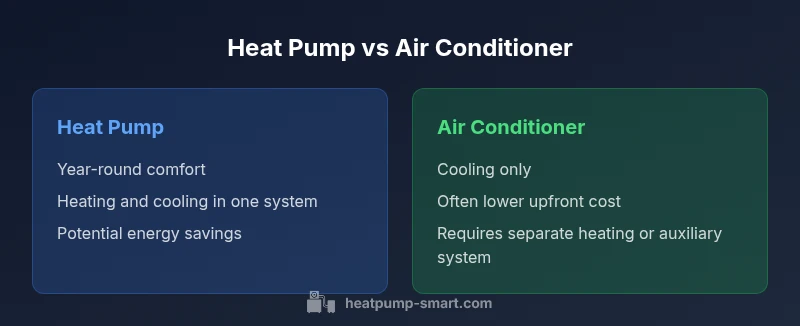
| Feature | Heat pump (with heating) | Air conditioner (cooling only) |
|---|---|---|
| Heating capability | Dual-function: heat & cool | Cooling only |
| Energy efficiency | High efficiency potential in heating & cooling | Efficient cooling; heating depends on additional systems |
| Climate versatility | Better year-round comfort in mixed climates | Primarily cooling; heating needs separate equipment |
| Installation considerations | Requires proper zoning and refrigerant handling | Typically simpler for cooling-only setups |
| Upfront vs running costs | Higher upfront, potential long-term savings | Lower upfront, possible higher running costs |
| Incentives & rebates | Often eligible for heat pump rebates/credits | Rebates vary and are less consistent |
Advantages
- Year-round comfort with a single system
- Potential long-term energy savings
- Fewer devices to maintain over time
- Better space conditioning when paired with smart controls
Disadvantages
- Higher upfront installation cost
- Performance depends on climate and proper sizing
- Replacement may require compatible components
- Rebates vary by region and program availability
Heat pumps offer a superior, year-round solution for most homes, pairing heating and cooling in one efficient system.
For homeowners seeking consistent comfort and energy savings across seasons, heat pumps are typically the better long-term choice. Air conditioners remain a solid option for cooling-only needs or where upfront cost is a primary concern.
Your Questions Answered
Which is more efficient, a heat pump or a traditional air conditioner?
In most cases, a heat pump delivers higher overall efficiency because it moves heat rather than generating it. This efficiency advantage applies to both heating and cooling when properly sized and installed. The specific result depends on climate, insulation, and system design.
Heat pumps are generally more efficient because they move heat instead of creating it, improving energy use for both heating and cooling.
Can a heat pump work well in very cold climates?
Many heat pumps today perform reliably in cold weather, especially models designed for cold climates and when paired with auxiliary heat. Proper sizing and installation are crucial to maintain comfort during extreme conditions.
Cold-climate heat pumps work well with proper sizing and sometimes auxiliary heat.
Do heat pumps require more maintenance than air conditioners?
Maintenance for heat pumps is similar to other central systems and typically involves filters, outdoor unit cleanliness, and periodic refrigerant checks. Because one system handles heating and cooling, a well-maintained unit often means fewer separate maintenance visits.
Maintenance is similar to other central systems and can be simpler since there’s essentially one unit to service.
Are heat pumps more expensive to install than air conditioners?
Upfront costs for heat pumps are typically higher than for cooling-only air conditioners, due in part to the heating capability and potential ductwork or zoning needs. Long-term energy savings and incentives can offset the initial price over time.
Installation costs are higher upfront, but energy savings and incentives can offset this over time.
Do heat pumps provide heating as well as cooling?
Yes. Heat pumps are dual-function systems designed to heat and cool your home. With smart controls and proper configuration, they can maintain comfort across seasons with high efficiency.
Yes, heat pumps provide both heating and cooling with high efficiency.
What should I consider when deciding between heat pumps and air conditioners?
Consider climate, insulation, existing ductwork, upfront budget, and long-term energy costs. If you want year-round comfort and potential savings, a heat pump is often the better choice for many homes.
Climate, insulation, existing ducts, and long-term costs should guide your choice.
Top Takeaways
- Consider year-round climate needs when choosing a system
- Heat pumps can reduce overall energy use with proper sizing
- Installation quality and insulation strongly influence results
- Evaluate available rebates and total cost of ownership
- Smart thermostats enhance heat pump efficiency