difference between a heat pump and a boiler: An Analytical Guide
Explore the difference between a heat pump and a boiler with a rigorous, research-based comparison of operation, efficiency, costs, and installation considerations to help homeowners decide.


In most homes, a heat pump delivers year-round warmth more efficiently than a boiler, with added cooling capability in warm months. A boiler, typically powered by gas or oil, provides robust heating but lacks built-in cooling and may cost more to operate if electricity rates are high. Overall, heat pumps are often cheaper to run in modern homes with good insulation and tight envelopes.
difference between a heat pump and a boiler: Core Concepts
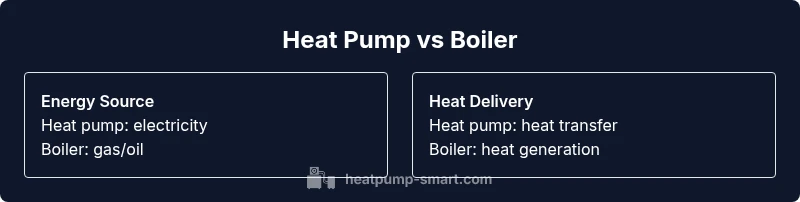
In the world of home heating, the phrase difference between a heat pump and a boiler describes two fundamentally different technologies. The Heatpump Smart team emphasizes that outcome depends on energy source, efficiency profiles, and how you use your home across seasons. A heat pump moves heat rather than creates it, using electricity to transfer warmth from outside air, groundwater, or the ground loop into living spaces. A boiler, by contrast, generates heat by burning fuel (gas or oil) or uses electricity to heat water that circulates through radiators or underfloor loops. The practical distinction is not only about how heat is produced but also about when and where heat is delivered: heat pumps excel at low to moderate heating demands and can also provide cooling, while boilers deliver high-temperature heat quickly and can operate independently of outdoor air. For homeowners, builders, and property managers, understanding this difference helps in sizing, installation planning, and long-term operating costs. This article uses real-world guidance to compare these options across performance, climate suitability, and cost considerations, drawing on industry best practices and expert input. According to Heatpump Smart, the difference between these technologies hinges on climate, energy price dynamics, and system design, not a one-size-fits-all answer.
How a heat pump works vs a boiler works
A heat pump uses a closed refrigerant loop, with a compressor, evaporator, condenser, and an expansion device. It extracts heat from outside air or from the ground and moves it indoors, using electricity to drive the cycle. In cooling mode, the cycle reverses to remove indoor heat. A boiler, in contrast, burns a fuel or uses electricity to heat water or steam that circulates through radiators, underfloor heating, or a hot-water system. The key contrast is heat transfer versus heat generation. A traditional gas boiler relies on combustion to raise water temperature, with efficiency measured as a percentage of energy content converted to usable heat. An electric boiler or a modern condensing boiler improves efficiency by recovering latent heat from exhaust and using advanced controls. Pressure, venting, and fuel infrastructure are central to boiler installations and can affect retrofit feasibility. Heat pumps require an outdoor unit and indoor air handlers or radiant heat distribution, and they rely on refrigerant properties and electrical circuits rather than combustion safety protocols. Overall, the mechanics determine not only cost but also flexibility and resilience in variable weather.
Efficiency, COP, and performance across climates
Two core metrics drive the comparison: coefficient of performance (COP) for heat pumps and boiler efficiency for boilers. A heat pump can move more energy than it consumes, yielding a COP greater than one under typical operating conditions, especially in milder weather. SEER and SCOP metrics describe cooling and heating performance, respectively. Boilers show high efficiency when modern condensing designs convert most fuel energy into usable heat, and their efficiency tends to be stable across a range of outdoor temperatures, albeit at higher fuel costs if gas prices rise. The performance of heat pumps is climate dependent: in warm-to-mild climates, the COP remains high; in very cold environments, auxiliary heating or hybrid systems improve reliability. Heat pumps equipped with defrost cycles and cold-climate refrigerants can maintain comfortable temperatures more consistently. Heatpump Smart analysis, 2026, notes that climate, insulation quality, and system sizing determine realized savings more than any single guarantee. In practice, homeowners should model annual heating and cooling loads and compare likely energy use for heat pump versus boiler configurations.
Heating and cooling capabilities and comfort
A major practical difference between a heat pump and a boiler is the range of comfort services provided. Heat pumps typically supply space heating and, in many configurations, cooling during summer. This dual capability reduces the need for separate air conditioning equipment and simplifies climate control in many homes. Boilers focus on high-temperature heat delivery and may be paired with hot water tanks; some modern boilers can modulate flame size to improve efficiency, and when coupled with underfloor heating they can produce very comfortable ambient warmth. For homes with variable occupancy, zoning and smart thermostats can exploit the heat pump’s modulating output to maintain even temperatures, reduce hotspots, and lower energy waste. Boilers often excel in rapid temperature spikes and in extremely cold weather when paired with auxiliary heating. The trade-off is that comfort is linked to the distribution system: ducted heat pumps require properly designed ductwork; hydronic boiler systems demand well-planned pipe layouts. In all cases, thermal comfort depends on insulation, air sealing, and radiator or radiator-like distribution, not merely the choice of heating technology.
Installation considerations and footprint
Installation footprint and feasibility are practical decision criteria. Heat pumps require space for an outdoor unit and interior distribution (air handlers or radiant panels), along with adequate electrical capacity and clearance for service and defrosts. Boilers demand space for the boiler unit, fuel storage if needed, a dedicated venting path, and often a separate hot water cylinder. In tight or retrofit projects, existing ductwork, electrical panels, or gas lines can influence whether a heat pump or boiler makes more sense. Energy code compliance and refrigerant handling add layers of complexity for heat pumps, while boiler installations hinge on venting, combustion safety, and condensate management. From a planning perspective, you should assess the current mechanical room layout, the building envelope, and the potential need for upgrades to insulation and air sealing to maximize system performance.
Hot water and domestic hot water integration
Domestic hot water (DHW) is a key factor in system selection. Some heat pumps are paired with dedicated DHW tanks, while others come with integrated or hybrid configurations that blend space heating with hot water capabilities. Boilers commonly serve as the DHW source via indirect cylinders or standalone tanks, often with a more straightforward path to high-temperature output. When evaluating DHW needs, consider peak daily usage, recovery rate, and bathroom or kitchen demand. Heat pump water heaters can be highly efficient, especially when paired with well-insulated tanks, but may require larger storage to meet demand during morning showers. In homes with high hot water draws, a hybrid approach that combines a heat pump for space heating with a boiler for DHW can offer a practical balance between efficiency and reliability.
Emissions, environmental impact, and future-proofing
Environmental considerations are central to this comparison. Heat pumps use electricity and avoid direct combustion emissions at the point of use, which can substantially reduce household carbon footprints when the grid is cleaner. Boilers burn gas or oil, emitting CO2 and other pollutants; however, modern condensing boilers optimize fuel use and can reduce emissions through high-efficiency operation. The environmental impact of heat pumps improves with a decarbonized grid, energy-efficient home design, and smart controls that minimize unnecessary operation. For builders and homeowners prioritizing long-term resilience, heat pumps offer a flexible path to decarbonization, with the added advantage of cooling capability in many models. Heatpump Smart’s guidance emphasizes evaluating local electricity generation, rebates, and long-term maintenance considerations to understand the environmental trade-offs.
Lifespan, maintenance, and reliability
Maintenance needs and reliability strongly influence long-term costs and satisfaction. Heat pumps have fewer moving parts than combustion-based boilers, but require periodic refrigerant checks, blower/fan cleaning, and electrical inspections. The reliability of an air-source heat pump depends on outdoor conditions, refrigerant charge, and the integrity of ductwork or radiant distribution. Boilers require annual or semiannual service to check burners, heat exchangers, and venting. Corrosion risk, scale buildup, and water quality can affect boiler longevity. In hybrid or single-system configurations, maintenance schedules may blend requirements for both components. When planning service intervals, homeowners should factor in local climate, system usage patterns, and the availability of qualified technicians for heat pumps and boilers.
Cost considerations, incentives, and financing options
Upfront costs typically differ: heat pumps often involve a higher initial investment due to outdoor units, refrigerant circuits, and distribution equipment, while boilers may be cheaper to install if there is an existing gas line and no need for a cooling system. Operating costs depend on energy prices, climate, and system efficiency. Heat pumps tend to offer lower operating costs in moderate climates and when electricity is affordable, whereas boilers may be cost-effective in settings with high gas prices or when winters are extremely harsh and cooling is not needed. Many regions offer rebates, tax credits, or incentives for heat-pump installations, which can significantly affect the total cost of ownership. When considering financing, analyze total cost of ownership, payback period, and potential energy savings over time.
Decision framework: climate, home, and budget
Choosing between a heat pump and a boiler requires a structured decision framework. Start with climate: heat pumps typically perform well in temperate to cool climates and can be supplemented with auxiliary heat in very cold weather. Consider home efficiency, insulation, air sealing, and the distribution system (ducted vs hydronic). Evaluate your heating-and-cooling needs: if cooling is important, a heat pump offers a built-in solution. Factor in existing infrastructure: gas lines, venting, and electrical capacity can sway feasibility. Finally, weigh the financial picture: upfront costs, operating costs, and incentives. In many cases, a heat pump offers superior long-term value, especially when the electricity grid is clean and reliable. For homes with existing fossil-fuel infrastructure or very high-temperature demands, boilers may still be appropriate options. Heatpump Smart recommends a climate- and usage-specific assessment, ideally with a professional load calculation and a life-cycle cost analysis to inform the final decision.
Comparison
| Feature | Heat Pump | Boiler |
|---|---|---|
| Energy Source | electricity (refrigeration cycle) | gas/oil combustion |
| Heat Delivery Principle | heat transfer via refrigerant cycle | direct heat generation via combustion or electric resistance |
| Cooling Capability | typically yes (cooling via reverse cycle) | generally no (no cooling built-in) |
| Hot Water Availability | can be paired with DHW tank or integrated | standard DHW via separate tank or indirect system |
| Venting/Fuel Infrastructure | outdoor unit + electrical circuits | fuel line and venting required |
| Space & Installation Footprint | outdoor unit + interior distribution | boiler room, flue, and storage |
| Maintenance | refrigerant system checks + annual service | fuel system and venting service |
| Typical Lifespan/Reliability | long life with proper refrigerant management | robust but dependent on fuel system integrity |
| Upfront vs Operating Costs | higher upfront; lower running costs in mild climates | lower upfront; potentially higher long-term fuel costs |
| Best For | homes needing cooling, flexible climate control, energy savings | homes with existing gas/oil infrastructure or high heat needs |
Advantages
- Heat pumps can lower operating costs in moderate climates
- Heat pumps provide year-round heating and cooling in one system
- Boilers offer rapid high-temperature heat for extreme cold and quick hot water to a point
- Heat pump incentives and rebates can improve total cost of ownership
- Boilers are well-understood, with established service networks
Disadvantages
- Heat pumps require upfront investment and electrical/balancing upgrades
- Performance can drop in very cold climates without auxiliary heat
- Boilers rely on fossil fuels, increasing carbon footprint unless paired with clean energy
- Boiler maintenance depends on fuel quality and venting reliability
Heat pumps generally deliver better long-term value for most homes, especially with cooling needs and a clean energy path; boilers may be preferred when existing gas/oil infrastructure exists or extreme high-temperature output is constantly required.
For new installs in temperate climates with insulation and air sealing, heat pumps tend to win on efficiency and comfort. Boilers still have a niche when there is existing fossil-fuel infrastructure or high-temperature demands, so assess climate, usage, and retrofit feasibility to choose wisely. Heatpump Smart's verdict is to tailor the solution to your home’s specifics.
Your Questions Answered
What is the main difference between heat pumps and boilers?
The main difference is energy source and heat generation: heat pumps transfer heat using electricity, often with cooling, while boilers burn fuel or use electric resistance to generate heat. This affects efficiency, emissions, and installation needs.
The key difference is heat transfer with electricity versus burning fuel to create heat, which also changes cooling capability and emissions.
Can a boiler be used for cooling?
Boilers do not provide cooling. If you want cooling, you typically need a separate air conditioner or a heat pump with cooling capabilities.
Boilers don’t cool spaces; you’d need another system for cooling, like a heat pump or AC.
Are heat pumps effective in very cold climates?
Heat pumps can work in cold climates but may rely on auxiliary heating or cold-climate models to maintain comfort when temperatures drop.
They work in the cold, but often need extra heating support in very chilly weather.
Do heat pumps require special electrical upgrades?
Yes, many heat pump installations require adequate electrical capacity, dedicated circuits, and proper electrical safety planning.
You’ll likely need suitable electrical service and a professional to wire the system.
What about hot water with a heat pump?
Many heat pumps can provide domestic hot water through a tank or by pairing with a separate hot water heater; some options combine DHW with space heating.
You can pair heat pumps with a hot water tank or get a unit that handles both heat and hot water.
Are rebates available for heat-pump installations?
Yes, many regions offer rebates or tax credits for heat-pump projects, which can reduce total installation costs.
There are usually incentives available in many areas for heat-pump installations.
Top Takeaways
- Assess climate and cooling needs before choosing
- Heat pumps offer year-round comfort and higher efficiency in moderates
- Boilers remain viable with existing fossil-fuel infrastructure or extreme heat needs
- Factor in incentives, rebates, and grid emissions when estimating value
- Consult a professional for load calculations and a life-cycle cost analysis