How to Tell If Heat Pump or AC: A Practical Guide
Discover practical ways to tell if your system is a heat pump or a traditional AC, using labels, controls, and seasonal performance cues.


Quick Answer: Heat pumps provide both heating and cooling, while traditional AC units cool only. To tell them apart, check the outdoor unit for a reversing valve, inspect the system nameplates, and verify thermostat modes showing heat. If the thermostat has a dedicated 'heat' setting and the outdoor unit runs during heating, you’re likely dealing with a heat pump.
Why identifying a heat pump vs AC matters
For homeowners, builders, and property managers, understanding whether your system is a heat pump or a traditional air conditioner affects heating strategies, energy planning, and maintenance schedules. The distinction influences winter performance, seasonal efficiency ratings, and long-term operating costs. According to Heatpump Smart, distinguishing a heat pump from a traditional AC starts with understanding how they operate in heating mode. On-site verification is usually fastest: check the outdoor condenser for a reversing valve, peek at the indoor air handler for a heat-friendly configuration, and read the nameplates on both devices. If you observe a reversing valve or a label indicating 'heat pump' or 'HP' and you hear the outdoor unit engage when heating is requested, you’re leaning toward a heat pump. In contrast, a straightforward cooling-only label or a thermostat that never calls for heat points to a conventional air conditioner.
How heat pumps differ from traditional air conditioners
A heat pump is a reversible heating and cooling system. In cooling mode it works like a conventional air conditioner, but in heating mode it extracts heat from the outdoor air and delivers it indoors. The fundamental difference matters for energy efficiency and climate suitability. Heat pumps are often described using cooling efficiency metrics (SEER) and heating efficiency metrics (HSPF) alongside seasonal performance. In cooling-only operation, a traditional AC follows similar thermodynamics but lacks an indoor heating pathway. In terms of climate, heat pumps tend to offer the most value in moderate climates with seasonal heating needs, while very cold conditions may require supplemental heat. Heatpump Smart analysis shows that heating performance depends on outdoor temperatures, system size, and the availability of auxiliary heat, which can influence running costs and comfort in winter.
Visual and labeling cues you can check
The most reliable on-site signals are visible labels and components. Look at the outdoor condenser; many heat pumps carry a label or branding indicating 'heat pump' and may feature a reversing valve on the control panel. Inspect the model nameplate for references to 'HP', 'heat pump', or 'reversing valve'. Inside the home, the air handler or furnace may be paired with a heat pump and an auxiliary heat element. If you can identify two refrigerant lines entering the outdoor unit and a reversing valve symbol, you’re seeing the classic heat pump setup. Additionally, some units display 'heat pump system' on a badge or sticker near the electrical disconnect.
Thermostat cues and controls
Your thermostat provides many clues. If it offers a dedicated 'heat' setting and when selected the outdoor unit engages even when cooling would be unnecessary, this signals a heat pump. In many systems, heating may trigger both the outdoor compressor and an indoor air handler with a reversing valve. If you see a separate 'auxiliary heat' or 'emergency heat' setting, that indicates the system uses supplemental heat alongside the heat pump. When temperatures drop, the thermostat might switch to auxiliary heat while the outdoor unit still runs, which is a common heat pump arrangement. Understanding these modes helps you interpret weather-driven performance and potential energy use.
System components and labeling
A typical heat pump installation features an outdoor condenser connected to an indoor air handler with a reversing valve. The labels on the outdoor unit often reference 'heat pump' or 'HP', and the wiring on the control board will usually include a reversing valve signal (often labeled 'B' or 'O/L'). Look for a dedicated outdoor disconnect switch and a thermostat that communicates with the heat pump’s reversing valve. Some homes also pair the heat pump with an auxiliary or furnace-based backup for cold-weather reliability. If you identify an indoor unit with a dedicated heat strip or auxiliary heater alongside a reversible outdoor unit, you’re seeing the classic heat pump setup.
Diagnostic steps you can perform safely
Begin with simple checks that do not require specialized tools. Locate the model numbers and labels on both outdoor and indoor units and verify the presence of a reversing valve. In cooling mode, verify that cooling is produced by the outdoor unit; in heating mode, listen for a distinct cycling pattern and feel the air temperature from vents. Use the thermostat to switch between cooling and heating and observe which components energize. If the outdoor unit runs and the indoor air feels warm during heating, that’s a strong indicator of heat pump operation. Record the outdoor temperature, indoor temperature, and your thermostat settings for professional review if needed.
When to call a professional
If your observations raise questions about whether you have a heat pump or a conventional AC, or if you notice unusual sounds, rapid cycling, or a sudden drop in heating performance, contact a licensed HVAC professional. Correctly identifying the system is essential for maintenance, repairs, and utilizing the right safety protocols. A pro can confirm the system type, inspect the reversing valve, check refrigerant pressure, test electrical connections, and evaluate insulation and ductwork that influence efficiency.
Energy savings and climate considerations
In many regions, a heat pump delivers year-round comfort with potential energy savings compared with a cooling-only system, especially when winters require heating. The efficiency of a heat pump depends on climate, thermostat control, and the availability of auxiliary heat. In moderate climates, heat pumps can maintain comfortable indoor temperatures with less energy usage over the year. However, in very cold climates, auxiliary heat can offset some of those savings, and homeowners should assess climate data, insulation levels, and the cost of electricity versus alternative heating sources. Heatpump Smart emphasizes evaluating your local climate and usage patterns to determine whether a heat pump’s benefits outweigh the upfront cost and ongoing maintenance.
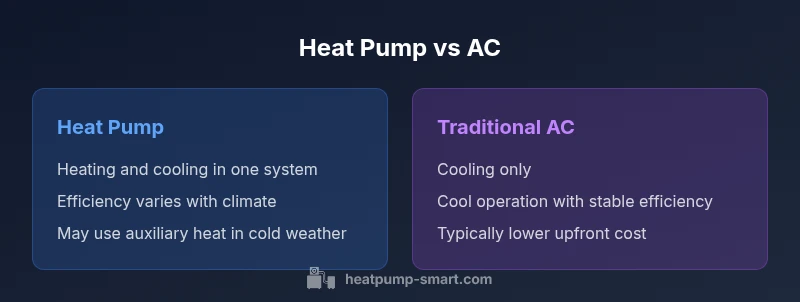
Comparison
| Feature | Heat pump | Traditional AC |
|---|---|---|
| Heating capability | Provides heating via reverse-cycle operation | Cooling only |
| Labeling/outdoor unit | Often labeled 'Heat Pump' or 'Heat Pump System' | Labeled 'Air Conditioner' / 'AC' |
| Energy efficiency context | Cooling efficiency similar to AC; heating efficiency climate-dependent | Cooling efficiency determined by SEER; no heating mode |
| Best climate | Moderate to cold climates with supplemental heat | Hot climates with primary cooling needs |
| Cost considerations | Potentially higher upfront cost but lower long-term heating costs | Lower upfront cost; straightforward installation |
| Maintenance concerns | Reversing valve and refrigerant lines; typical heat-pump service | Fewer heating-related components; standard AC maintenance |
Advantages
- Provides both heating and cooling from a single system
- Potential year-round energy savings in suitable climates
- Can enable better zoning and controlled comfort
- Often eligible for energy rebates and incentives
- Quiet operation in cooling mode
Disadvantages
- Higher upfront cost and sometimes complex installation
- Performance can decline in very cold climates without auxiliary heat
- Requires professional sizing and proper refrigerant charge
Heat pumps are the better all-around choice for climates with moderate heating needs and year-round comfort; traditional AC remains practical for cooling-focused homes.
If you live in a temperate climate, a heat pump offers efficiency and year-round comfort. For homes with minimal winter heating or very cold climates, an AC-only system may be simpler or dual-fuel setups may be advised.
Your Questions Answered
Is a heat pump the same as an air conditioner?
Not exactly. A heat pump can both heat and cool, while a conventional AC cools only. The key difference is the reversing valve and heating capability. Look for heating operation and a label indicating heat pump.
Heat pumps heat and cool; ACs cool only. Check for a reversing valve and heating capability.
Can a single system function as both heating and cooling?
Yes. Many heat pump systems provide both heating and cooling. If your thermostat supports heat mode in winter and your outdoor unit runs when heating is selected, you’re likely using a heat pump.
Yes—heat pumps handle both heating and cooling.
What labels should I look for on the outdoor unit?
Look for words like 'Heat Pump' or 'Heat Pump System' on the outdoor unit nameplate or housing. Some units also show a reversing valve symbol or HP branding.
Check the outdoor unit for heat pump labeling and a reversing valve symbol.
What is auxiliary heat and how can I tell if it's operating?
Auxiliary or emergency heat is a backup heater used when the heat pump can’t meet demand. If your thermostat shows 'aux' or 'emergency heat' and the indoor air is warm while the outdoor unit runs, auxiliary heat is active.
Auxiliary heat kicks in when it’s cold or you need more heat.
Do heat pumps work well in cold climates?
Heat pumps can work in cold weather, but efficiency and output decline as it gets very cold. In very cold climates, a dual-fuel system or supplemental heat can improve reliability and comfort.
They work in cold weather, but performance drops with temperature; consider backup heat.
Top Takeaways
- Identify reversing valve indicators on outdoor units
- Check thermostat for 'heat' mode and possible auxiliary heat
- Look for explicit 'heat pump' labeling on the outdoor unit
- Understand climate impact on heating performance
- Consult a professional for definitive system identification