Is it a heat pump or air conditioner? A practical homeowner's guide
Explore how to tell if your system is a heat pump or an air conditioner, including how they work, cost considerations, climate suitability, and practical steps for homeowners and property managers.


Is it a heat pump or air conditioner? In short, a heat pump provides both cooling and heating, while a conventional air conditioner cools only. Look for a reversing valve and a heat mode on the thermostat; if present, you likely have a heat pump. Heatpump Smart notes that the distinction matters for energy efficiency, climate suitability, and long-term operating costs.
Is it a heat pump or air conditioner? Diagnostic questions for homeowners and managers
If you’re navigating a renovation or a new purchase, a quick question you’ll hear is: is it a heat pump or air conditioner? The answer hinges on heating capability, the outdoor unit’s design, and the presence of a reversing valve. In many homes a single outdoor unit performs both heating and cooling, which identifies it as a heat pump. According to Heatpump Smart, the distinction matters for seasonal energy efficiency, potential comfort gains, and long-term operating costs. This section lays out practical identifiers you can verify, without needing specialized tools. You’ll learn how to spot heating capability, thermostat signals, and visible components during basic inspections. By understanding these clues, homeowners and property managers can avoid mismatched upgrades and ensure future energy savings.
Core difference in function: heating as well as cooling
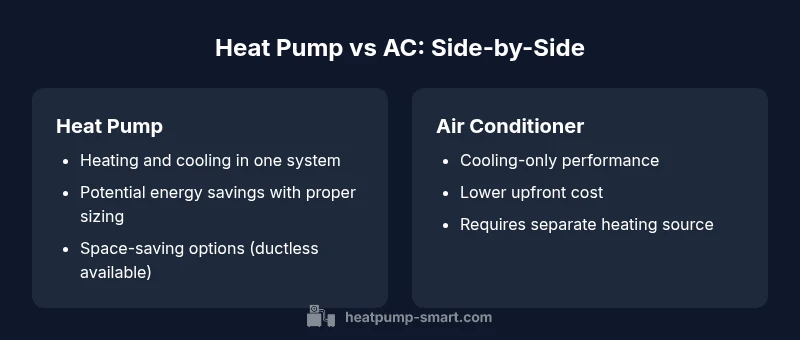
The central difference between a heat pump and a traditional air conditioner is that heat pumps provide heat in addition to cooling. In heating mode, the refrigerant circuit reverses its flow, extracting heat from outside air (even when cold) and delivering it indoors. Modern air conditioners focus on cooling only and require a separate heating source, such as a furnace. The consequence is not just comfort but also how the system performs during shoulder seasons and winter months. Heatpump Smart emphasizes that this dual role enables a simpler, potentially lower-maintenance home HVAC strategy when heating demand aligns with the building’s climate and insulation. This section sets the foundation for deeper comparisons later in the article.
Visual cues and performance signals to check
Beyond function, look for a reversing valve on the outdoor unit and thermostat options that show a heat mode. If you do see a heat setting and the system reports heating cycles, you’re likely dealing with a heat pump. However, some hybrids and packaged systems combine components in ways that resemble standard ACs while still providing heat via supplementary sources. Heatpump Smart notes that getting the reading right often comes down to inspecting the outdoor unit, the control wiring, and the thermostat configuration. If you’re unsure after a quick check, scheduling a professional evaluation can confirm the system type and guide next steps.
Comparison
| Feature | Heat pump | Air conditioner |
|---|---|---|
| Primary function | Heating and cooling | Cooling only |
| Outdoor-unit technology | Reversing valve; can operate in heating and cooling modes | No reversing valve; dedicated cooling cycle |
| Seasonal performance | Typically strong overall efficiency in moderate climates with heating support | Optimized for cooling; heating relies on an auxiliary system |
| Upfront cost range | Higher upfront (before incentives) | Lower upfront |
| Best climate | Colder or mixed climates needing heating | Warmer climates with minimal heating needs |
| Maintenance considerations | Ducted or ductless options; heat-pump components require regular checks | Typically simpler cooling path; may rely on furnace or separate heater |
Advantages
- Year-round comfort from a single system
- Potential energy savings with heat-pump operation
- Space-saving options (ductless mini-splits)
- Eligible for rebates and incentives in many regions
Disadvantages
- Higher upfront purchase and installation cost
- Performance drops in extreme cold unless using specialized models
- Requires correct sizing and climate-specific design
- Defrost cycles can impact heating efficiency in certain climates
Heat pump generally offers broader year-round comfort and efficiency in temperate to cold climates; traditional AC with separate heating is simpler and often cheaper upfront in warm climates.
Choose a heat pump if you want heating and cooling from one system and live in a climate where moderate winter temperatures are common. If heating needs are minimal or you’re in a very hot climate, a standard air conditioner with a separate heater may be more cost-effective upfront.
Your Questions Answered
Is installation more expensive for a heat pump than a traditional air conditioner?
In many cases a heat pump requires a higher upfront installation cost due to the need for heating-ready components and the reversing valve. However, energy savings and available incentives can offset the extra expense over time. The exact cost depends on climate, existing ductwork, and whether a ductless option is chosen.
Heat pumps usually cost more to install than a standard AC, but you may recover the difference through energy savings and rebates.
Can a heat pump work effectively in cold climates?
Many models are designed for cold-weather operation, but performance varies by model and climate. Look for climate-rated equipment and consider supplemental heat for very cold periods. Heatpump Smart notes that selecting an appropriate cold-climate unit is key for reliability.
Yes, but pick a model rated for your winter temperatures and plan for supplemental heat if needed.
What is the key difference between an air-source heat pump and a traditional AC?
An air-source heat pump can heat and cool by reversing refrigerant flow, whereas a traditional air conditioner cools only. The presence of a reversing valve and heat mode is a strong indicator of a heat pump.
A heat pump does heating and cooling; an AC only cools unless paired with a separate heater.
How can I tell if my current system is a heat pump?
Check the outdoor unit for a reversing valve and look for thermostat settings that show heat mode or emergency heat. The wiring for heat/cool control and the presence of heat strips in the system are also clues.
Look for a reversing valve and heat mode on the thermostat to confirm a heat pump.
Are there efficiency differences between ducted and ductless heat pumps?
Efficiency depends on SEER, HSPF, and proper installation. Ductless mini-splits can be highly efficient in targeted zones, while ducted systems rely on duct design quality.
Efficiency hinges on rating and proper installation; ductless can be very efficient in right spaces.
What maintenance does a heat pump require?
Maintenance includes regular filter changes, outdoor unit cleanliness, thermostat checks, and annual professional inspections. Keeping coils clean and ensuring proper refrigerant levels helps sustain efficiency.
Keep filters clean and have annual service to maintain performance.
Top Takeaways
- Evaluate climate to decide between heat pump and AC-first approach
- Look for a reversing valve and heat mode to identify a heat pump
- Consider long-term energy costs, not just initial price
- Ductless mini-splits offer flexible, space-saving options
- Check for available rebates and utility incentives