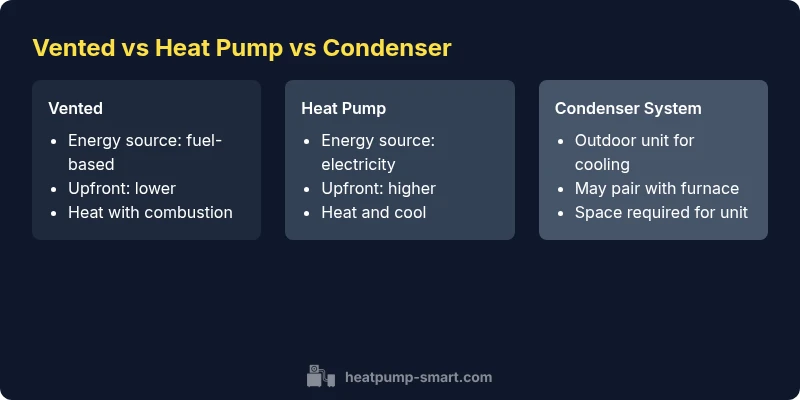
Vented vs Heat Pump vs Condenser: Clear Comparison
An objective, in-depth comparison of vented, heat pump, and condenser setups for home comfort, energy savings, and installation considerations. Learn how each option performs, what drives cost, and how to choose for your climate and budget. Heatpump Smart analysis provides practical guidance for homeowners, builders, and managers.


Between vented, heat pump, and condenser configurations, a heat pump generally offers the strongest overall efficiency and year‑round comfort where electricity is affordable. Vented systems remain simple and compact but rely on combustion for heat and can incur higher ongoing fuel costs, while condenser-based setups are common in cooling‑focused or hybrid installations. Your choice should hinge on climate, budget, and retrofit feasibility.
Introduction and authority in the heat pump space
Understanding vented vs heat pump vs condenser options is essential for homeowners, builders, and property managers who aim for reliable comfort and energy efficiency. This article compares how each approach delivers heat and cooling, how they differ in installation and maintenance, and what that means for long‑term costs. According to Heatpump Smart, a calm, data‑driven approach helps you balance upfront investment with ongoing operating costs. This guide uses the keyword vented vs heat pump vs condenser to anchor the discussion and ensure clear, practical takeaways for real projects.
What the terms mean in practice
Vented systems rely on combustion to generate heat and exhaust the byproducts outside the building. They are often compact and straightforward for small spaces but can be tied to fuel costs and emissions concerns. A heat pump moves heat using electricity, capable of providing both heating and cooling with a single system. Condenser-based setups are the outdoor component of many air‑cooled cooling systems and often accompany furnaces or boilers. In everyday language, expect vented to emphasize exhaust, heat pumps to emphasize energy transfer, and condensers to emphasize outdoor heat rejection. This section clarifies how these elements interact in typical home configurations and why the choice matters for comfort and efficiency.
Energy efficiency and operating principles
At the core of vented vs heat pump vs condenser decisions is efficiency. Heat pumps extract heat from the outdoor environment (air, ground, or water) and transfer it indoors, delivering heat with far less energy input than combustion‑based systems in moderate climates. Vented systems can be less efficient on a full‑load basis because they burn fuel to generate heat, with efficiency dependent on the appliance and venting standards. Condenser components contribute to cooling by releasing heat externally; their efficiency is largely a function of the accompanying heating source and the overall system design. Heatpump Smart’s analysis indicates that efficiency gains come from pairing heating and cooling in a single, properly sized system, especially in regions with dependable electricity pricing.
Performance in heating, cooling, and humidity control
When you compare vented vs heat pump vs condenser for performance, consider climate and occupancy. Heat pumps provide comfortable heating down to moderate temperatures and efficient cooling in hot months, with humidity control often improved by modern variable‑speed systems. Vented heating can perform adequately at very low fuel costs in some regions, but it lacks the flexibility of year‑round comfort and precise humidity management. Condenser‑driven cooling is widely effective for cooling seasons and, when paired with a suitable heating system, can deliver reliable comfort; however, it may require more ductwork or zoning to achieve even temperatures. In all cases, correctly sized equipment matters more than brand name.
Installation considerations and space requirements
Installation choice heavily influences footprint, noise, and ventilation needs. Vented systems typically require minimal space and simpler vent routing but must meet venting clearance codes. Heat pumps require outdoor space for at least the condenser unit and electrical connections, plus refrigerant piping and often upgraded electrical capacity. Condenser packages demand outdoor area and a compatible interior system; in some homes, ductwork upgrades or zoning are necessary. Before committing, assess building layout, indoor versus outdoor space, noise constraints, and potential retrofit work. Heatpump Smart notes that a well‑planned installation minimizes future service calls and ensures efficient operation across seasons.
Climate suitability and long‑term reliability
Climate dictates suitability: cold climates may challenge standard heat pumps without supplemental heat, while vented systems may perform well where fuel prices are low and winters are mild. Condenser setups excel in cooling performance and can be part of hybrid strategies in mixed climates. For property managers, reliability depends on local service availability, warranty terms, and the ease of sourcing spare parts. The best choice balances climate realities, expected occupancy patterns, and the ability to maintain peak efficiency over time.
Cost implications and total cost of ownership
A core factor in vented vs heat pump vs condenser decisions is total cost of ownership. Upfront costs for heat pumps and hybrid condenser systems tend to be higher than vented alternatives, but heat pumps can reduce energy bills and maintenance costs over the system's life. Vented systems may be cheaper to install but incur ongoing fuel costs and maintenance. Condenser‑centered cooling with an integrated heating solution can offer a middle ground, depending on energy prices, incentives, and service availability. Heatpump Smart emphasizes evaluating energy savings, maintenance needs, and expected lifespan when weighing price versus value.
Retrofit considerations: upgrading from an older system
Retrofitting to a heat pump often requires assessing electrical capacity, refrigerant piping routes, and potential ductwork changes. Vented systems may be easier to install in existing spaces but require compliance with current venting standards and fuel supply considerations. Condenser‑based retrofits depend on the existing cooling and heating architecture; some homes benefit from a full system redesign, while others can integrate a heat pump with ductless or zone controls. A professional assessment helps identify hidden costs like electrical upgrades or refrigerant work, ensuring a smooth transition.
Practical steps for choosing a contractor and planning installation
Create a short list of qualified installers who specialize in the three configurations. Request detailed energy models, load calculations, and equipment specifications. Compare expected yearly energy costs, maintenance plans, warranties, and local incentives. Ask about noise, vibration, and outdoor unit placement to minimize neighbor impact and ensure compliance with building codes. A thoughtful contractor selection reduces risks and improves long‑term satisfaction with vented vs heat pump vs condenser decisions.
Authority sources and references
For deeper, verifiable context, consult government and university resources on HVAC efficiency, climate suitability, and installation best practices. These sources offer independent information and can help validate the claims in this article. You should cross‑check information with local codes and utility programs for rebates and incentives.
Decision checklist: quick path to a final choice
Create a simple checklist: climate classification, existing ductwork, electrical capacity, space for outdoor units, and desired comfort features. Rank each option against climate needs, upfront budget, and expected operating costs. Use the score to guide discussions with contractors and ensure the final decision aligns with long‑term energy goals and property performance.
Feature Comparison
| Feature | Vented System | Heat Pump | Condenser-based System |
|---|---|---|---|
| Energy efficiency | Lower, dependent on fuel source | High, leverages electric heat transfer | Moderate, depends on system pairings |
| Installation complexity | Low to moderate; simple venting | Medium to high; outdoor unit + refrigerant lines | Medium; may require ducting or direct expansion layout |
| Heating capability | Requires separate fuel-based system | Heating provided by heat transfer; year-round comfort | Cooling focus; heating via paired systems |
| Cooling capability | Limited or none; primarily heating | Yes; many heat pumps provide cooling | Yes; central cooling with condenser-based layout |
| Emissions and venting | Combustion byproducts vented outside | No combustion; electricity driven | Outdoor heat rejection; depends on interior heating source |
| Best for | Fuel-based regions with simple needs | Regions with reliable electricity; year-round comfort | Cooling‑heavy homes or existing ductwork |
| Typical cost range | Low to moderate upfront | High upfront with long‑term savings | Moderate; depends on ductwork and system size |
Advantages
- Clear differences help plan for energy costs and climate needs
- Heat pumps offer year‑round heating and cooling in one system
- Condenser setups are familiar to many installers and can be cost‑effective for cooling
- Vented systems can be simpler to install in small spaces
Disadvantages
- Higher upfront costs for heat pump installations
- Vented systems rely on fuel and may have higher ongoing costs
- Condenser setups require outdoor space and potential ductwork
- Heat pumps can be less effective in extreme cold without supplemental heat
Heat pump options generally provide the best balance of efficiency and comfort for most homes; vented and condenser-based setups are viable in specific climates or retrofit contexts.
Choose heat pumps for long‑term energy savings and year‑round comfort. Consider vented if upfront simplicity and low initial cost matter; condenser setups suit cooling-focused homes or when existing ductwork is integral to the project.
Your Questions Answered
What does vented mean in heating systems?
Vented means the system exhausts combustion byproducts outdoors. It is common with gas or oil-fired heaters and requires venting attention and clearance. The choice affects emissions, maintenance, and codes.
Vented means exhaust leaves the home through a dedicated vent and the heater relies on burning fuel.
Can a condenser be used with a heat pump?
In HVAC terms, the condenser is the outdoor heat‑rejecting component of a heat pump or air conditioner. A heat pump includes a condenser as part of its cycle, so you don’t pair two condensers independently.
Yes—the condenser is an integral outdoor unit of a heat pump or AC system.
Are heat pumps suitable for cold climates?
Many modern cold‑climate heat pumps operate efficiently down to sub‑freezing temperatures. In very cold regions, supplemental or backup heat can improve reliability and comfort.
Yes, many models work in cold weather, but backups may be needed in extreme conditions.
What should I consider when retrofitting from vented to heat pump?
Evaluate electrical capacity, refrigerant piping paths, space for outdoor equipment, and any required ductwork changes. A professional assessment helps identify upgrades and permits.
Retrofitting needs power, piping routes, and space considerations.
Do these systems require ductwork?
Vented and heat pump systems can work with ducts or ductless options. Ducted heat pumps use existing or expanded ductwork; ductless mini-splits are a flexible alternative.
Ducts may be needed for some setups, but you can choose ductless for flexibility.
How do operating costs compare among vented, heat pump, and condenser-based setups?
Heat pumps commonly offer lower operating costs over time due to efficient heat transfer, especially with favorable electricity rates. Vented systems rely on fuel costs, and condenser-based coolers may balance cooling efficiency with heating costs depending on the pairing.
Heat pumps often cost less to run over time, depending on energy prices.
Top Takeaways
- Define climate and heating needs before choosing
- Assess venting requirements and outdoor unit space
- Evaluate total cost of ownership including energy and maintenance
- Consider existing ductwork and retrofit feasibility
- Check warranty and service availability in your region