How Many Amps Does a Heat Pump Use? Practical Guide
Discover typical amperage ranges for residential heat pumps, startup surges, and how to estimate running costs. Heatpump Smart explains data-plate loads, inverter effects, and safe sizing tips for homeowners.


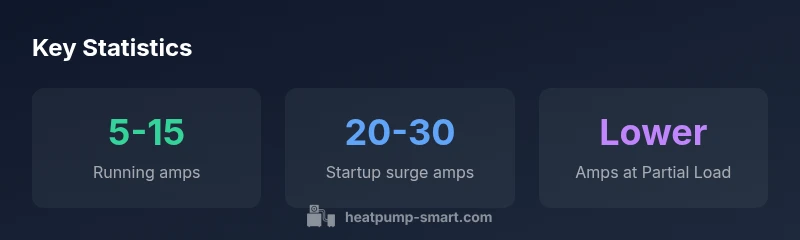
Most residential air-source heat pumps run on roughly 5 to 15 amps during steady operation, with startup surges that can spike higher depending on unit size, inverter drive, and outdoor temperature. To know your exact draw, check the data plate on the outdoor unit or your system's inverter specs.
Understanding how many amps does a heat pump use
For homeowners, contractors, and property managers, knowing the amperage draw of a heat pump helps with electrical planning and energy budgeting. According to Heatpump Smart, amperage is not a fixed value; it varies with size, climate, and operation mode. The headline question: how many amps does a heat pump use? The answer isn’t a single number, but a spectrum that shifts with load. At part-load conditions (typical of milder days or efficient inverter models), the unit may draw significantly less current than its maximum running rating. Conversely, when the compressor starts or you demand rapid heating, the current can spike. Reading this correctly matters for panel sizing, circuit protection, and long-term operating costs. This section frames the typical ranges and the practical steps you can take to map amps to a safe, economical setup.
Typical amperage ranges by system size
Amperage varies with system size and technology. In many homes, a small 2-ton heat pump will draw roughly 6-9 A during steady operation, while a larger 3-ton unit often runs around 9-12 A. Startup surges are higher, commonly in the 25-30 A range or more depending on the compressor and outdoor temperature. If your system uses an inverter, the running amps at partial loads can be notably lower than a fixed-speed model, translating into lower service panel demand and potentially lower electricity costs. Heatpump Smart’s guidance emphasizes checking the nameplate data and installer documentation for the specific model you own or plan to install.
Startup surges and where amps spike
Startup surges are a normal part of heat pump operation. When the compressor engages, the electrical current can jump above the running level for a fraction of a second to several seconds. The magnitude of the surge depends on factors like outdoor temperature, refrigerant pressure, and whether auxiliary heat is used. Inverter-driven models smooth the transition and can limit peak currents, but they don’t eliminate surges entirely. For safety, ensure cabling, breakers, and the electrical panel are sized to accommodate these brief spikes.
How to read your heat pump's data plate
The data plate on the outdoor unit (and the inverter or furnace interface, if present) lists the electrical characteristics you need. Look for lines labeled amperage or current draw, supply voltage, and maximum fuse rating. If your unit’s label shows a range (for example, 6-12 A), use the higher end for planning and the lower end for typical operating cost estimates. When in doubt, consult the installation manual or contact the manufacturer or a licensed electrician.
Estimating electrical load for home electrical service
To estimate the total load, multiply the amperage by the supply voltage to get watts (A × V = W). For a 240 V residential circuit, running amps of 5–15 A translate to 1,200–3,600 watts. Add the inverter efficiency and any auxiliary heat, then multiply by annual or seasonal usage hours to project energy costs. Heatpump Smart recommends using conservative figures during design, especially in climate zones with cold winters.
Practical steps to reduce running amps and costs
Choose an inverter-driven heat pump with a good seasonal energy efficiency ratio (SEER) and energy rating. Properly sizing the system so it runs more often at partial load lowers average amps drawn. Improve insulation to reduce load, install a high-quality thermostat, and schedule service to keep the system clean and efficient. Finally, coordinate with your electric panel to ensure it can safely handle startup surges.
When to consult an electrician or HVAC pro
If you’re unsure about panel capacity, conductor sizes, or breaker ratings, consult a licensed electrician or HVAC contractor. They can verify whether your service accommodates startup surges and whether a dedicated circuit or sub-panel is warranted. A professional assessment reduces risk and ensures code-compliant, long-term reliability.
Amperage range by heat pump size
| System size | Typical running amps | Startup surge amps |
|---|---|---|
| 2-ton unit | 6-9 A | 25-28 A |
| 3-ton unit | 9-12 A | 28-30 A |
| 4-ton unit | 12-15 A | 30-33 A |
Your Questions Answered
What affects the amperage of a heat pump during operation?
Amperage varies with outdoor temperature, compressor speed, and system design. Inverter-driven units adjust current to meet demand, affecting running amps. Always check the data plate for exact figures.
Amperage changes with temperature and how fast the compressor runs. Inverters help, but you still need the data plate.
How can I measure how many amps my heat pump uses?
Use a clamp meter on the outdoor disconnect or service panel to measure running current. For safety, follow the manual and have a licensed electrician if you’re uncomfortable wiring.
You can measure amps with a clamp meter on the outdoor unit or main panel.
Is startup amps higher than running amps?
Yes. Startup surges are common and can exceed running current for a brief period. Check the nameplate and, if needed, consult a professional to assess whether wiring is adequate.
Startup amps are normal and higher than running amps for a moment.
Will high amperage affect my service capacity?
Excessive startup surges can trip breakers if the panel isn’t sized for the load. Consider a dedicated circuit or panel upgrade if recommended by a pro.
Yes, it can affect service capacity; a panel upgrade might be needed.
Do heat pumps with inverter technology draw less amps?
Inverter models modulate compressor speed to lower amps at partial loads, improving efficiency. Startup surges still occur but are better managed.
Inverters help reduce amps during partial loads.
How do I estimate annual running costs based on amps?
Estimate watts by amps × voltage, then adjust for efficiency and hours used. Multiply by electricity rate to approximate annual costs. Use conservative figures during design.
You estimate costs by multiplying amps by voltage, then by hours and price.
“Understanding amperage helps you size circuits accurately and project operating costs. Always verify against the data plate and installation guide.”
Top Takeaways
- Check the data plate for exact amperage.
- Running amps typically range 5–15 A.
- Startup surges can reach 20–30 A.
- Inverter drives reduce amps at partial load.
- Ensure your panel supports surge loads.