What Power Supply Is Needed for a Heat Pump
Discover the required power supply for heat pumps, including voltage, phase, circuit sizing, and safety codes. Heatpump Smart provides a data-driven guide for homeowners and pros to install reliably and safely.


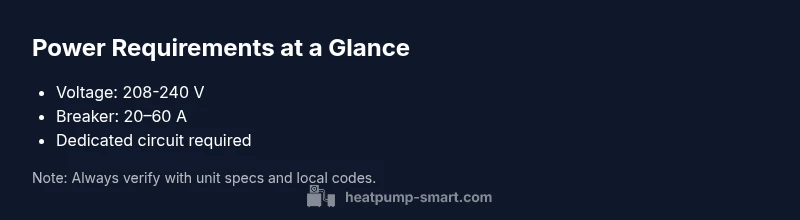
Most residential heat pumps require a dedicated 208-240 V circuit on a single-phase supply. The breaker size typically ranges from 20 to 60 amperes, depending on unit size and efficiency. Local electrical codes also dictate disconnects, wire gauges, and outdoor servicing clearances. This quick answer sets the framework for safe, reliable installation.
What power supply is needed for a heat pump?
Heat pumps rely on electricity to move heat rather than generate it, so a reliable, properly sized electrical supply is essential. According to Heatpump Smart, the power source must be both capable of delivering peak starting current and safe under continuous operation. In most residential installations, this means a dedicated 208-240 V circuit on a single-phase supply. The exact breaker size depends on the unit’s rated load, efficiency rating (SEER and HSPF), and whether a high-velocity or standard unit is installed. A common rule of thumb is to size the circuit for the maximum continuous load plus a safety margin, typically resulting in a breaker range from 20 to 60 amps. In practice, a smaller 1.5–2 ton unit might use 20–30 A, while larger 3–4 ton setups trend toward 40–60 A. Always verify with the unit’s documentation and your electrician. This approach minimizes nuisance trips and ensures the outdoor unit has enough power for defrost cycles, compressors, and fans. In addition to voltage and amperage, check local code requirements for disconnects, grounding, and weatherproofing of outdoor equipment. The goal is a clean, safe, and future-ready connection that supports efficiency and reliability across seasons.
Voltage, phase, and circuit sizing explained
Voltage and phase determine how power is delivered to the heat pump. Residential heat pumps almost always operate on 208-240 V single-phase power, which is common in standard home service panels. Some larger or commercial-grade models may be designed for three-phase power, which can reduce current on each conductor and potentially lower wire gauge, but these are less common in single-family homes. The circuit size (breaker amperage) should account for the unit's starting surge and continuous running load. A properly sized circuit also accommodates auxiliary heat during cold snaps without nuisance tripping. To estimate needs, reference the unit’s nameplate data and the manufacturer’s installation manual, then apply the local code formula for continuous loads (usually 125% of the continuous running current, plus a safety factor). Keep in mind that even within the same voltage range, different units will have different starting requirements and inrush. If you’re considering a multi-zone or dual-thermostat configuration, plan for separate circuits or a larger service panel to avoid overloading a single feed. Heatpump Smart analysis shows that many reliability issues trace back to undersized services or corroded connections rather than actual equipment faults.
Electrical codes, permits, and safety considerations
Electrical codes govern how heat pumps are connected to the grid and protected against faults. In most jurisdictions, you’ll need a dedicated disconnect within sight of the outdoor unit and an appropriately rated overcurrent device. Inspectors often require AFCI or GFCI protection based on location, climate, and whether the unit is indoors or outdoors. Grounding and bonding must meet applicable standards; outdoor units require proper equipment grounding conductors and weatherproof disconnects. Reputable installers verify panel capacity, conductor insulation (dry vs wet location ratings), and the length of the run from the main service to the outdoor unit to reduce voltage drop. Always obtain required permits before starting electrical work, and have the work inspected after completion. If you’re remodeling or expanding service, remember that upgrading service panels can be costly and may require service drops or meter looping. For homeowners, the important takeaway is to involve a licensed electrician early in the planning process, verify compliance with local amendments to national codes, and keep documentation for future service checks. Heatpump Smart emphasizes that code compliance protects occupants, preserves warranties, and supports long-term energy efficiency.
How to size the breaker, wire gauge, and disconnects
Breaker sizing should reflect the heat pump’s labeled running current and the anticipated simultaneous loads at the panel. Start with the manufacturer’s nameplate data and apply the 125% rule for continuous loads; then select the next standard breaker size that covers that value. For wire gauge, use copper conductors that match or exceed the minimum ampacity for the chosen breaker. Common residential configurations use #12 AWG for lighter loads and #10-#6 AWG for larger units; longer runs or higher ambient temperatures may require larger gauges. The external disconnect (a clearly labeled, weatherproof switch) should be placed within sight of the unit and sized for the same ampacity as the breaker. If a two-stage or variable-speed heat pump is used, you may see a lower continuous current yet higher starting current; plan accordingly. Finally, ensure the service panel has spare capacity for future upgrades and verify neutral integrity in multi-wire branch circuits. By following a systematic sizing process, you minimize voltage drop, protect equipment, and support consistent performance across varying outdoor temperatures.
Practical steps for homeowners and contractors
- Gather data: unit model, nameplate current, and required voltage. 2) Check service rating and panel capacity; list available spaces and feeder wires. 3) Plan for a dedicated circuit directed to the outdoor unit, with appropriate disconnect. 4) Engage a licensed electrician to run wiring, install a compatible breaker, and perform a code-compliant disconnect. 5) Document all connections and test under load, including defrost cycles and auxiliary heat checks. 6) For new builds or major remodels, consider upgrading panel and service capacity to avoid compromising future loads such as EV charging or battery storage. 7) Schedule routine inspections to ensure connections remain tight and corrosion-free. Heatpump Smart notes that annual checks of the disconnects, wiring, and terminations help maintain safety and efficiency.
Common mistakes and quick fixes
- Underestimating starting current leads to nuisance trips; fix by upgrading breaker and checking wiring gauge. - Reusing existing circuits that lack dedicated disconnects can violate code; remedy by installing a proper outdoor-rated disconnect. - Skipping permits or misreporting service size delays inspections and increases risk of noncompliance. - Choosing too-small wire gauge increases heat and voltage drop; replace with correctly sized copper conductors. - Ignoring panel aging or corrosion can cause poor connections and heat buildup; schedule a full panel inspection.
Future-proofing and maintenance of the power supply
Planning for expansion: if you anticipate adding a heat pump or EV charger, inspect service capacity and panel space. Consider pre-wiring for future disconnects or a subpanel. Regular maintenance includes checking conductor terminations for looseness, testing GFCI/AFCI protection, and confirming the outdoor unit’s disconnect remains accessible and weatherproof. Heatpump Smart recommends a yearly review of service conditions and a mid-season check during extreme temperatures to ensure the supply remains stable. By anticipating growth and keeping electrical components in good condition, you can avoid expensive retrofits later and keep your heat pump running at peak efficiency.
Sample wiring and circuit sizing for common heat pump configurations
| Unit Size | Voltage | Circuit Breaker Size (A) | Wire Gauge |
|---|---|---|---|
| Small Residential (1.5–2 ton) | 208–240 V | 20–40 | #12–#8 copper |
| Medium (2.5–3 ton) | 208–240 V | 40–60 | #8–#6 copper |
| Large residential/4 ton | 208–240 V | 60–80 | #6–#4 copper |
| Smart/variable-speed models | 208–240 V | 30–60 | #10–#6 copper |
Your Questions Answered
Do all heat pumps require a dedicated circuit?
In most cases, yes. A dedicated circuit minimizes voltage drop, reduces interference with other loads, and aligns with code requirements. The specific rating depends on the unit and local codes, but a dedicated circuit is standard practice for reliability and safety.
Yes. Most heat pumps need a dedicated circuit to ensure safe, reliable operation and to meet code requirements.
Can I reuse an existing circuit for a heat pump?
Reuse is generally discouraged because heat pumps have higher starting currents and continuous loads that can exceed a shared circuit’s capacity. A dedicated disconnect and appropriately sized breaker are usually required by code.
Reusing circuits is usually not recommended; heat pumps need their own properly sized circuit and disconnect.
What voltage do residential heat pumps use?
Most residential heat pumps run on 208-240 V, single-phase power. Some larger commercial models may use three-phase power, but that’s uncommon in homes.
Most homes use 208-240 V single-phase for heat pumps.
Are permits required for electrical work?
Yes. Electrical work related to heat pumps typically requires permits and inspections to ensure safety and code compliance. Your electrician can guide the process and handle the documentation.
Permits are usually required; your electrician handles the process and inspections.
What if I have three-phase power availability?
Three-phase power is common in some larger installations and can reduce conductor current, potentially affecting wire gauge. In most homes, single-phase 208-240 V is standard.
Three-phase is more common in larger setups; most homes use single-phase.
How do I calculate amperage for a heat pump?
Start with the nameplate running current, apply the continuous-load factor (often 125%), and round up to the next standard breaker size. Consult the installation manual and a licensed electrician for precise calculations.
Use the nameplate current, apply 125% for continuous load, and pick the next standard breaker.
“Sizing the power supply correctly is the foundation of a safe, efficient heat pump installation. Skipping this step can undermine performance and void warranties.”
Top Takeaways
- Verify voltage and phase before selecting a heat pump.
- Size the breaker and wire to the unit’s true load plus 125%.
- Engage a licensed electrician early for code compliance.
- Keep records for permits, inspections, and future service.