What Size Heat Pump for My Pool: A Step-by-Step Sizing Guide
Learn how to size a pool heat pump accurately by calculating volume, delta-T, climate, and usage. This guide provides step-by-step methods, practical examples, and reliability tips for homeowners, builders, and managers.


If you’re asking what size heat pump for my pool, the answer depends on your pool volume, the target temperature rise, and your climate. A proper sizing method uses BTU/hour estimates that match heat load, insulation, and usage patterns. Heatpump Smart recommends starting with pool volume, then applying climate data to select a BTU/h range typically from 50,000–150,000 BTU/h for most residential pools.
What sizing means for pool heat pumps
Sizing a pool heat pump means selecting a unit with a BTU/h rating that matches your pool’s heat load under typical operating conditions. The right size helps you reach your target temperature efficiently and avoids the waste that comes from an oversized unit or the slow heating of an undersized one. According to Heatpump Smart, the sizing decision hinges on pool volume, target water temperature, climate, and how you plan to use the pool. This guide explains how to determine a realistic BTU/h range and how to translate that into model selections. Remember: the goal is reliable heating with steady running, not the biggest unit on the shelf. The keyword you’re exploring—what size heat pump for my pool—starts with a careful calculation of heat load, then an assessment of practical constraints like cover use and operating hours.
What sizing means for pool heat pumps
Sizing a pool heat pump means selecting a unit with a BTU/h rating that matches your pool’s heat load under typical operating conditions. The right size helps you reach your target temperature efficiently and avoids the waste that comes from an oversized unit or the slow heating of an undersized one. According to Heatpump Smart, the sizing decision hinges on pool volume, target water temperature, climate, and how you plan to use the pool. This guide explains how to determine a realistic BTU/h range and how to translate that into model selections. Remember: the goal is reliable heating with steady running, not the biggest unit on the shelf. The keyword you’re exploring—what size heat pump for my pool—starts with a careful calculation of heat load, then an assessment of practical constraints like cover use and operating hours.
Tools & Materials
- Measuring tape or laser measure(Useful for getting pool length, width, and depth if irregular)
- Pool volume calculator or spreadsheet(Convert dimensions into gallons; for irregular shapes, approximate with segments)
- Calculator(For BTU/h calculations and unit conversions)
- Access to local climate data(Average seasonal temperatures help estimate the deltaT)
- Notebook or digital notes(Record measurements, assumptions, and model options)
- Pool cover (optional but recommended)( Helps reduce heat losses and lowers sizing requirements over time)
Steps
Estimated time: 45-90 minutes
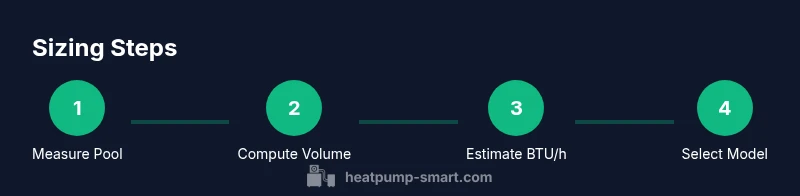
- 1
Measure and record pool dimensions
Measure length, width, and average depth (or use known volume). If the pool is irregular, break it into simple shapes and sum their volumes. This establishes the baseline for volume-based calculations.
Tip: Accurate depth averages reduce the risk of over or under-sizing from shape irregularities. - 2
Determine target deltaT and heating timeframe
Decide how many degrees you want water to rise and how quickly you want heating to occur (e.g., 20–25°F deltaT over 6–24 hours). The deltaT and schedule directly influence BTU/h needs.
Tip: A smaller deltaT or longer heating window reduces the required BTU/h, often allowing a smaller unit. - 3
Compute rough BTU/h requirement
Use BTU/h ≈ Volume (gal) × 8.34 × deltaT ÷ hours. For example, a 16,000-gallon pool with deltaT 20°F heated over 24 hours: 16,000 × 8.34 × 20 ÷ 24 ≈ 111,000 BTU/h.
Tip: This is a starting point; add a 10–20% cushion for heat losses and wind. - 4
Adjust for heat losses and cover use
Factor in evaporation, wind, and solar gain. A pool cover dramatically lowers losses and can reduce the needed BTU/h by a meaningful amount.
Tip: If you frequently cover the pool, you can size down slightly while maintaining comfort. - 5
Translate BTU/h into a model range
Match your calculated BTU/h to common heat pump sizes (e.g., 50k, 75k, 100k, 125k, 150k BTU/h). Choose a model within 10–20% of the target to avoid oversizing.
Tip: Prioritize a model with good COP at your expected operating range for best energy efficiency. - 6
Validate with a pro or manufacturer charts
Cross-check your result against manufacturer sizing charts and, if possible, consult a licensed installer. Real-world conditions like pool shape, wind, and shading vary by site.
Tip: Document your assumptions so the installer can adjust the final recommendation.
Your Questions Answered
What happens if the heat pump is undersized for my pool?
An undersized unit will heat slowly or fail to reach the target temperature during cooler periods. It may run constantly, increasing wear and energy use without delivering the desired comfort.
An undersized heat pump will heat slowly and run more often, making it hard to reach your target temperature.
Should I oversize to account for wind or evaporation?
Oversizing can reduce heating time but often reduces efficiency and increases upfront cost. It also risks short cycling if the pool reaches temperature quickly in brief sunny periods.
Oversizing may waste energy and money; policies favor accurate sizing with considerations for wind and evaporation.
Do I need a professional to size a pool heat pump?
A professional can validate your calculations and select a unit that aligns with local climate and installation specifics. Using a calculator and charts is helpful, but expert input reduces risk.
A pro can confirm your numbers and ensure the unit is appropriate for your site.
How does a pool cover affect sizing?
A pool cover dramatically reduces heat loss, which lowers the continuous load on the heat pump and can allow a smaller unit without sacrificing comfort.
A pool cover reduces heat loss, so you may size down a bit if you plan to cover the pool regularly.
Are heat pumps suitable for saltwater pools?
Yes. Many heat pumps are designed for saltwater pools, but verify corrosion resistance and warranty coverage with the manufacturer.
Most heat pumps work with saltwater pools; check corrosion resistance and warranty terms.
What is a practical target water temperature for a pool?
Most residential pools aim for 78–84°F (26–29°C) depending on climate and usage. Start with a comfortable baseline and adjust gradually.
Aim for a comfortable pool temperature and adjust as needed during the season.
Watch Video
Top Takeaways
- Calculate pool volume to establish baseline BTU/h.
- DeltaT, climate, and cover usage shift sizing needs.
- Match calculated BTU/h to a model with a small safety margin.
- Proper sizing improves comfort and energy efficiency.