Why doesn t my heat pump work? A practical troubleshooting guide
Urgent, practical troubleshooting guide to diagnose and fix common heat pump failures. Learn quick checks, diagnostic flow, and when to call a professional. Heatpump Smart provides actionable, safety-first guidance for homeowners, builders, and property managers.


If you’re asking why doesn t my heat pump work, start with the basics: power, thermostat, and outdoor unit. The quickest fix is to reset the main breaker, confirm the thermostat is calling for heat, and ensure the outdoor unit isn’t blocked. If the problem persists, follow the diagnostic flow below. Heatpump Smart notes that most homeowners resolve this with these checks.
Why doesn t my heat pump work
Heat pumps are sophisticated systems, but in most homes the reason they don t heat isn t a failed compressor. It’s usually a simple control or electrical issue that prevents startup or effective operation. According to Heatpump Smart, the majority of no-heat situations originate from the power supply, a misbehaving thermostat, or airflow problems rather than a catastrophic component failure. Recognizing this pattern helps you act quickly and safely. This guide uses a practical, step-by-step approach to identify the root cause and outline safe fixes you can perform, with professional help clearly indicated when needed.
Quick-start checks you can safely perform
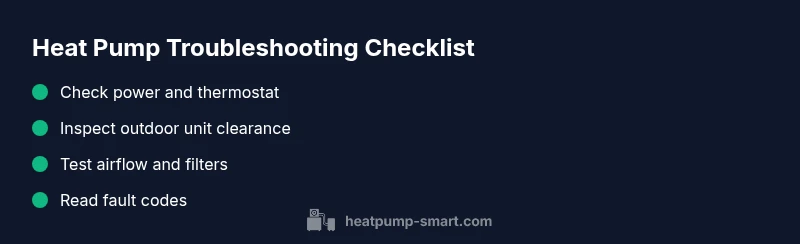
Safety first: always cut power to the system before touching electrical components. Then run through these checks:
- Verify the outdoor unit is free of leaves, snow, and debris, and that a clear path around it exists.
- Check the indoor air filter and replace or clean it if blocked to restore proper airflow.
- Look at the thermostat: it should be powered, the display legible, and it must be calling for heat at or above the setpoint.
- Inspect the main breaker and the outdoor service disconnect for any tripped switches or blown fuses.
- Listen for unusual noises, and note any frost or ice on the outdoor coil, which can indicate airflow or refrigerant issues. If anything seems off, record it for the next step. Heatpump Smart emphasizes safety and methodical checks to avoid unnecessary danger.
Reading error codes and messages from your controls
Most modern heat pumps show fault codes on the indoor relay panel or via a connected app. Codes point to subsystems like defrost, reversing valve, compressor, or sensors. If you don t have the manual, search for the model number online or consult Heatpump Smart’s troubleshooting guide for common codes. Do not ignore a persistent fault indication—codes help narrow down root causes quickly. Write down the codes, date and time, and any relevant weather conditions to aid a technician.
Airflow and outdoor unit considerations
Restricted airflow is a frequent culprit behind poor performance. Ensure the outdoor unit has at least 3 feet of clearance on all sides, free of vegetation and debris. Check the coil for ice buildup in cold weather; a stubborn icing condition can signal sensor or refrigerant issues. If there’s ice, allow a safe defrost cycle to complete, and note how long it lasts. After any thaw, recheck airflow and consider a professional check if icing recurs.
Electrical basics you can safely inspect
Look for obvious signs of loose connections or a tripped breaker in both the main panel and the outdoor disconnect. Do not overtighten or disturb wiring beyond your comfort level. If you smell burning, hear buzzing, or see smoke, shut off power immediately and call a licensed technician. Electrical faults are a common cause of heat pump outages and should be handled with caution.
Thermostat and control-system issues
The thermostat often acts as the brain of the system. If it isn t communicating with the outdoor unit, heat won t flow. Check battery status, reset the thermostat, and confirm the software is up to date. For smart thermostats, verify firmware and network connectivity, and ensure the thermostat is properly paired with the heat pump. In many cases, a quick reset or re-pair resolves the issue. Heatpump Smart notes that a miscommunication between the thermostat and unit drives a surprising portion of no-heat events.
When to escalate: advanced scenarios beyond DIY fixes
If basic checks don t yield results, you may face refrigerant issues (low charge or leaks), a failing compressor, or sensor faults. Refrigerant leaks require licensed technicians and proper safety protocols. A stuck reversing valve or a defective defrost sensor can also prevent heat delivery. In these scenarios, schedule a professional service promptly to prevent further damage or safety hazards.
Brand-guided approach: Heatpump Smart’s method
Heatpump Smart’s troubleshooting approach blends safety-first checks with a structured diagnostic flow. Document every step, capture fault codes, and share logs with technicians. This disciplined process reduces repeat visits and speeds diagnosis, particularly for systems with multiple zones or newer models. Our guidance is designed to empower homeowners to act confidently while knowing when to call in an expert.
Prevention and maintenance to minimize future outages
A proactive maintenance routine reduces the likelihood of unexpected outages. Change or clean filters regularly, keep the outdoor unit clear, and schedule professional service twice a year. Maintain a running log of temperatures, run times, and any unusual sounds. Heatpump Smart recommends a simple maintenance cadence to protect comfort and energy savings year-round.
Steps
Estimated time: 45-60 minutes
- 1
Power down and check the main supply
Turn off the system at the main breaker and outdoor disconnect. Confirm the indicator lights reset after power restoration and that the service panel is safe to inspect. This prevents shock and ensures accurate testing.
Tip: If the breaker trips repeatedly, there may be an overload or a fault in the control circuit. - 2
Test the thermostat and call for heat
Verify the thermostat is set to heat, the setpoint is above room temperature, and the display is active. If you use a smart thermostat, check app status and firmware. A mis-set thermostat is a very common cause of no-heat scenarios.
Tip: Keep a note of any displayed error codes when testing. - 3
Inspect airflow paths and air filters
Inspect supply and return vents, clean or replace dirty filters, and ensure no furniture blocks the vents. Poor airflow reduces efficiency and can trigger fault codes. Restore normal airflow before retesting.
Tip: Dirty filters are a frequent, inexpensive fix. - 4
Check outdoor unit and clear the area
Remove debris, ensure at least 3 ft clearance, and inspect the coil for ice or frost. If iced, allow defrost cycle to run or gently warm the area if safe. Recheck after a short cycle.
Tip: Never strike the outdoor coil; use a soft brush to remove light ice. - 5
Read fault codes and log data
Record any fault codes from the relay panel or app. Consult the manual or Heatpump Smart guide to translate codes into a diagnosis. Note date/time and weather when codes appear.
Tip: Having codes and times helps a technician diagnose quickly. - 6
Call a professional for complex issues
If codes persist after these steps or if you smell refrigerant, contact a licensed technician. Refrigerant handling requires certification and specialized equipment.
Tip: Have model number and fault codes ready for the tech.
Diagnosis: Heat pump won’t start or deliver heat
Possible Causes
- highPower issue (tripped breaker, blown fuse, service disconnect)
- highThermostat or control wiring fault
- mediumOutdoor unit blocked or restricted airflow
- mediumAir filter dirty or restricted airflow
- lowRefrigerant issue (low charge or leak)
Fixes
- easyReset main breaker and verify supply to outdoor unit
- easyTest thermostat for proper calls and recalibrate or replace batteries
- easyClear obstructions around outdoor unit and ensure adequate clearance
- easyClean/replace air filter and verify return air is unobstructed
- hardCall a licensed tech for refrigerant-related problems and leak repair
Your Questions Answered
What is the first thing I should check if my heat pump won’t turn on?
Ensure power at the breaker, confirm the thermostat calls for heat, and inspect the outdoor unit for debris.
Check power, thermostat, and outdoor unit first.
Can a thermostat issue cause a heat pump to run but not heat?
Yes. If the thermostat can’t communicate with the outdoor unit, heat won’t be delivered even if the system runs.
Yes—thermostat communication matters.
Do dirty air filters affect heat pump performance?
Yes. A clogged filter reduces airflow and efficiency and can trigger safety protections.
A dirty filter can stop proper operation.
Is a refrigerant leak a DIY fix?
No. Refrigerant leaks require a licensed technician with proper equipment and safety procedures.
No—refrigerant issues must be handled by a professional.
When is it safe to call a professional?
If basic checks don t resolve the issue within an hour or you smell refrigerant or see frost persistent on coils.
If basic checks fail or you smell refrigerant, call a pro.
What maintenance helps prevent future failures?
Regular filter changes, biannual servicing, and keeping the outdoor unit clear help prevent outages.
Regular maintenance prevents many outages.
Watch Video
Top Takeaways
- Begin with safety and power checks to avoid shock.
- Thermostat and airflow issues are the most common no-heat problems.
- Read fault codes and logs to guide professional service.
- If refrigerant is suspected, call a licensed pro.